


Hi-vis is required when site rules and work risks call for it, not simply because a garment is bright. In Australia, it is commonly required on construction, warehouse, transport, roadwork, rail and civil worksites. Exact requirements depend on hazards and site conditions. Knowing how to choose workwear that meets site safety rules starts with matching garments to those requirements, then checking fit, protection and comfort.
It’s easy to focus on visibility and overlook the demands of a full shift. Clothing also needs to allow movement, suit the weather and withstand the work. This guide explains when hi-vis is typically required, what to look for in visibility gear, and how to choose protective workwear for your task and environment. Practical checks for fit, fabric and care can help your gear support the job without getting in the way.
Key Takeaways
- Hi-vis is commonly required on Australian construction, transport, warehouse, roadwork, rail and civil sites, but the exact garment requirements depend on site rules and risks.
- Match protective clothing to the hazards of the task, including visibility needs, heat, sparks, flames and weather exposure.
- Choose a fit that allows free movement without loose fabric that could catch on machinery, and account for any layers worn underneath.
- Inspect workwear for wear and damage, follow care instructions, and replace garments when they no longer provide suitable protection.
- For painting work, explore painters workwear and clothing suited to the demands of the job.
1. How To Choose Top Quality Industrial Workwear?
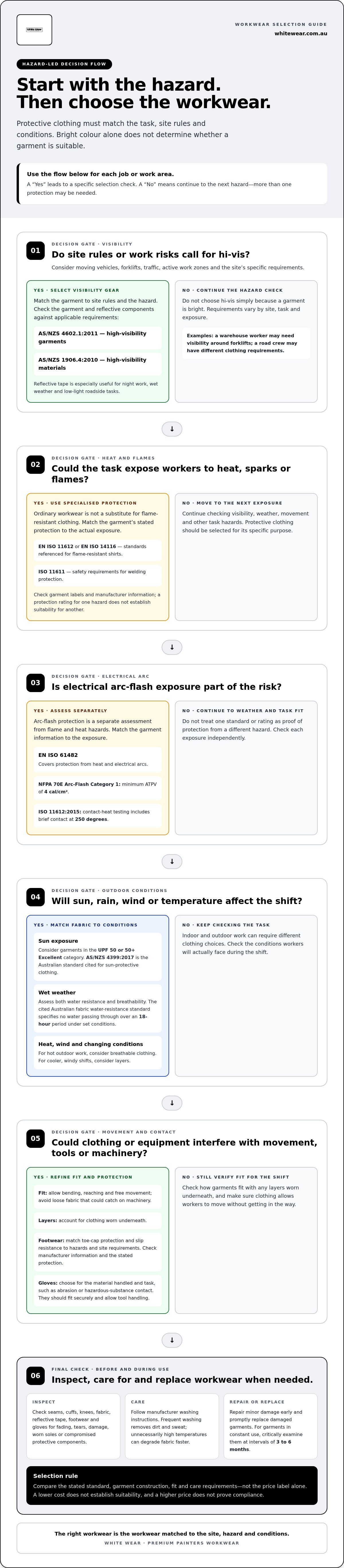
Start with the hazards workers face, then match each garment to the task and site rules. For outdoor or roadside work, hi-vis helps workers stand out around traffic, vehicles and active work zones. In Australia, AS/NZS 4602.1:2011 covers high-visibility garments, while AS/NZS 1906.4:2010 covers high-visibility materials. Check that both the garment and its reflective components meet the applicable requirements.
Look closely at garment coverage and tape placement. Reflective tape is especially useful during night work, wet weather and low-light roadside tasks. Outdoor workers also face sun exposure, so consider garments in the UPF 50 or 50+ Excellent category.
Indoor and outdoor conditions call for different choices. A warehouse worker may need hi-vis around moving forklifts, while a painter working outdoors may need breathable clothing for hot weather and layers for cooler, windy shifts. On a construction site, assess risks such as falling objects and moving machinery. A safety hat and protective footwear address different hazards from hi-vis clothing, so choose each item for its specific purpose.
Heat, sparks and flames require specialised flame-resistant clothing, not ordinary workwear. Check garment labels and manufacturer information for relevant protection standards, including EN ISO 11612 or EN ISO 14116 for flame-resistant shirts. For construction work near heat sources, match the garment’s stated protection to the actual exposure. Water, heat or chemical-resistance claims also need to align with the necessary standards.
Inspection and care help keep hi-vis clothing fit for use. Examine seams, cuffs, knees, fabric and reflective tape for fading, tears or damage. For garments in constant use, critically examine them at intervals of 3 to 6 months. Follow the manufacturer’s washing instructions; frequent washing removes dirt and sweat, while unnecessarily high temperatures can degrade fabric faster. Repair minor damage early and replace damaged garments promptly.
There is no single useful cost figure for compliant Australian workwear: garment type and required protection affect what you need to buy. Budget and premium labels don’t establish compliance, so compare the stated standard, garment construction and care requirements instead. A lower-cost option still needs to suit the hazard and site rules, while a higher price alone doesn’t prove that it does.
For a practical selection, list the job hazards, note whether work is indoors or outdoors, and identify the site’s hi-vis requirements. Then check garment labels, coverage, fit and care instructions before use. Clothing should let workers bend, reach and move without loose fabric catching on machinery. This step-by-step approach helps match protective clothing to the conditions of each shift.
2. Protective footwear and flame-resistant materials
In Australia, choose protective footwear by matching toe-cap protection and slip resistance to the task’s hazards and site requirements. For example, assess falling-object risks in construction and slippery surfaces in wet or wash-down areas. Check the manufacturer’s information for the footwear’s stated protection and applicable standard, then compare it with the hazards workers actually face.
Footwear is only one part of a protective clothing system. Choose gloves for the material handled and the task, such as protection from abrasion or contact with a hazardous substance. Gloves must fit securely and let workers handle tools; loose clothing or ill-fitting equipment can interfere around machinery. Before use, inspect gloves and footwear for damage, worn soles, split seams and compromised protective components.
Heat, sparks and flames need specialised flame-resistant materials. ISO 11612 outlines protection against heat and flames, while ISO 11611 specifies safety requirements for welding protection. Match the garment’s stated protection to the exposure, such as welding sparks, rather than treating ordinary workwear as a substitute.
Electrical arc-flash exposure calls for a separate assessment from flame and heat hazards. EN ISO 61482 covers protection from heat and electrical arcs. NFPA 70E arc-flash Category 1 has a minimum ATPV of 4 cal/cm2, while ISO 11612:2015 contact-heat testing includes brief contact at 250 degrees. These references describe different protections; a rating for one hazard doesn’t establish suitability for another.
Visibility and thermal protection may need to work together outdoors. Reflective strips support visibility in low light, while flame-resistant garments address heat exposure. For sun protection, AS/NZS 4399:2017 is the Australian standard cited for sun-protective clothing. Wet-weather performance also depends on the fabric: the Australian fabric water-resistance standard specifies that fabric will not permit water to pass through over an 18-hour period under set conditions. Wet-weather clothing can be assessed for both water resistance and breathability.
Build a practical selection around the job: identify the exposure, choose clothing and equipment with relevant manufacturer information, and inspect each item for wear. For painters choosing apparel alongside task-specific footwear and protective equipment, painters workwear can form part of the clothing selection. It doesn’t replace protective footwear or specialised garments required for other hazards.
3. WHEN IS HI-VIS WORKWEAR REQUIRED ONSITE?
Hi-vis clothing is commonly required on Australian construction, warehouse, transport, roadwork, rail and civil worksites. The exact garments depend on site hazards and rules. Workers near moving vehicles, forklifts or active work zones may need visibility clothing even when other areas don’t. For example, a warehouse vest requirement may differ from a road crew’s clothing requirements.
Site-specific rules turn general hazard controls into practical instructions. Before starting work, read the site induction materials, note required garments and follow signs at entrances or in work areas. A supervisor may set requirements beyond general standards because local traffic, machinery, lighting or tasks create distinct risks. Keep instructions clear when workers move between locations with different conditions.
Australian workplace safety requirements for PPE are set out in the model WHS Regulations. Workplace PPE requirements can include duties for both workers and visitors. Safe Work Australia created the model WHS laws in 2011.
The PCBU is responsible for selecting and issuing required PPE, including garments, that protect workers, suit the work and hazards, fit comfortably, and work with other PPE. Workers must wear or use issued PPE as instructed and report damage, defects or a need for decontamination.
PPE selection starts with risk, not clothing preference. Under the model WHS Regulations, a PCBU must issue PPE only when other control measures haven’t eliminated or minimised risk so far as is reasonably practicable. Consulting workers, providing training and checking equipment over time can help ensure PPE remains suitable. This process links a task, such as working beside moving vehicles, with suitable visibility garments.
Role-specific rules reflect exposure. Road crews, traffic controllers, rail workers and civil teams generally face stricter visibility requirements near moving traffic. Construction workers may also need safety helmets where falling objects are a hazard. Visitors entering a controlled work area must wear required PPE correctly and follow the information, training or instructions provided.
For a practical workplace check, identify the task, location and nearby hazards before choosing garments. Confirm the site’s visibility rules, PPE signs, required clothing and any compatibility issues with other equipment. A painter working indoors may face different visibility needs from a worker beside an outdoor vehicle route. Clear instructions and correct use support compliance throughout the shift.
4. Choosing visibility gear for different work environments
Choose visibility gear around the environment, the light and the worker’s distance from hazards. In Australia, AS/NZS 4602.1:2011 covers high-visibility garment colours, reflective tape placement and visibility requirements. That makes the garment’s class and design relevant to the task, not merely its colour. A worker near moving vehicles needs visibility suited to those conditions.
Day and night work create different visibility demands. Fluorescent colours help outdoor workers stand out in daylight, while reflective strips improve visibility in low-light conditions. For shifts spanning both, garments combining fluorescent material and retroreflective strips can address changing light. Check the garment’s label and construction against worksite requirements, especially if a shift moves from daylight into darkness.
Daytime compliance depends on garment coverage. A small bright panel may not provide the coverage the task requires. Check front and rear coverage while wearing the garment, and make sure jackets, harnesses or carried equipment don’t obscure key areas.
Class 2 is described as the common job-site bar, while Class 3 covers high-speed traffic or low-light conditions. Road crews, traffic controllers, rail workers and civil teams generally face stricter visibility rules near moving traffic. For roadside work, reflective tape is especially important at night, in wet weather or near heavy vehicles. Site instructions and exposure determine which garment class suits the task.
Construction environments can require more than a hi-vis vest. A construction worker exposed to falling-object risks may need a safety helmet as well as visibility clothing. In a warehouse, a vest can make workers more visible around moving forklifts. Choose each item for its hazard, then check how the combination fits: a jacket or helmet shouldn’t conceal reflective sections or interfere with other required equipment.
Moisture can affect how visibility garments perform in practice. Rain can make outdoor workers harder to see, so consider reflective elements and outer layers suited to wet conditions. A waterproof jacket must still preserve the visibility features required by the site. Check that reflective tape remains visible when the jacket is fastened and that added layers don’t cover high-visibility areas.
Before each shift, compare the work plan with the garment’s class, coverage and condition. A day-only task in a separated work area may need different visibility gear from night roadwork beside fast-moving traffic. Confirm the site’s rules for each location, including transitions between indoor and outdoor environments. Then inspect the worn combination for obscured tape, damage or moisture that reduces visibility.
5. Fabric maintenance, flexibility, breathability and durability
A good fit supports movement through a full shift. Use the manufacturer’s size chart and measure chest, waist, hips and inseam before choosing garments. If you wear layers underneath, allow room without choosing clothing so loose that it could catch on machinery. Test the fit by bending, reaching and lifting. A sleeve that pulls across the shoulder, for example, can restrict movement when reaching for tools.
In Australian conditions, breathability is a practical consideration. For physical work in hot weather, breathable fabrics or ventilation zones can help with comfort. A painter working outdoors, for example, may need a lighter shirt than someone working through a cold, windy shift. In cooler months, layers can add warmth while preserving movement. If PPE feels uncomfortable or fits poorly, the PCBU must help address the issue.
Check construction details where daily tasks create friction. Reinforced knees and strong seams are practical features in work pants, since these areas often wear first. Check cuffs, pockets and stitching for loose threads or damage, especially after repeated bending, kneeling or carrying tools. Clothing that moves with the worker can reduce resistance during repetitive tasks, while durable fabrics need to withstand regular washing.
Care affects a garment’s useful life. Wash workwear frequently to remove dirt and sweat, but follow the care label and avoid unnecessarily high temperatures, which can degrade fabric faster. Air drying is recommended where possible, particularly for stretch fabrics. Store clean, dry clothing in a clean, dry area to help maintain its structure. Keep garments needing repair separate until the damage is addressed.
Build a simple maintenance routine around the work cycle. Before wearing a garment, inspect stress points such as knees, seams and cuffs. Look for tears, thinning fabric or closures that no longer work properly. Repair minor damage early, and replace clothing that no longer provides suitable protection. For hi-vis clothing, inspect reflective sections too, since worn or obscured tape can affect visibility.
Choose fabrics and features according to the task, not appearance alone. A shirt for repetitive reaching should allow shoulder and arm movement; work pants for kneeling should withstand friction at the knees. For painters seeking clothing suited to their trade, explore painters workwear as part of a practical, comfortable work wardrobe.
White Wear: Painters workwear
White Wear offers painters workwear and painters clothing for people whose shifts involve the practical demands of painting. Its specialised apparel gives painters a trade-focused option when building a work wardrobe around daily tasks, movement and regular wear. Use it as the clothing choice for painting work, while selecting hi-vis garments and protective equipment separately to meet site rules and specific hazards. A workwear choice should support the job, but it doesn’t replace required PPE or site instructions. If painting is your trade and you’re refining what you wear through the workday, explore White Wear’s painters clothing. Visit whitewear.com.au to learn more.
Make your next workwear choice with purpose
Workwear decisions are most useful when they become part of how you prepare for each shift. Let your task guide your clothing choices, and choose garments that feel comfortable throughout the day. This practical approach to how to choose workwear that meets site safety rules can help you build a wardrobe around the demands of your trade, rather than relying on one outfit for every job.
For painters, suitable workwear is an everyday essential. White Wear offers painters workwear and clothing designed for the demands of the painting trade, including flexible, hard-wearing options. Choose clothing that suits your work, then follow site requirements for any additional protective equipment.
Contact White Wear about painters workwear as you plan your next workwear choice. A thoughtful fit for your trade can help you step into the working day feeling ready and confident.
Frequently Asked Questions
WHEN IS HI-VIS WORKWEAR REQUIRED ONSITE?
Hi-vis is commonly required on Australian construction, warehouse, transport, roadwork, rail and civil sites, especially where work involves vehicles, machinery or active work zones. The required garment depends on the site’s hazards and rules. For example, someone moving between a warehouse floor and a loading area may encounter different visibility conditions. Follow induction instructions for each work area rather than assuming one garment rule applies across the whole workplace.
How To Choose Top Quality Industrial Workwear?
To decide how to choose workwear that meets site safety rules, start with the task’s hazards and workplace instructions, then assess garment protection, fit and care. A shirt for indoor painting has different demands from clothing worn beside vehicle traffic. Check labels and manufacturer information, and test movement by reaching, bending and handling tools. Quality means a garment is suitable for its intended use, not simply that it looks substantial or costs more.
What standards apply to hi-vis workwear?
In Australia, AS/NZS 4602.1:2011 covers high-visibility garment design and visibility requirements, while AS/NZS 1906.4:2010 covers materials used in safety garments. These standards address different parts of the garment system. Look at the garment’s label and product information for its stated compliance, then consider the worksite’s required class and conditions. A bright colour alone doesn’t show that a garment meets the relevant requirements.
Who enforces hi-vis requirements?
Employers, site supervisors and workplace safety officers commonly enforce hi-vis rules at Australian worksites, while state workplace safety authorities have regulatory roles. In practice, a supervisor may control entry to a work zone and direct workers to wear the specified garment. Visitors must also follow the site’s PPE instructions. If a task or location changes during a shift, follow the instructions for the new area.
How do I check a site's safety requirements before buying workwear?
Use site induction materials, PPE signs and task instructions to identify required visibility classes, colours and other clothing rules before purchasing. Note whether the work includes night shifts, roadside exposure, moving machinery or indoor transitions. Ask the employer or site supervisor about requirements for the specific role and location. Then compare those instructions with garment labels and manufacturer details, including whether added layers or equipment might cover reflective areas.
What Australian standards apply to high-visibility clothing, such as AS/NZS 4602.1?
AS/NZS 4602.1:2011 applies to high-visibility garments in Australia and New Zealand, including garment colours, reflective tape placement and visibility requirements. AS/NZS 1906.4:2010 addresses the high-visibility materials used in safety garments. In practical terms, check both what the garment is designed to meet and whether its materials and construction suit the site’s specified use. Site instructions determine the required garment class for the task.
How do I choose the right hi-vis garment class for day, night and roadwork?
Match the class to the light and traffic exposure stated in the site rules. Class 2 is described as a common job-site requirement; Class 3 covers high-speed traffic or low-light conditions. Day compliance depends on at least 0.2 m² of high-visibility colour on both the front and back. For night or wet roadside work, check that reflective sections remain visible when the garment is worn with other equipment.
How do I select workwear for heat, sun exposure, rain and extreme weather in Australia?
Choose clothing around the specific exposure: breathable fabrics for hot physical work, layers for cold conditions, and suitable sun-protective garments outdoors. AS/NZS 4399:2017 is the Australian standard cited for sun-protective clothing. Heat and flame exposure calls for specialised garments, with ISO 11612 outlining protection against heat and flames. For rain, assess the garment’s stated water-resistance and breathability information, then ensure added outer layers don’t conceal required hi-vis features.


