


A premium price makes sense when customers can see the value behind it. For workwear, that means a reason to choose a garment beyond its basic function, such as considered design, practical details or a fit with the buyer’s priorities. Workwear that helps justify a premium pricing structure needs to deliver on the promise its price makes.
It’s reasonable to seek stronger returns without losing customers who compare prices closely. But a higher price alone doesn’t create value. The product and the buying experience need to meet the expectations the price sets.
This article explains when premium pricing may suit workwear, which customers are most likely to value it, and how to make a point of difference clear. It also covers how pricing fits a broader business strategy, so the price reflects both customer-perceived value and the position you want your brand to hold.
Key Takeaways
- Set prices around the value customers perceive, while ensuring product quality and the overall experience support that price.
- Use premium pricing when a distinctive product, strong reputation or clearly valued quality gives customers a reason to choose it.
- Identify who values your point of difference and how it meets their needs; a higher price may deter customers focused mainly on cost.
- Keep pricing aligned with product, marketing and brand decisions, and review it as costs or market conditions change.
Value-based pricing
Value-based pricing sets a selling price around what customers believe a product delivers, not just what it costs to produce. For workwear, perceived value should connect to the garment’s quality, the buying experience and a clear reason to choose it over alternatives.
Quality and Perceived Value
Perceived value is the benefit customers associate with a garment, including its quality and the experience of buying and wearing it. A premium position needs visible reasons, such as considered design, suitable materials, consistent sizing or clear product information. For example, a painter who values a polished appearance throughout the workday may care about design as well as practical function. Loyalty is more likely when the product and customer experience meet the expectations set by its price.
Competition and Product Value
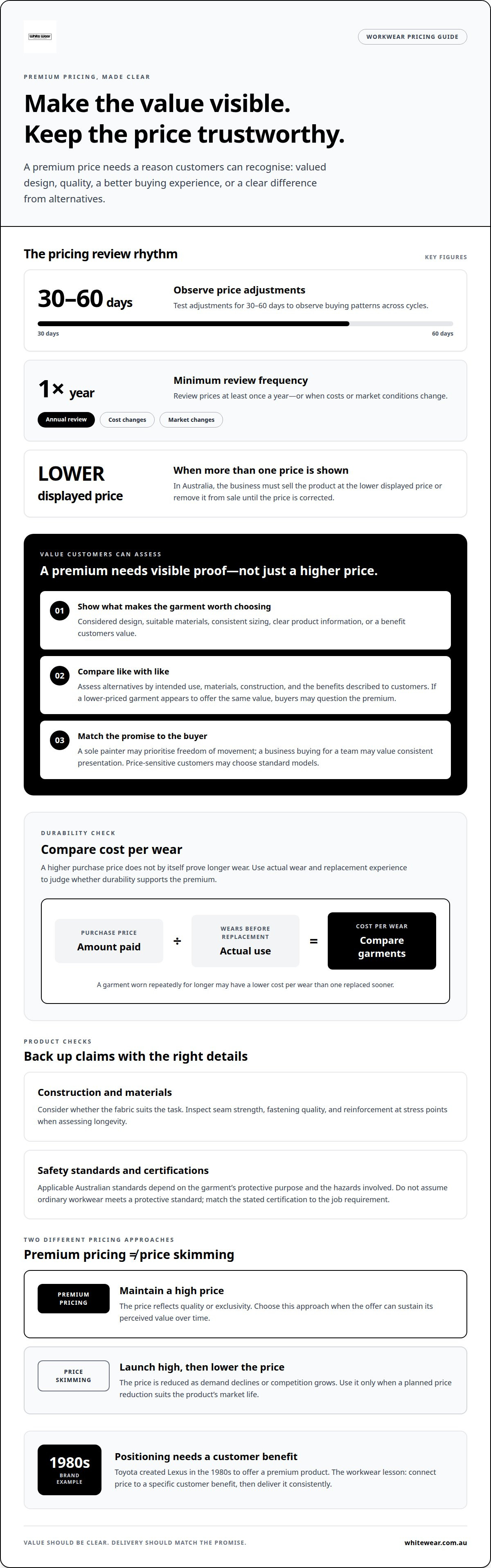
Competitor pricing provides context for setting a price, but it doesn’t prove that a higher price is justified. Compare products by their intended use, materials, construction and the benefits described to consumers. If a similar garment costs less and appears to offer the same value, customers may question the premium. A gap between promise and delivery can weaken trust, reduce loyalty and make future selling harder. Distinction must be clear, not merely claimed.
Durability and Cost per Wear
Premium workwear may offer better durability, but a higher price alone doesn’t prove it will last longer than standard workwear. Compare cost per wear by dividing the purchase price by the number of times the garment is worn before replacement. A garment worn repeatedly for longer may have a lower cost per wear than one replaced sooner. Use actual wear and replacement experience to judge whether durability supports the premium.
Standards, Fabrics, and Construction
Applicable Australian safety standards and certifications depend on a garment’s protective purpose and the hazards involved. Don’t assume ordinary workwear meets a protective standard. Match the garment’s stated certification to the job requirement. To assess longevity, consider whether the fabric suits the task and inspect construction details such as seam strength, fastening quality and reinforcement at stress points. These checks help explain value without suggesting that a particular fabric or certification guarantees longer wear.
When Should You Use Premium Pricing?
Use premium pricing when a product offers a valued point of difference, such as distinctive design, exceptional quality or exclusivity. The price needs to match customers’ perceived value and ability to pay. For example, a workwear business might position a garment for buyers who prioritise a polished look and consistent performance, while recognising that price-sensitive customers may choose standard models.
Lexus offers a familiar example of premium brand positioning: Toyota created the brand in the 1980s to offer a premium product. The lesson for workwear brands isn’t to imitate luxury branding alone. It’s to connect the price to a specific customer benefit, then deliver it consistently. If the difference is hard to see or explain, a premium may narrow the customer base without strengthening loyalty.
How much does premium workwear cost in Australia? There’s no single price for all premium workwear. The amount depends on the garment and the value customers perceive. Warranty and repair arrangements also vary by brand and product. A premium position alone doesn’t establish what a warranty covers or whether repairs are offered.
Premium pricing differs from price skimming. Premium pricing maintains a high price to reflect quality or exclusivity. Skimming launches at a high price, then lowers it as demand declines or competition grows. Choose premium pricing when the offer can sustain its perceived value over time. Choose skimming only when a planned price reduction suits the product’s market life, rather than confusing customers about its lasting worth.
Clear pricing protects trust. In Australia, if a product is displayed with more than one price, the business must sell it at the lower price or remove it from sale until the price is corrected. Review prices at least once a year, or when costs or market conditions change. Test adjustments for 30-60 days to observe buying patterns across cycles. For a workwear example, explore painters workwear as you consider how product value supports a premium position.
Identifying target customers and unique selling points
A premium price is easier to support when it meets a need valued by a defined customer group. Connect a distinctive feature to a clear buyer priority instead of trying to appeal to everyone.
Customer Segments and Willingness to Pay
Customer segmentation groups buyers by shared needs or purchasing behaviour, helping businesses understand differences in willingness to pay. A sole painter choosing everyday garments may prioritise freedom of movement, while a business buying for its team may care more about consistent presentation.
Compare the problem each group wants to solve, the alternatives they consider and the benefit they value most. Workwear that helps justify a premium pricing structure should address a specific priority, rather than rely on a higher price as proof of quality. This makes it easier to set a price customers can connect to a meaningful benefit.
Market Reach and Customer Expectations
A premium position can narrow a product’s potential customer base because some buyers focus mainly on price. That can still be a sound choice when the selected segment values the difference and demand supports the position.
Set expectations with accurate descriptions and examples that show the product’s intended value. If a brand highlights a polished appearance, its presentation should make that clear without implying unverified performance. Customers compare what arrives with what was promised, so a mismatch can weaken trust. The clearer the benefit, the easier it is for buyers to decide whether it matters to them.
Brand Alignment and Customer Loyalty
Brand alignment means the product, its presentation and the customer experience communicate a consistent promise. Each interaction shapes whether customers believe the product fits the position they were offered.
To assess whether workwear that helps justify a premium pricing structure suits a segment, connect its distinguishing features to that group’s everyday priorities. Keep descriptions specific, and don’t present distinctive garments as interchangeable with basic alternatives. When the experience reflects the promise, customers have a stronger reason to choose the brand again. A mismatch can erode loyalty and perceived value.
Integrating pricing with broader business strategy
A pricing decision shapes how customers understand a product and what the business chooses to deliver. Connect pricing with product, marketing and brand decisions instead of treating it as a standalone figure.
Pricing Models and Strategies
A pricing model is the method used to calculate a price; a pricing strategy defines its role in the business. Choosing a calculation alone won’t position a product or attract the right customers.
For example, a cost-based model starts with business costs, while a value-based model considers customer-perceived benefits. A premium pricing strategy then positions the product around quality, design or exclusivity. The model informs the number; the strategy explains why customers should accept it.
Choose an approach that matches the product’s purpose and the brand promise. If a workwear business wants to attract buyers seeking a refined professional appearance, its product descriptions and marketing should support that position. Pricing, presentation and product performance should tell the same story.
Premium Strategy Examples and Returns
Premium strategies can include maintaining a consistent high price for a distinctive core product or using limited editions and special collaborations to create interest. Curated bundles can also add value, provided they don’t undermine the core price. Each approach should reinforce the brand instead of relying on discounting to make sales easier.
How can businesses calculate return on investment for premium workwear? Compare the added cost of the premium option with measurable benefits, such as changes in replacement frequency or gross profit. The calculation is useful only when the business defines the comparison and tracks the same measures over time.
For example, record purchase and replacement costs for comparable garments, then assess the difference alongside customer feedback and sales performance. Treat feedback as context, not a substitute for financial results. Include pricing in product, marketing and brand discussions so the team can assess the overall impact before changing a price.
For a practical product reference, explore painters workwear and consider how its role fits your pricing strategy.
White Wear: Painters workwear
White Wear offers painters workwear and painters clothing designed for professionals in the painting industry. When deciding whether a premium position fits your business, consider how the garments align with customers’ priorities for comfort, function and performance through demanding workdays. Judge their value against the needs they serve, not the price alone.
For painters looking for workwear designed around their trade, White Wear provides a focused place to explore clothing made for painting work. Consider the product’s relevance to your customers and the expectations your pricing communicates. Contact White Wear to discuss painters workwear and clothing for your needs.
Put your next pricing decision into practice
Turn your intended position into a decision customers can recognise in the garment itself. Workwear that helps justify a premium pricing structure connects a clearly valued difference with a price customers understand, while staying consistent with what the business can deliver. Use this as a practical test for future product choices, not simply a reason to put a higher figure on the label.
If painting professionals are your audience, bring their everyday priorities into the decision: the demands of the role, the appearance they want to maintain and what makes apparel worth choosing again. White Wear offers painters workwear and painters clothing, giving you a focused range to consider when selecting trade-specific apparel for your business.
When you’re ready to explore that fit, contact White Wear about premium workwear. A considered next step can help turn your pricing intention into a product choice grounded in your trade. Move forward with clarity and confidence.
Frequently Asked Questions
What should you consider when pricing products and services?
Start with the costs of delivering the product or service, then assess what customers value and what price your market can support. For workwear, compare the needs of individual painters with those of businesses buying for a team. Their priorities and purchasing decisions may differ. Include relevant taxes in cost calculations, and consider whether the price leaves room for profit while remaining consistent across sales channels.
What workwear features justify premium pricing?
Features can support a premium when they solve specific workday needs and customers value the difference. For example, Easy Move™ items are crafted from signature Easy Move™ fabric with 3% Lycra. Product details can also include practical elements such as a 4-knot duster brush holster or an iPhone Plus-size phone holder with dust-flap. Clear, accurate descriptions help buyers understand what a garment offers before choosing it.
How do comfort, fit, and performance features affect workwear pricing?
Comfort, fit and task-focused details can affect whether a price feels worthwhile to the person wearing the garment throughout the workday. Women’s Easy Move Painters Pants have standard cuffs without elastic, a high-waisted, hip-friendly fit and no unnecessary pink stitching. These details may matter to painters seeking a particular fit and appearance; their value depends on whether they match the wearer’s priorities.


