


A polished appearance can open the conversation, but a strong tender earns confidence. Knowing how to dress to win strata management painting contracts starts with clean, professional workwear suited to the site and the people you’re meeting. Your clothing sets the tone; a clear scope, compliance documents and a plan for working around residents show you’re ready for the job.
It’s understandable to focus on getting in front of strata managers. First impressions matter, but they are only one part of a decision that also weighs capability, safety and how well your proposal addresses the building’s needs.
This article explains how to present yourself professionally, what Australian strata tenders may assess, and how to make your submission clear and credible. It also covers how resident communication, site planning and practical workwear support a professional approach.
Key Takeaways
- Pair a polished, site-appropriate appearance with a tender that clearly demonstrates capability, safety planning and understanding of the building’s needs.
- Match compliance documents to the project, including relevant licensing, insurance, risk assessments and working-at-heights evidence.
- Make your quote easy to assess by spelling out the scope, preparation, materials, access arrangements, schedule and resident communication.
- Show that you can coordinate work in occupied buildings, protect shared spaces and keep residents informed as the project progresses.
- Choose painters workwear and clothing that help you present professionally through site visits and the working day; White Wear offers apparel for painting work.
Compliance considerations
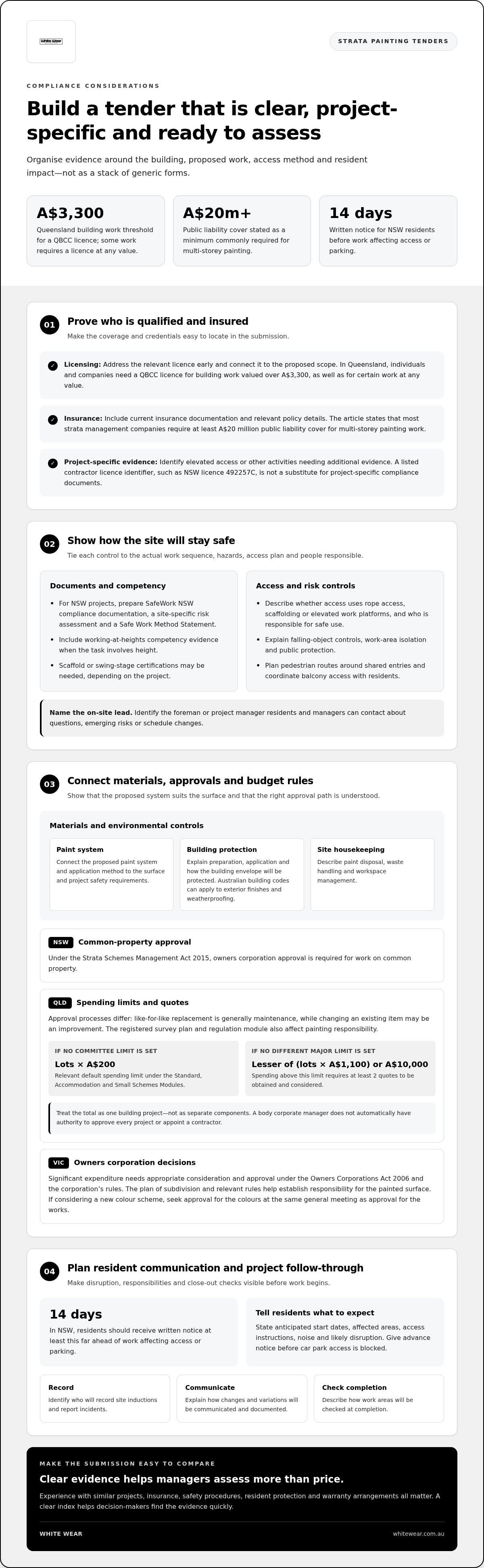
Compliance evidence can strengthen a tender before work begins. Present it as a project-specific package, not a stack of generic forms. Strata managers need to understand who will perform the work, how risks will be controlled, and how residents’ spaces will remain safe. Match each document to the building, proposed access method, surface preparation and expected disruption. A clear index helps owners and decision-makers locate key evidence quickly.
Licensing, insurance and tender evidence
In Queensland, individuals and companies must hold a QBCC licence for building work valued over A$3,300, as well as for certain types of work at any value. Address licensing early in the tender, and connect the licence information to the proposed scope. For example, identify whether the work includes elevated access or other activities requiring additional evidence. The NSW contractor licence 492257C is an identifier listed for a painting contractor, not a substitute for project-specific compliance documents.
Insurance is another key selection consideration. The page states that most strata management companies require at least A$20 million in public liability cover for multi-storey painting work. Include current insurance documentation with the submission, alongside the relevant policy details. A tender should also make the coverage easy to find, rather than expecting a manager to search through attachments. Clear evidence helps the committee assess exposure before selecting a contractor.
Safety and access planning
For NSW projects, prepare SafeWork NSW compliance documentation, a site-specific risk assessment and a Safe Work Method Statement. Explain the work sequence, hazards, controls and responsibilities. Include evidence of working-at-heights competency when the task involves height. Scaffold or swing-stage certifications may also be needed, depending on the project. If the work involves rope access, scaffolding or elevated work platforms, describe the access method and who is responsible for its safe use.
Make high-risk controls practical. Explain how workers will manage falling-object hazards, isolate work areas and protect the public. For a shared entry, describe how pedestrians will move around the work zone. For balconies, outline how access will be coordinated with residents. Confined or shared spaces also need clear procedures. Name the foreman or project manager who will be on site, so residents and managers know whom to contact about questions, emerging risks or schedule changes.
Materials, approvals and environmental controls
Consider whether the proposed paint system and application methods are appropriate for the project’s safety requirements. Australian building codes can also apply to exterior finishes and weatherproofing. In the tender, connect the proposed paint system to the surface and project requirements. Explain the preparation and application methods, and how the work will protect the building envelope. Environmental requirements may apply to paint disposal and workspace management, so describe waste handling and site housekeeping rather than leaving them implicit.
Approval responsibilities differ by state and scheme. Under the Strata Schemes Management Act 2015 (NSW), owners corporation approval is required for work on common property. In Queensland, maintenance and improvements can follow different approval processes. A like-for-like replacement is generally treated as maintenance, while changing an existing item may be an improvement. The registered survey plan and regulation module also affect painting responsibility. A body corporate manager doesn’t automatically have authority to approve every project or appoint a contractor.
For Queensland schemes under the Standard, Accommodation and Small Schemes Modules, default spending limits can affect the decision process. If no committee spending limit has been set, the relevant limit is the number of lots multiplied by A$200. If no different major spending limit has been set, that limit is the lesser of A$1,100 multiplied by the lots or A$10,000. Spending above it requires at least 2 quotes to be obtained and considered. Treat the total as one building project, not separate components.
In Victoria, significant owners corporation expenditure requires appropriate consideration and approval under the Owners Corporations Act 2006 and the corporation’s rules. The plan of subdivision and relevant rules help establish responsibility for the painted surface. If owners are considering a new colour scheme, seek approval for the proposed colours at the same general meeting as approval for the works. That keeps visual decisions connected to the project decision.
Resident notice and disruption
Include resident communication in the compliance and delivery plan. In NSW, residents should receive written notice at least 14 days before work affecting access or parking. Across all residential communities, plan painting work to minimise disruption and give residents advance notice before car park access is blocked. State anticipated start dates, affected areas, access instructions, noise and likely disruption. This makes the tender more credible because scheduling is addressed before work begins.
Show how compliance will continue after the work is awarded. Identify who will record site inductions, communicate changes and report incidents. Explain how variations will be documented and how work areas will be checked at completion. This helps managers compare quotes on more than price: experience with similar projects, insurance, safety procedures, resident protection and warranty arrangements all matter. Precise evidence makes a submission easier to assess and the work easier to oversee.
What are common mistakes that cause strata painting contractors to lose tenders or appear unprofessional?
A tender can lose credibility through small inconsistencies. A quote might promise a complete repaint while its exclusions omit balcony doors. A site meeting may reveal access constraints that never appear in the proposed schedule. Strata managers compare documents for alignment, so make the scope, pricing, work sequence and resident plan tell the same story. A neat submission helps, but precise details show that you understand occupied buildings.
Vague scopes and incomplete quotes
A broad description such as “prepare and repaint exterior” leaves important questions unanswered. Identify the areas, preparation method, repairs, paint system, coats, access equipment, protection, clean-up and waste removal. State exclusions, too. For example, distinguish included crack patching from larger substrate repairs that require separate approval. Explain the process and expected timeline. If the tender documents identify balcony railings, name them directly rather than relying on “all external surfaces.”
An unclear pricing structure creates another comparison problem. If one quote includes preparation and another treats it as an allowance, the totals don’t cover equivalent work. Explain assumptions in plain language and connect each cost item to a defined task. Describe how variations will be recorded and approved before extra work proceeds. This gives the owners corporation a clearer basis for comparing quotes and reduces disputes about what the original agreement covered.
Underestimating occupied-building coordination
A schedule that ignores residents can look unrealistic before painting begins. Balcony access, parked vehicles, entry paths and shared spaces all affect the sequence. Set out which areas will be unavailable, how access will be coordinated and how work zones will be kept clear. For example, a balcony-preparation plan should explain how residents will receive instructions and how the team will handle an inaccessible balcony. Give advance notice that explains the scope, timing, access instructions and enquiry contact.
Silence during delivery can damage trust as quickly as poor preparation. Name the primary contact and assigned supervisor in the proposal. Explain how progress updates will reach the manager and residents, and how the team will report delays, weather impacts or access changes. A clear communication method prevents residents from having to chase different workers for answers. It also gives the strata manager a reliable channel for raising concerns.
Making experience difficult to assess
Generic claims of “extensive experience” don’t show whether a contractor understands strata work. Give relevant examples of work in occupied buildings, complex scheduling or high-rise access. Explain the challenge, the response and the result without overstating how closely the project matches the current one. A concise case example might describe staged access to shared balconies and how residents were kept informed. Connect that experience to the building being considered.
Another mistake is presenting a capable team without explaining accountability. Identify who supervises daily work, handles resident questions and manages variations. Explain how painters, access personnel and project leadership work together. If the proposal names a project manager, describe their role during preparation, active work and close-out. Much like how construction and property professionals rely on Cadeau + Bliss to mark successful handovers with clients, detailing a thoughtful close-out plan ensures your business leaves a lasting, positive impression. Clear responsibilities help the committee understand who makes decisions on site and how unexpected issues reach the right person.
Overlooking presentation and document quality
Presentation starts before the committee opens the quote. At a site visit, arrive prepared, introduce yourself clearly and respect residents’ routines. Clean, suitable clothing and tidy equipment support a professional impression, but they don’t replace technical competence. Avoid loud conversations in shared spaces or leaving samples and tools where residents walk. These details matter because strata painting happens around people, not in an empty building. Knowing how to dress to win strata management painting contracts means dressing appropriately for both the meeting and the worksite.
Then review the submission as a manager would. Use consistent project names, dates, contact details and terminology across the quote, schedule and attachments. Remove blank fields, conflicting timelines and unexplained abbreviations. Compare every promised task with the scope and schedule. If the documents describe different work, correct them before submission. In practice, how to dress to win strata management painting contracts also means presenting a tidy, trade-ready image that reinforces the care shown in your proposal.
Strata painting contractors should understand owners corporation approval processes, resident communication and work in occupied buildings. Show relevant experience managing similar properties, particularly projects involving high-rise access or complex scheduling.
Commercial painting
Commercial strata painting is an asset-maintenance project, not simply a colour refresh. External painting commonly forms part of a building’s broader maintenance program, while interior common areas have different wear patterns. In Australia, external strata properties generally require painting every 7-10 years, and interior common areas may need attention every 5-7 years. These are planning guides, not automatic triggers. Building age, surface condition, materials, exposure and paint quality shape the appropriate cycle.
Build the tender around the building’s condition
A repaint can conceal rather than resolve deterioration if the underlying surface is poorly assessed. More than 70% of strata buildings need remedial repair before repainting. Defects may remain hidden beneath existing coatings or render, then appear when those layers are opened. A strong tender explains how inspection findings affect preparation, repairs and the final paint system. For example, identify whether cracked render or deteriorated sealant needs attention before coating begins.
Diagnosis also affects pricing certainty. Consultant-led procurement may use an inspection to identify defects, calculate repairs and prepare a scope. A hybrid investigation may include rope or elevated-access inspections, drone imaging, or targeted opening up of suspect areas. Distinguish measured repairs from provisional items in the tender. This helps the committee understand what the quote includes and how newly discovered defects could change the work.
Make price comparisons meaningful
Scope differences can make headline totals misleading. Describe the surfaces, preparation standard, repair allowances, paint type and quality, number of coats, access method, protection, clean-up and waste removal. If scaffolding is required, explain how access affects the price and sequence.
For a fair comparison, committees need to see what each quote measures, includes and excludes. Separate confirmed quantities from assumptions, and explain how variations will be managed. Include the schedule, resident impacts, communication contact and warranty arrangements. A coating warranty can depend on applying the paint in line with its specification and carrying out suitable maintenance afterwards. State the proposed system and preparation clearly rather than relying on a broad promise of a durable finish.
Show a workable sequence
Access equipment, weather and occupied spaces shape the work plan. Depending on the building, contractors may use elevated work platforms, scaffolding or abseiling. Explain which access method suits each area, where equipment will operate and how residents’ movement will be managed. Paints for Australian strata buildings should suit intense UV exposure, humidity and rain. A weather-aware schedule should explain how conditions affect preparation and application without treating every façade as identical.
A Newcastle case study involved a 16-unit, three-storey apartment block and ran for 11 working days. Rain delayed that project for two days. The example shows why a tender should explain sequencing and how delays affect resident notices, access and completion. Identify the supervisor or project manager, progress-update method and approach to variations. Staged works need enough workforce and coordination to keep separate areas orderly.
Plan maintenance beyond the repaint
Building wash-downs are advised every 2-3 years, depending on the building. Yet for an Australian building approaching 7-8 years since construction, a wash-down may do more harm than good. Explain the condition and maintenance assumptions behind any proposed cleaning or repainting scope. A wash-down can be a cheaper alternative, but it isn’t a substitute for professional repainting. Inspection findings and surface condition should guide the recommendation. For broader facility upkeep and property care, commercial managers often source maintenance and cleaning supplies in bulk from distributors like MOC Import Export GmbH.
Present the proposal as part of a considered maintenance decision. Clarify what the work will address, what remains outside scope, and how completion will be inspected. That level of detail helps owners assess value alongside cost and disruption. For a polished, practical appearance during site visits and painting work, explore painting workwear.
Strata painting should be part of the building’s broader maintenance program, not treated as purely cosmetic work. External projects commonly require non-structural remedial work, including concrete spalling, render, joint, timber and crack repairs, sealant replacement, localised waterproofing, and patching deteriorated or unstable substrates.
Address water penetration and substrate deterioration before repainting, as new paint alone may provide only a temporary solution. Choosing paint suited to the building’s surface can help prevent concrete cancer and rusting. Depending on the project, contractors may use elevated work platforms, scaffolding or abseiling for access.
White Wear: Painters workwear
White Wear offers painters workwear and clothing for professionals who want a polished, work-ready appearance. For a strata site visit, clean, appropriate clothing supports a considered first impression; during the workday, dedicated painting apparel keeps your presentation aligned with the trade. It won’t replace a clear tender, safety documentation or a well-managed project, but it can complete the professional picture you present to strata managers and residents.
Choose workwear that suits the painting tasks ahead and feels appropriate for meeting owners, inspecting shared spaces or working on site. When you’re refining how you present yourself throughout the tender process, explore painters workwear and clothing.
Make your next impression count
Your next site meeting is an opportunity to show your professionalism before the tender is read. Knowing how to dress to win strata management painting contracts means treating presentation as one part of readiness: arrive looking prepared, communicate respectfully and make your proposal easy to assess. Let your appearance support the quality of work you’re prepared to deliver.
Choose painters workwear or clothing that suits your day, from meeting strata managers to working on site. White Wear focuses on clothing for painters, giving you a practical way to bring a considered, professional look to the workday.
Contact White Wear about your project and take a confident next step toward presenting your painting business with purpose.
Frequently Asked Questions
What should a painter wear when meeting an Australian strata manager to pitch for painting contracts?
Wear clean, trade-appropriate clothing that looks professional and suits the planned meeting. Choose painters’ clothing that allows movement if the appointment includes a site walk-through, and wear clean footwear suited to the location. Keep your presentation practical: avoid paint-marked garments, carry a neat folder or tablet, and have your business details ready. A considered appearance supports your introduction, while your answers and proposal demonstrate your understanding of the project.
What PPE and branded workwear are expected from commercial painters on strata sites in Australia?
Use PPE suited to the tasks and site risks, and follow the project’s safety controls. A site-specific risk assessment and Safe Work Method Statement should address hazards and controls; evidence of working-at-heights competency may be relevant for elevated work. Branded clothing can help residents identify your team, but it doesn’t replace protective equipment or safe work procedures. A ground-level common-area job and a scaffold-access façade project, for example, call for different risk planning.
How do painting contractors get onto strata management company preferred supplier lists in Australia?
Prepare a concise supplier profile and submit it through the strata management company’s procurement or supplier-registration process. Include business details, relevant project examples, insurance documentation, safety materials and a clear contact person. Tailor the profile to strata work, such as occupied buildings or complex access, rather than sending a generic introduction. Keep the information current and respond promptly to tender invitations so managers can assess your capability when a suitable project arises.


