


Why should your uniform serve as a permanent, splattered record of every shift you've worked this month? For the modern residential specialist, white stain resistant painters pants are more than a tradition; they're a canvas that often betrays the precision of your craft. We understand the physical toll of fighting against stiff, heavy fabrics that restrict your movement on a ladder, only to watch that gear degrade after a handful of washes. You deserve a professional kit that respects the 10-hour shifts you endure and the high standards your clients expect from a premium service.
Choosing the right workwear in 2026 is no longer about temporary surface coatings that disappear in the laundry. It's about structural fabric innovation that preserves your professional dignity. This guide will show you how advanced stain resistant technology and ergonomic design transform your workwear from a simple daily utility into a sophisticated professional asset. We'll preview the smart textiles and tailoring breakthroughs that ensure your uniform stays as polished and resilient as your reputation.
Key Takeaways
- Understand why traditional cotton drill fails against modern paints and what defines a true professional-grade barrier in 2026.
- Discover the science behind high-performance stain resistant painters pants, where polyester-cotton hybrids offer superior repulsion and breathability.
- Identify essential durability markers like triple-stitching and bar-tacking that transform your workwear into a multi-year professional asset.
- Learn how a tailored fit improves your range of motion while reducing the fabric tension that often leads to deep-set stains.
- Establish your authority in high-end residential spaces by maintaining a pristine aesthetic that justifies your premium service rates.
What Defines True Stain Resistant Painters Pants in 2026?
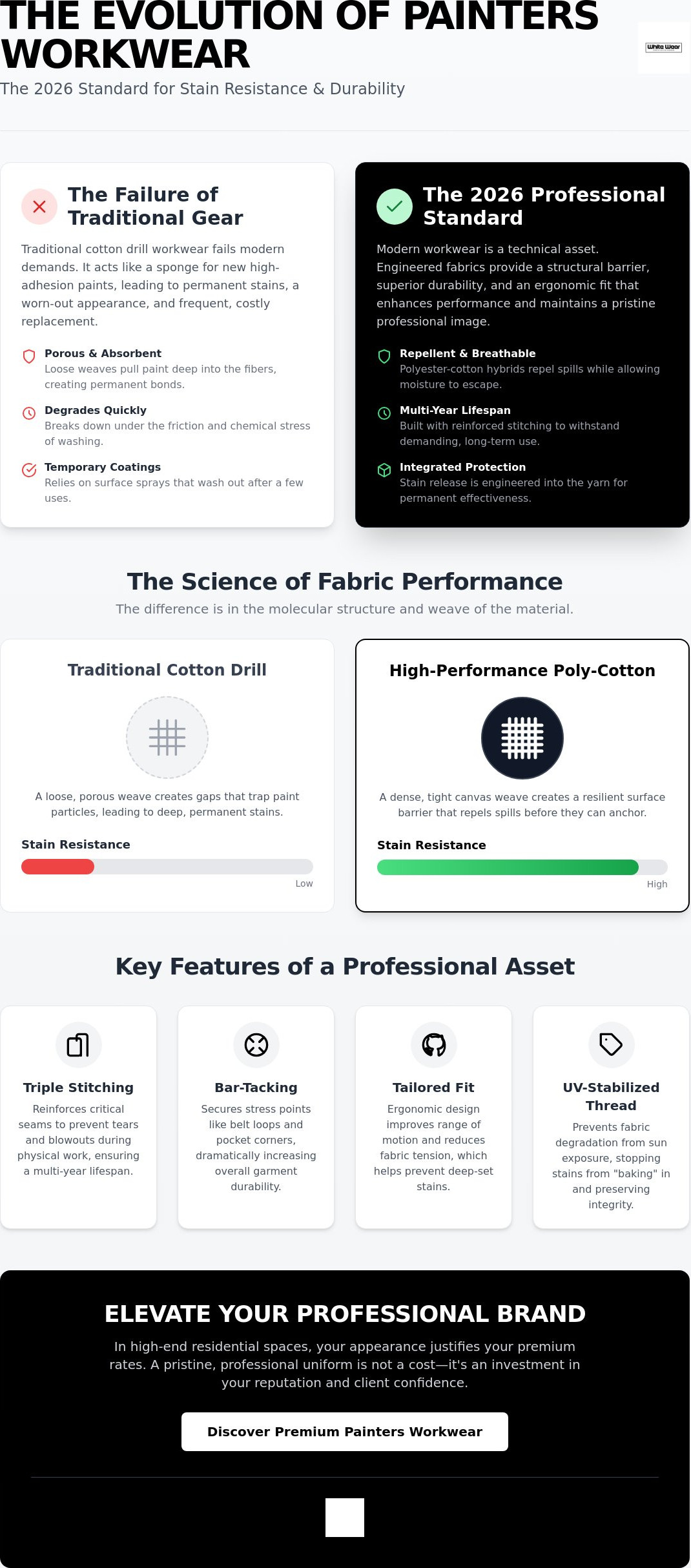
In 2026, the standard for professional workwear has evolved far beyond simple coverage. True stain resistance is now a structural mandate, not a marketing buzzword. Traditional cotton drill pants, once the industry standard, frequently fail the demands of modern, high-adhesion paints. These older fabrics are inherently porous. They act as a wick, pulling acrylic and oil-based hybrids deep into the core of the fiber. Once that bond is formed, your uniform becomes a permanent record of past mistakes. High-performance stain resistant painters pants solve this by treating the fabric as a technical shield. This shift in quality directly impacts your professional dignity. It changes the financial math of your kit. While disposable alternatives require constant replacement, engineered apparel offers a lifecycle that justifies the investment. Your clothing is a vital component of your Personal protective equipment (PPE). It should perform with the same precision as your finest brushes.
Understanding the difference between temporary hydrophobic coatings and permanent fabric treatments is essential for any business owner. Many entry-level options rely on a surface spray that provides a satisfying beading effect for the first few days. However, these coatings are fragile. They break down under the friction of movement and the chemical stress of laundering. A professional-grade treatment is integrated at the molecular level of the yarn. This ensures the protection remains effective throughout the life of the garment. A single pair of high-end trousers that lasts months is more economical than multiple cheap alternatives that look ragged within weeks.
The Role of Fabric Density and Weave
The difference between a generic trouser and a professional asset lies in the architecture of the weave. Loose drills are prone to liquid penetration because the gaps between threads are wide enough for paint particles to settle. In contrast, tight canvas weaves provide a dense, resilient surface that repels spills before they can anchor. Higher thread counts don't just feel better against the skin; they create a smoother finish that limits the mechanical grip of drying paint. Fabric density serves as the primary physical barrier against the rapid saturation of high-viscosity acrylic paints.
Beyond the Surface: Integrated Stain Release
Modern textile technology doesn't just repel liquids; it facilitates their removal. Integrated stain release ensures that even if paint begins to dry, it sits on the surface of the fiber rather than soaking into the core. This makes easy-wash properties a reality for the modern tradie. It allows you to maintain a crisp, white aesthetic even after a grueling week on a high-end residential site. The 2026 standard for professional apparel longevity focuses on maintaining this visual integrity through dozens of industrial wash cycles. You shouldn't have to choose between a clean appearance and a hard day's work.
The Science of Fabric Performance: Engineered for the Australian Tradie
The Australian workday is a brutal testing ground for professional apparel. For decades, 100% cotton was the industry standard, yet it lacks the molecular resilience required to repel modern, high-adhesion synthetic pigments. Polyester-cotton hybrids have emerged as the superior choice for stain resistant painters pants. This shift isn't just about durability; it's about the fundamental physics of the fiber. Polyester acts as a non-porous barrier that prevents paint from anchoring, while cotton ensures the garment remains soft and breathable against the skin. Recent Cornell University research on stain resistance highlights how these hybrid interfaces can be engineered to repel oils and liquids more effectively than natural fibers alone. By integrating these materials, your uniform stops being a sponge and starts being a shield.
Managing the delicate trade-off between protection and breathability is where 2026 textile engineering truly shines. High-performance fabrics now utilize multi-layered wicking systems. These systems pull perspiration away from the body without compromising the external repellent barrier. In our unique climate, extreme UV radiation can accelerate the "baking" of stains into the fabric. Premium painters workwear utilizes UV-stabilized threads that maintain their structural integrity under the sun. This prevents the fabric from becoming brittle and porous, which is exactly when traditional pants begin to fail. When the fabric remains smooth at a microscopic level, paint has nothing to grip onto.
Tensile Strength and Mechanical Stretch
Ergonomic safety on-site requires a garment that follows your lead. Standard elastane-heavy fabrics often lose their shape or "bubble" after repeated washing, which compromises the stain-resistant finish. Mechanical stretch, achieved through a specific weave architecture, provides flexibility without the rapid degradation of synthetic elastic fibers. This ensures your protective barrier doesn't crack or peel when you're squatting or reaching on a ladder. It's a sophisticated approach to movement that respects the physical demands of your craft.
Thermal Regulation During Long Shifts
Heat buildup isn't just a comfort issue; it's a maintenance problem. High body temperatures can cause sweat to interact with surface contaminants, effectively setting a stain before you've even finished your shift. Premium textiles facilitate air permeability, allowing heat to escape while keeping the protective shield intact. Proper thermoregulation reduces sweat-induced stain setting, ensuring your whites remain clinical and professional from the first hour to the tenth. You stay cool, and your pants stay clean.
Key Features to Evaluate in High-Performance Work Trousers
High-performance gear requires more than just advanced textiles; it demands a structural design that understands the movement of a professional. When selecting stain resistant painters pants, the construction must be as resilient as the fabric itself. You need a garment that supports repetitive climbing, deep squatting, and constant tool access without compromising its clinical aesthetic. Triple-stitching and bar-tacking at critical stress points ensure your investment survives the rigors of a demanding 2026 work schedule. These markers of quality prevent the seams from pulling apart under tension. Similarly, knee pad compatibility is a non-negotiable feature for those spending hours on residential flooring or baseboards. It protects the painter's joints while preventing the fabric from wearing thin at the point of contact. A secure, engineered waistband is equally vital. It ensures your trousers stay in place during active movement, providing comfort that lasts through a 10-hour shift.
The Anatomy of a Professional Utility Pocket
The modern toolkit has evolved. Pockets must now accommodate high-resolution smartphones alongside traditional scrapers and five-in-one tools. A well-designed cargo pocket features a secure closure to protect sensitive electronics from dust and overspray. Strategically placed brush loops are equally vital. They're engineered to keep the brush handle away from your leg, preventing accidental paint transfer to the clean surface of your trousers. This attention to detail is what separates a generic utility pant from a professional asset. For more insight on making the right selection, consult our resource on Choosing the Best Painters Pants.
Durability Markers: Seams and Zips
Hardware is often the first point of failure in inferior workwear. YKK zippers and heavy-duty buttons are essential for professional-grade gear. They provide a reliable closure that won't jam or break after a few wash cycles. A gusseted crotch is another critical inclusion. It provides an extra panel of fabric that redistributes stress, effectively preventing blowouts during active movement on ladders. This level of engineering ensures your uniform remains intact and professional throughout the most grueling shifts. You can explore more about these standards in The Professional Painter’s Guide to Elevated Workwear.
Selecting the Right Cut and Fit for the Professional Workday
Professionalism is fundamentally visual. When you step onto a high-end residential site, your silhouette communicates your standards before you ever open a tin of paint. A baggy, neglected uniform suggests a lack of precision, whereas a tailored fit projects an image of clinical authority. Modern stain resistant painters pants are now designed with an aesthetic that mirrors the quality of your craft. This isn't about vanity; it's about the dignity of the trade and the psychological advantage of feeling as sharp as your finish. Choosing between slim, regular, and relaxed fits allows you to match your gear to your specific specialty. While a slim cut offers a modern, sharp profile for interior detailing, a regular fit provides the balanced volume needed for all-day versatility.
Beyond appearance, fit is a critical factor in how a textile performs under pressure. When trousers are too tight, the fabric is forced to stretch beyond its intended limit. This tension pulls the weave apart at a microscopic level, creating openings where paint can bypass the protective barrier and anchor into the core fibers. On the other hand, excessive fabric creates deep folds where wet paint can pool and eventually saturate the material. A precise fit ensures the stain-repellent technology remains intact while you move. To ensure your next shift is supported by the best in ergonomic design, explore our full range of premium painters workwear.
Sizing Accuracy and the Australian Workday
Precision in sizing is the cornerstone of a functional workday. Understanding Australian sizing conventions, such as the 92R, is essential for achieving a fit that supports your movement without constant adjustment. We prioritize true-to-size manufacturing because we know that downtime spent managing returns is lost revenue for your business. A correctly hemmed trouser is also a vital safety feature on-site. A proper fit prevents fabric dragging through wet paint on drop sheets or snagging on ladder rungs during a climb.
Specialized Cuts for Women
The professional woman has been underserved for too long by unisex options that are simply downsized versions of men's patterns. These compromises often result in a poor rise and restricted movement through the hips, which can be exhausting over a 10-hour shift. The 2026 market has finally seen a rise in dedicated female-fit painters trousers that respect anatomical differences without sacrificing durability. You can find a more detailed analysis of these innovations in The Professional Woman’s Guide to Elevated Workwear.
Elevating Your Brand: The White Wear Approach to Excellence
Our development process is rooted in the reality of the 10-hour shift. Every pocket, seam, and loop in our painters clothing is the result of peer-led development. We don't design in a vacuum; we iterate based on the physical feedback of professionals who live in these garments. This ensures that every feature has a specific purpose, from the placement of a scraper pocket to the reinforcement of a waistband. This commitment to functional design reduces the friction of your workday. It allows you to focus entirely on the quality of your finish rather than the limitations of your kit. When your gear performs flawlessly, your brand reputation follows suit.
The "White Wear" Difference in Fabric Treatment
We take a proprietary approach to textile engineering that balances heavy-duty protection with modern lifestyle elegance. Our treatments ensure that our whites stay whiter for longer, resisting the yellowing and graying that plagues traditional cotton drill. This isn't a temporary coating. It's a fundamental improvement to the fiber that maintains essential breathability in the Australian heat. We're committed to the professional dignity of the trade, providing refined essentials that reflect the sophisticated nature of modern painting. Choosing durability over disposability reduces both the financial burden on your business and the environmental cost of frequent replacements.
Winning More Jobs Through Professionalism
First impressions are anchored in visual cues. A uniform that remains free of past "permanent records" of messy shifts tells the client you're organized, disciplined, and careful. These are the exact traits homeowners look for when inviting a contractor into their private spaces. Professionalism creates authority, and authority allows you to command the market rather than competing on price alone. Your workwear should be an asset that helps you close the deal. Experience the evolution of painters workwear at White Wear and transform how you present your craft to the world.
Mastering the Modern Workday Silhouette
The landscape of professional painting has shifted. It no longer accepts gear that fails to keep pace with the precision of your trade. You've discovered how the integration of advanced textile science and ergonomic tailoring transforms your kit from a simple requirement into a definitive professional advantage. By prioritizing stain resistant painters pants that offer both clinical authority and mechanical resilience, you ensure your aesthetic matches the high-end results you deliver. These garments are the result of peer-led development, designed specifically for the rigours of the 2026 Australian workday.
Investing in a sophisticated aesthetic is about more than the current shift. It's about building a sustainable brand that commands respect and premium rates in the residential market. You deserve workwear that protects your dignity as much as it protects your skin. It's time to trade the splattered records of past shifts for a future of enduring excellence. Elevate your professional image with White Wear’s stain-resistant collection today and experience the refined essentials your craft deserves. Your next 10-hour shift should be defined by comfort, not compromise.
Frequently Asked Questions
Do stain resistant painters pants actually work against oil-based paints?
Yes, professional-grade fabrics are engineered with oleophobic properties that specifically resist oil absorption. While traditional cotton acts as a sponge, these advanced textiles create a molecular barrier that slows the penetration of oil-based pigments. This gives you a critical window to blot the spill before it anchors into the fiber core. The result is a garment that remains clinical and clean even after accidental contact with high-adhesion primers and finishes.
How many washes does the stain resistant treatment typically last?
Integrated fabric treatments are designed to last the entire lifecycle of the garment. Unlike temporary surface sprays that wash away, 2026 fabric technology anchors the repellent properties directly into the yarn during the weaving process. You can expect your stain resistant painters pants to maintain their protective shield through dozens of industrial wash cycles. This permanent innovation ensures your professional image doesn't degrade alongside your laundry schedule.
Can I use bleach on my stain resistant white work trousers?
We recommend avoiding harsh chlorine bleach as it can compromise the structural integrity of the technical fibers. Strong chemicals often break down the integrated repellent barrier, making the fabric more porous over time. Instead, utilize oxygen-based whiteners or specialized workwear detergents designed for synthetic-natural hybrids. These solutions lift surface contaminants and maintain that bright, clinical white without stripping away the essential stain-release properties that protect your investment.
Are these pants breathable enough for 35-degree Australian summer days?
High-performance painters clothing is specifically engineered for the thermal demands of the Australian climate. The fabric utilizes a sophisticated wicking system that pulls moisture away from the skin while allowing constant airflow through the weave. This air permeability ensures you stay cool during grueling 10-hour shifts in peak summer. You don't have to sacrifice your physical comfort to maintain a professional, stain-free appearance on a demanding job site.
What is the best way to pre-treat a fresh paint spill on these trousers?
The most effective method is to gently lift any excess liquid with a clean scraper and blot the area with a damp, lint-free cloth. Avoid rubbing the spill, as mechanical pressure can force paint particles past the protective barrier and into the weave. Because the fabric is designed for easy-wash performance, most surface marks will release during a standard laundry cycle if they haven't been aggressively scrubbed into the fibers during the workday.
Do I need to buy a specific size to account for fabric shrinkage?
You should select your true size based on standard Australian conventions like the 92R. Premium polyester-cotton blends are pre-shrunk during manufacturing to ensure dimensional stability. Unlike 100% cotton drill, which can lose significant length after the first hot wash, these technical fabrics hold their shape and fit. This precision in sizing reduces the risk of fabric dragging on drop sheets or restricting your movement during repetitive climbing.
Are there stain resistant options for female painters?
The 2026 market has seen a significant shift toward inclusive, high-performance design for the professional woman. Dedicated female-fit stain resistant painters pants offer the same molecular protection as men's versions but are tailored for anatomical comfort. These cuts provide a better rise and improved mobility through the hips, ensuring that every professional on the team can maintain a sophisticated, clinical aesthetic without compromising on the ergonomic requirements of the job.
How does the cost of stain resistant pants compare to standard cotton drill over one year?
While the initial outlay for technical workwear is higher, the total cost of ownership over a year is substantially lower. Standard cotton drill often becomes a "permanent record" of past shifts, requiring frequent replacements to maintain a professional appearance. Engineered trousers resist this rapid degradation and maintain their visual integrity for much longer. You'll find that investing in two pairs of high-performance pants is more economical than replacing five pairs of inferior alternatives.


