


Could a more polished arrival help turn a suitable quote into a yes? Understanding how a professional uniform can increase your quote conversion rate starts with treating it as one part of the customer’s decision, not a shortcut to acceptance. Consistent, painter-focused workwear can help present a considered first impression, but it can’t make up for a quote that misses the mark.
If prospective customers decline when your work and price seem right, it can be hard to know what influenced their decision. Your appearance is one factor you can control, alongside clear communication, a well-defined scope, competitive pricing and timely follow-up. Practical workwear can also support comfort and movement through a demanding day, helping you feel prepared when meeting clients.
This article looks at how a uniform may contribute to buyer confidence, what else can influence quote conversion, and how to test the effect in your own business. Track accepted quotes alongside useful details such as lead source, quote value and whether you wore consistent workwear. This gives you evidence from your own conditions rather than assumptions or another business’s figures.
Key Takeaways
- See how consistent, practical workwear may shape a customer’s impression of your care and organisation.
- Learn why painter-specific clothing that supports comfort and movement can help you feel prepared throughout the working day.
- Compare presentation with quote clarity, scope, communication, reviews and follow-up to understand how a professional uniform can increase your quote conversion rate.
- Use a simple test to track quote outcomes alongside job type, lead source, quote value and response timing.
- Explore how White Wear painters workwear, “Designed In Australia. Made For Painters”, can support a considered quote-day standard.
How a Professional Uniform Can Shape a Painting Customer’s First Impression
A quote visit begins before you discuss paint, preparation or price. The customer sees who has arrived, how they’re dressed and whether the visit feels considered. A professional uniform is consistent, practical clothing suited to a painter’s trade. It doesn’t need to look formal; it should be appropriate for the work and present a neat, recognisable appearance.
That consistency may contribute to an impression of care and organisation. It’s a possible confidence signal, not evidence of workmanship, reliability or value. An outfit can’t show whether surfaces will be prepared properly or whether a quote covers the customer’s needs. Demonstrate those things through your work, communication and the detail you provide.
What customers may notice during a quote visit
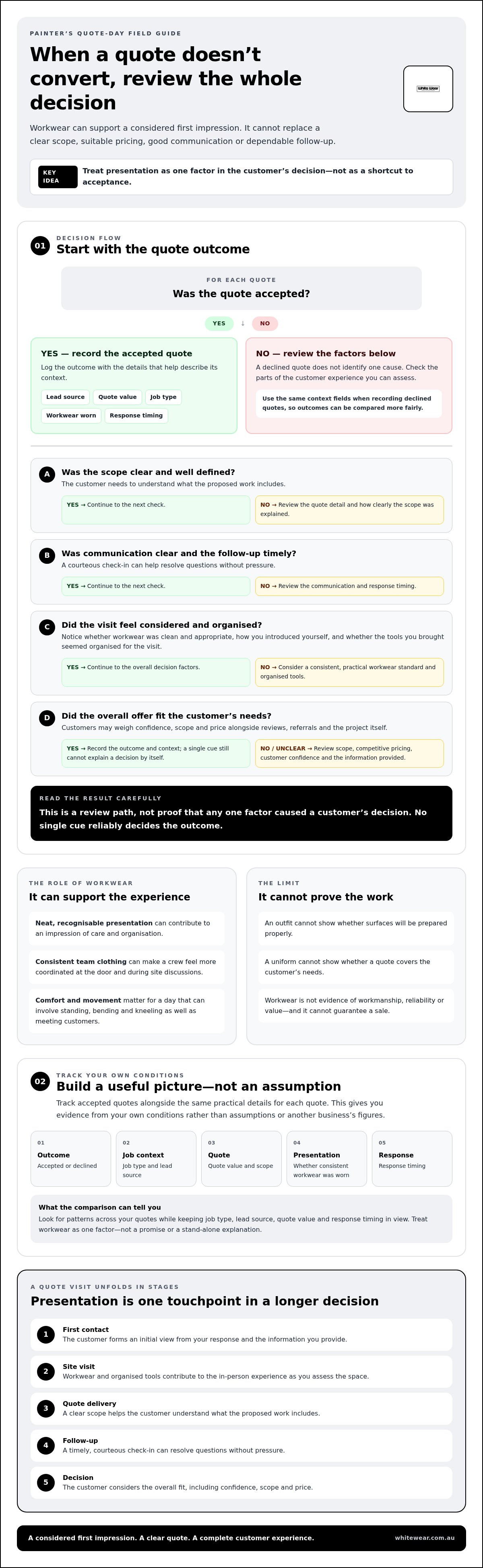
Customers may notice clean, appropriate workwear, how you introduce yourself and whether the tools you bring seem organised for the visit. These cues can help the encounter feel professional, but impressions vary by customer and project. A homeowner comparing quotes may weigh your presentation alongside reviews, referrals, scope and price. No single cue reliably decides the outcome.
Think of workwear as setting a considered tone, not making a claim on your behalf. It should suit a painter’s day and allow you to move comfortably between a walkthrough and a discussion of the job. The concept of a uniform includes workplace clothing used for identification and shared presentation, which helps explain why consistency can be meaningful without proving the quality of the work.
Where the uniform fits in the customer journey
Your clothing is one touchpoint in a longer decision. Each stage gives the customer different information, and a strong first impression still needs to be supported by a relevant quote and dependable communication.
- First contact: The customer forms an initial view from your response and the information you provide.
- Site visit: Workwear and organised tools contribute to the in-person experience as you assess the space.
- Quote delivery: A clear scope helps the customer understand what the proposed work includes.
- Follow-up: A timely, courteous check-in can resolve questions without pressure.
- Decision: The customer considers the overall fit, including confidence, scope and price.
Coordinated clothing may also support a recognisable business presence. For ideas on how workwear can contribute to that broader presentation, explore painter uniforms for company branding.
So, how a professional uniform can increase your quote conversion rate is best understood as a question to test, not a promise. Workwear can support an impression, but it cannot guarantee a sale. Treat it as one part of the customer experience and assess it alongside the factors that shape each quote and decision.
Why Painter-Specific Workwear Can Support a More Professional Quote Experience
A professional quote experience is built from small, consistent details. Practical workwear suited to painting connects the customer-facing visit with the work that follows: you arrive ready to assess the job, then move into the tasks the project requires. Clothing that suits your routine can make that transition more natural and help you stay focused through a full working day.
Consistency across a painting team
When a crew follows a shared clothing standard, customers see a more coordinated team at the door and during site discussions. That standard might simply mean clean, suitable painters’ clothing worn consistently. It doesn’t require custom logos or personalisation. The aim is to make presentation feel as considered as the way your team communicates, prepares and treats the customer’s space.
Keep expectations practical. Align workwear choices with the service standards your business already follows, such as arriving prepared and keeping the work area orderly. A uniform can’t do that work for you, but it can complement it. Workwear is one visible element of a consistent professional experience.
Practical features that support a polished working day
Comfort and movement matter because a painter’s day can involve standing, bending and kneeling as well as meeting customers. Choose clothing suited to the tasks at hand, so appearance and function don’t compete. The point isn’t to claim that a garment improves quote acceptance; it’s to choose workwear that supports the way you work.
White Wear’s Easy Move™ pants are made from signature Easy Move™ fabric with 3% Lycra and are knee-pad compatible. The Easy Move Painters Pants have cuffed bottoms and a built-in elastic and Velcro belt. The Easy Move Pants Standard Cuffs (No Elastic) have no cuffed bottoms and use a side adjuster. The pants also have an elastic waistband and belt loops. A 4-knot duster brush holster is positioned to stay out of the way when bending or kneeling, while a dust-resistant iPhone Plus-size phone holder has a secure flap. These are practical workwear details, not proof of workmanship or a promise about a customer’s decision.
- During a site visit: Choose clothing that feels appropriate for discussing the project and moving around the property.
- Between tasks: Consider whether the fit supports the bending and kneeling your work involves.
- Across the crew: Set a clear, realistic standard so the team’s presentation feels consistent.
For more considerations on fit and function, explore this guide to choosing the best painters pants. A considered choice can support your daily routine while keeping presentation in view.
That’s the practical link between workwear and how a professional uniform can increase your quote conversion rate: it may contribute to a coherent customer experience, but it can’t guarantee a sale. If painter-focused clothing is part of the standard you’re shaping, explore White Wear painters workwear for your working day.
Uniforms Versus Other Quote-Winning Factors: What Should Painters Compare?
A customer’s decision rarely rests on one detail. A coordinated appearance may help set a professional tone, while the quote itself needs to make the proposed work easy to understand. To assess how a professional uniform can increase your quote conversion rate, compare presentation with the other parts of the customer experience instead of treating clothing as the only variable.
Each factor may matter differently depending on the customer, project and competing options. Use this table to identify what you can observe and improve:
| Factor | What to assess |
|---|---|
| Presentation | Is your workwear neat and appropriate for a painting quote visit? |
| Quote clarity | Can the customer understand the price, proposed work and next steps? |
| Scope | Are preparation, inclusions and exclusions described clearly? |
| Communication | Did you respond clearly and keep the customer informed? |
| Reviews | Can prospective customers find feedback that helps them assess your past work? |
| Follow-up | Did you check whether the customer had questions after receiving the quote? |
These factors interact, but they aren’t interchangeable. A polished arrival won’t clarify an ambiguous scope, and a detailed proposal may not resolve a timing mismatch. Customers weigh project suitability, timing, value and confidence differently, so look for patterns in your own enquiries rather than assuming one factor explains every outcome.
How to calculate a quote conversion baseline
Choose a clear definition before comparing results. A practical baseline is accepted quotes divided by quotes sent during the same period, expressed as a percentage. Decide consistently whether withdrawn, unanswered or revised quotes count in the total. For example, you might exclude withdrawn quotes, but apply that rule every time you calculate the rate.
Maclean Partners gives an illustrative example of 85 sales from 156 quotes, described as a 54% conversion rate. That example is not established as a painter-industry benchmark. Your own baseline is more useful because it reflects your leads, jobs and tracking method.
What a uniform cannot fix in a quote
Workwear can’t compensate for unclear inclusions, slow responses, poor-fit leads or mismatched expectations. If a customer expected a different scope, needs timing your schedule can’t meet, or doesn’t understand what the price covers, changing your outfit won’t resolve the underlying concern.
Track other conditions alongside presentation. Record the job type, lead source, quote value and response timing, then note whether the quote was accepted, declined or left unanswered. If you change workwear while also revising your pricing or follow-up process, you won’t know which change influenced the result. Consistent tracking makes comparison fairer, though it still won’t prove that appearance alone caused a difference.
How to Test Whether a Professional Uniform Improves Your Quote Conversion
A simple before-and-after test can help you assess whether changing your workwear coincides with a change in accepted quotes. The key is consistency: keep your quote process steady, record comparable information and resist reading too much into a small shift. A comparison can reveal a pattern, but it cannot prove that the uniform caused it.
Use this five-step process to make the test useful:
- Baseline: Record your current conversion rate using a clearly defined method and a period that reflects your normal quote volume.
- Standardise: Set a consistent workwear approach for quote visits, such as wearing the same painter-appropriate clothing standard each time.
- Track: Log the outcome of every quote alongside job type, lead source, quote value and response timing.
- Compare: Calculate the rate for the test period using the same formula and outcome rules as the baseline.
- Review: Look for patterns, account for other changes and decide whether to keep testing or adjust your approach.
Conversion rate = accepted quotes ÷ quotes sent × 100. Use the same definition of an accepted quote and decide in advance how you’ll treat withdrawn, unanswered or revised quotes. Keep your quoting, pricing, communication and follow-up practices as consistent as possible while testing. That gives you a fairer comparison of workwear periods.
Set up a fair before-and-after comparison
Choose a tracking period that suits your usual quote volume, rather than selecting dates just because the result looks favourable. Record the same fields and quote outcomes before and after you standardise workwear. Note changes that could affect results, including lead sources, pricing, seasonal demand or sales scripts. If several factors change at once, it becomes harder to interpret the difference.
A simple spreadsheet is enough if it captures each quote consistently. Include the date sent, job type, lead source, quote value, response timing and final status. Keep personal details limited to what you need to manage enquiries, and focus your analysis on patterns across the work rather than one customer’s decision.
Interpret the results without overclaiming
Compare conversion rates alongside quote volume and lead quality. A higher rate could coincide with receiving more suitable enquiries, while a lower one might reflect a different mix of project types. Small or uneven samples are inconclusive, so continue recording results rather than treating an early fluctuation as a firm answer.
Customer feedback can add context. If a customer mentions that your crew looked organised, record the comment as a perception, not proof that clothing secured the job. The test can help you explore how a professional uniform can increase your quote conversion rate, but it’s evidence from one business, not a guaranteed result.
As you run the test, choose painters’ clothing that feels practical for your day and consistent with your customer-facing standard. Explore White Wear painters workwear for quote visits and the work that follows.
How WhiteWear Painters Workwear Fits a Professional Quote-Day Standard
A quote-day standard doesn’t need to be complicated. It can mean choosing practical painters’ clothing that feels appropriate for meeting a customer, supports your working routine and gives your team a consistent baseline for presentation. White Wear is an Australian specialist in painters workwear, guided by the phrase “Designed In Australia. Made For Painters”. Its range focuses on clothing designed for the painting trade.
Workwear may help create a considered impression, but it can’t promise customer confidence or quote acceptance. Choose garments that work for the day ahead, from discussing a project to moving through painting tasks, while your quote and communication demonstrate the value of the work.
Painter-focused details for work and customer visits
Fit and function are personal, so consider how a garment supports the movements in your routine. White Wear’s Easy Move™ pants use signature Easy Move™ fabric with 3% Lycra and are knee-pad compatible. The Easy Move Painters Pants have cuffed bottoms, an elastic waistband, belt loops and a built-in elastic and Velcro belt. By contrast, Easy Move Pants Standard Cuffs (No Elastic) have no cuffed bottoms and use a side adjuster. These details can help painters compare options based on the garment’s actual design.
The Women’s Easy Move Painters Pants have a high-waisted, hip-friendly fit with extra room at the hips. That is a distinct fit detail, not a specification to apply to every style. Keeping product features separate helps you choose workwear based on the garment itself rather than assuming one design suits every painter.
A 4-knot duster brush holster is positioned to stay out of the way when bending or kneeling. The pants also have a front slip pocket and a dust-resistant iPhone Plus-size phone holder with a secure flap. White Wear’s range includes shorts such as Maxi Flex Shorts and White Wear Classic Shorts, with additional utility and tool pockets on shorts. These practical details are designed around painting tasks, while a consistent choice of suitable garments can support a neat, considered appearance at customer visits.
Turn the idea into a consistent business standard
Make the standard simple enough to use every time. Decide what your team will wear for customer visits, communicate the expectation clearly and apply it consistently. The goal isn’t to look identical at any cost; it’s to make presentation feel intentional and suitable for the work.
Then pair that visual standard with the parts of the experience customers need to assess the job: a clear scope, timely communication and reliable follow-up. That balance is central to understanding how a professional uniform can increase your quote conversion rate. Treat workwear as one part of the experience, not a substitute for a well-prepared proposal or a promise of a sale.
If painter-focused clothing fits the standard you want to set, explore White Wear painters workwear and consider which options suit your working day.
Make Your Next Quote Visit a Measurable Step Forward
Choose one practical change for your next run of quote visits, then keep your process steady enough to learn from the results. Consistent workwear can be part of that experiment, but your customer’s decision still rests on the overall experience and whether the proposal fits their needs. Track outcomes over time and let your own evidence guide what you refine.
For painters who want clothing designed with the trade in mind, White Wear’s approach is “Designed In Australia. Made For Painters”. Its Easy Move™ pants use signature Easy Move™ fabric with 3% Lycra and are knee-pad compatible. Those details speak to practical workwear, not a promise of more accepted quotes. The value of how a professional uniform can increase your quote conversion rate is something to assess in your own business, one consistent step at a time.
Explore White Wear painters workwear and choose workwear suited to your routine. A more considered standard starts with a choice you can put into practice, then measure with confidence.
Frequently Asked Questions
Can a professional uniform really increase a painter’s quote conversion rate?
It may contribute to a positive impression, but it can’t secure a customer’s acceptance on its own. To assess how a professional uniform can increase your quote conversion rate, compare similar types of enquiries before and after adopting a consistent workwear standard. Note whether customers mention presentation, but treat comments as context rather than proof. A result is more useful when you also account for differences in project type and lead source.
How do painters calculate their quote conversion rate?
Divide accepted quotes by quotes sent during the same period, then multiply by 100. For example, if 8 of 20 sent quotes are accepted, the conversion rate is 40%. Decide how to handle revised, withdrawn and unanswered quotes before calculating, and keep that approach unchanged. For a clearer picture, group results by the date quotes were sent and allow time for customers to make a decision.
What matters more than a uniform when a customer accepts a painting quote?
No single factor matters most in every situation. A customer may focus on whether the proposed preparation suits their property, whether the timing works for their plans, or whether the quote explains the work clearly. If a quote isn’t accepted, review any questions the customer raised and compare the proposal with the original request. That can help identify whether the issue was fit, clarity or another concern, rather than assuming presentation was decisive.
Should every painter in a team wear the same uniform?
A shared workwear standard can help the team look coordinated, but every garment doesn’t have to be identical. Set a practical expectation for customer visits, then allow choices that suit different roles, fit preferences and tasks. For instance, team members may follow the same standard for neatness and suitable painters’ clothing while choosing different cuts. Consistency is about a recognisable level of presentation, not assuming matching outfits prove the quality of the work.
How long should painters track quote conversions before judging a uniform change?
Track until you have a useful set of comparable quotes for your normal workflow, rather than relying on a fixed number of weeks or enquiries. Make sure outcomes have had time to settle, and compare similar project types where possible. If one period has mostly small interior jobs and another has different work, note that difference. With few quotes or changing conditions, keep the finding tentative and continue collecting information.
What workwear details can support a professional appearance on quote visits?
Choose clean, practical clothing suited to painting work and comfortable enough for the activities planned that day. For example, Easy Move™ pants use signature Easy Move™ fabric with 3% Lycra and are knee-pad compatible. Consider fit and function alongside how consistently your team presents itself to customers. These details support workwear choices; they don’t predict whether a particular quote will be accepted.


