


The most comfortable painter’s clothing may be the wrong choice for a hazardous zone. Choosing anti-static clothing for painting in hazardous locations means looking beyond fit and flexibility: static control is one part of a site-specific safety system, not protection on its own.
If you’re unsure whether ordinary workwear is suitable around flammable vapours or dust, the answer depends on the site risk assessment and applicable requirements. Clothing also needs to work with grounding and other controls. A garment that feels technical or uses stretch fabric isn’t automatically certified for hazardous-area use.
This guide explains what anti-static clothing is designed to do, what it can’t do, and what to verify before entering a painting area with ignition risks. It also distinguishes protective clothing selected for a documented site requirement from painter-focused workwear designed for comfort and practical tasks. White Wear’s pants use Easy Move™ fabric with 3% Lycra for stretch and flexibility. Comfort matters through a long workday, but it shouldn’t be mistaken for certified protection.
Key Takeaways
- Start with the site risk assessment to establish whether the painting task requires anti-static clothing and which properties are specified.
- Understand how garment construction can help dissipate static charge, and why this doesn’t eliminate ignition risk or replace other controls.
- Compare anti-static, flame-resistant, chemical-resistant and general painter workwear by their intended purpose and supporting documentation.
- Use a step-by-step check of the task, exposure, required properties, garment documentation, fit and care to guide your choice of anti-static clothing for painting in hazardous locations.
- Address documented site protection requirements before choosing workwear for comfort and practical painting needs. Painter-focused features aren’t proof of anti-static protection.
When does painting work call for anti-static clothing?
Start with the site risk assessment. Whether a painting task calls for anti-static clothing depends on the hazards identified in that work area, not simply on the fact that paint is being applied. Anti-static garments are designed to help control static charge, which may build as clothing moves or rubs against other surfaces. They can form part of a control approach, but they don’t remove ignition risks or replace other workplace controls.
That distinction matters when selecting anti-static clothing for painting in hazardous locations. Friction and movement during sanding, mixing, spraying or reaching across a work area can contribute to static charge. If a flammable atmosphere is also present, a discharge may matter. The antistatic device overview describes how static can be generated and dissipated, including through antistatic garments.
General painter workwear supports the task; verified protective clothing is selected against a documented hazard. A job title, paint-stained finish or comfortable fit doesn’t establish that a garment provides anti-static protection.
What makes a painting location potentially hazardous?
A painting area may present a fire or explosion hazard if flammable vapours or gases are present, or if combustible dust can be created or dispersed. These conditions aren’t present at every painting site. The relevant risks depend on factors such as the coating and other materials in use, the process, and where the work takes place, including proximity to storage or other operations.
Use the documented site risk assessment to understand which hazards have been identified and which workplace controls apply. A spray task involving a particular coating, for example, may have different conditions from brushwork in another area. Don’t infer that a space is hazardous or hazard-free from its appearance alone. Follow the responsible site safety process for the specific work area.
When should clothing requirements be assessed?
Assess clothing requirements before work begins, and review them when the task or conditions change. Surface preparation, coating application and work near stored materials can involve different exposures and processes. A change in location, materials or work method may also affect the hazards identified in the site assessment.
Your occupation alone doesn’t determine whether anti-static garments are needed. The decision should follow the task-specific risk assessment and applicable workplace controls. If the assessment specifies anti-static clothing, treat it as a protective requirement, not a preference to weigh against ordinary workwear features. If the task changes, use the site’s safety process to review whether the clothing selection still matches the identified hazards.
How anti-static garments manage static, and where their limits begin
Friction can move electrical charge between surfaces. As a painter bends, walks, reaches or handles materials, charge may build on clothing or other surfaces. If it discharges suddenly, the resulting spark can become an ignition source where a flammable atmosphere is present. Anti-static garments are designed to help control this charge, but how they work depends on their construction and how they’re used within the site’s specified safety system.
Some garments use conductive elements to help charge dissipate rather than accumulate in one place. That doesn’t mean every garment labelled “anti-static” works the same way or that a garment alone makes a task safe. Site controls, training and any other required protective equipment still matter. The coating, application method and work environment all shape the broader context. The American Coatings Association provides information about the coatings industry, while Australian site requirements should be guided by the applicable local risk assessment and controls.
A feature claim is not proof of certification. A fabric that feels smooth, flexible or technical doesn’t establish that a garment has been tested for specific protective performance.
What do conductive fibres and garment design do?
Conductive fibres, sometimes incorporated into fabric, are one possible way to help dissipate static charge. They aren’t a universal garment specification. Performance may also depend on how the garment is constructed, how much of the body or underlying clothing it covers, and how it’s intended to work with other parts of the wearer’s protective system.
Look for evidence tied to the garment’s intended performance, such as relevant test documentation and clear instructions for use and care. Don’t infer performance from a fibre name, marketing phrase or appearance alone. The site assessment should identify which documentation and system conditions are relevant.
Why anti-static does not automatically mean flame-resistant
Anti-static properties concern the control of electrical charge. Flame resistance concerns how a material responds to heat or flame. Chemical protection is different again: it relates to exposure to substances and the garment’s ability to protect against them. These properties address separate hazards, so one claim doesn’t automatically establish another.
If a task requires more than one protective property, the garment’s claims and supporting documentation need to substantiate each required property. No single label should be treated as proof of suitability for every painting hazard. Confirm that the clothing selection matches the documented site requirements, and follow instructions on layering, footwear, care and use so the specified protective system isn’t undermined.
Comfort features have a different purpose. Stretch fabric can support movement, and practical workwear can suit the physical demands of painting, but neither feature demonstrates static control, flame resistance or chemical protection. For suitable painting tasks where certified hazardous-area protection isn’t required, explore painter-focused workwear designed around the trade. Keep that comfort decision separate from the evidence needed for protective clothing.
Anti-static, flame-resistant, and painter workwear: compare the claims
Protective terms answer different safety questions. Anti-static clothing relates to static charge; flame-resistant clothing relates to heat and flame; chemical-resistant garments address specified chemical exposure. General painter workwear is designed around the practical demands of painting, but comfort, flexibility and tool features don’t establish protective certification.
Never infer hazardous-area suitability from a garment’s appearance or a broad product description. For anti-static clothing for painting in hazardous locations, match the claim to the site’s documented requirements, then look for evidence that applies to the exact garment and intended use.
| Garment category | Intended function | Evidence to look for |
|---|---|---|
| Anti-static | Helps control static charge where this property is required. | Exact garment identification, stated anti-static property, applicable standard and supporting test or certification documentation. |
| Flame-resistant | Provides specified performance against heat or flame exposure. | A clearly stated flame-resistant claim and documentation for the relevant standard and garment. |
| Chemical-resistant | Provides protection against specified chemicals and exposure conditions. | Evidence identifying the chemicals and use conditions covered, alongside relevant garment documentation. |
| General painter workwear | Supports painting tasks with practical wear features and comfort. | Product details for its stated features. Don’t treat these as evidence of protective certification. |
Which garment claims answer which safety question?
Start with the hazard, not the label. If the site assessment identifies a static-ignition concern, verify the specified anti-static property. If it identifies flame or chemical exposure, those needs call for their own supporting evidence. The site documentation should state the required garment properties and applicable standards. References such as EN 1149 or AS/NZS standards are useful only when their relevance and current applicability have been checked for the task.
What should a buyer verify on product documentation?
Read beyond a short retailer description. Check the exact garment model, the protective property claimed, the standard named and the supporting documentation. Confirm that the evidence applies to the complete garment, not just a fabric sample or one component, and that the intended use matches the painting task. Follow documented conditions for wearing, layering and care.
A general phrase such as “static control” may not tell you what was tested, which model the claim covers or how it must be used. Record the relevant garment details against the site requirement so the selection can be checked consistently before work begins. If a standard is cited, verify its current version and that it addresses the hazard identified in the assessment. A standard name alone doesn’t establish suitability for every hazardous area.
DIY anti-static sprays and informal treatments aren’t substitutes for verified garment documentation. They don’t establish that the finished clothing meets the site’s specified protective requirement, particularly after use or laundering. Likewise, painter workwear can be a considered choice for suitable tasks without being protective clothing. Keep these decisions distinct: confirm the required protection first, then choose practical workwear features that suit the painting job.
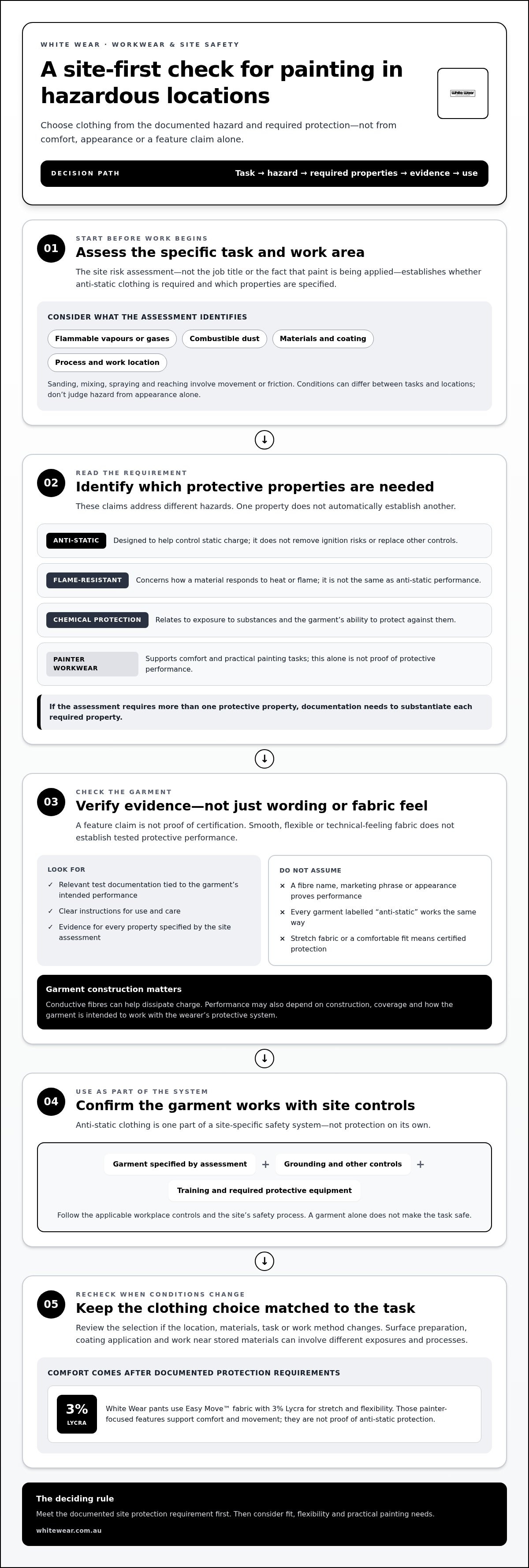
How to choose anti-static clothing for a painting task
Choose from the documented site requirement outward, not from a feature list inward. This keeps the decision specific to the painting task and avoids treating a garment description as a substitute for protective evidence. Use the site’s safety process and applicable Australian requirements to guide each check. If the work method, materials or location changes, revisit the selection against the updated assessment.
A practical document-first buying checklist
Work through the checks in order. The aim is to connect the identified hazard to the garment and its instructions, rather than choosing a familiar style and assuming it will suit the site.
- Start with the site risk assessment. Record the work area, hazards identified and controls that apply. Don’t assume every painting location has the same requirements.
- Describe the task. Note whether the work involves surface preparation, coating application or another activity, and whether the method or location is expected to change during the shift.
- Consider exposure. Identify the materials, process and conditions relevant to the worker’s exposure. Use the site assessment rather than assumptions based on the job title or the name of the coating.
- Identify required properties. Translate the assessment into the garment properties specified for the task. Anti-static, flame-resistant and chemical-resistant claims address different needs.
- Match claims to documentation. Check the exact garment model, stated property, applicable standard and supporting documentation. Confirm that the evidence covers the garment configuration and intended use, not just a fabric or component.
- Check fit and configuration. Make sure the specified garment can be worn as intended for the activity, including any required layering and other PPE. Follow site instructions about how the complete clothing system is used.
- Review care requirements. Read the garment’s care and maintenance instructions and keep them available with the product details. Don’t assume performance remains unchanged if the garment is altered or treated.
Fit, movement, and garment-system considerations
A garment needs to suit the movements involved in painting, from reaching and bending to handling tools. Assess fit while wearing any required layers and PPE, and check that the selected configuration follows the site’s instructions. A comfortable fit supports the workday, but comfort alone says nothing about protective performance.
Care is part of the selection, too. Cleaning methods, repairs or modifications may affect a garment’s specified performance if they aren’t permitted by its documentation. Don’t apply DIY treatments or substitute another item unless the product instructions allow it. If instructions conflict with the site requirement, pause the selection and use the responsible site safety process to resolve the issue before work starts.
Once documented protection needs are met, choose practical clothing for suitable painting tasks. Explore painter-focused workwear for trade-specific comfort and function, keeping those features separate from verified hazardous-area protection.
Choose painter-focused workwear without mistaking it for anti-static protection
There are two separate decisions. First, meet the protective clothing requirements documented for the site and task. Then choose suitable painter workwear for comfort and practical movement, provided it fits within the site’s controls. Keeping those decisions distinct helps prevent a well-designed work garment from being mistaken for verified hazardous-area protection.
That distinction is central to choosing anti-static clothing for painting in hazardous locations. If the site assessment calls for a specific protective property, the garment needs evidence that matches that requirement. Painter-focused fit and features can support the workday, but they can’t replace that evidence or change what a garment is designed to do.
Where painter-focused features fit into the decision
Flexibility can make bending, reaching and changing position more comfortable during painting. Knee-pad compatibility can support tasks that involve working close to the floor. These features serve practical work needs; they don’t establish anti-static, flame-resistant or chemical-resistant performance, and they aren’t proof of certification.
For example, White Wear’s Easy Move Painters Pants use signature Easy Move™ fabric with 3% Lycra, have cuffed bottoms, and are knee-pad compatible. They also feature an elastic waistband, belt loops, an elastic and Velcro belt, a 4-knot duster brush holster, a front slip pocket and a dust-resistant iPhone Plus-size phone holder with a secure flap. These practical details can help you assess workwear for a suitable painting task, but they don’t establish protective properties for hazardous-area work. Check the site requirements and product documentation separately.
Explore workwear designed with painters in mind
White Wear is an Australian specialist in painter-focused workwear. Its phrase, “Designed In Australia. Made For Painters”, reflects a focus on clothing for the realities of the trade. The range includes painter-focused pants and shorts, with features intended to support comfort, flexibility and practical use. These are workwear choices, not claims of hazardous-area protection.
When comparing apparel, consider the movements and tasks you perform across the day, such as kneeling, reaching or moving between work areas. Then look at the garment’s confirmed features and decide whether they suit those everyday demands. If the site requires protective clothing, keep that selection anchored to the documented requirement rather than assuming general painter workwear will meet it.
For a broader view of trade apparel, explore guidance on elevated workwear for professional painters. If pants are your focus, look for advice on choosing painters’ pants by considering fit, movement and the way you work. These practical choices can help refine your workwear selection once the site’s protective requirements have been addressed.
Ready to choose clothing for suitable painting tasks? Explore White Wear’s painter-focused apparel for workwear designed with the trade in mind, and keep comfort and certified protection as separate decisions.
Make your next workwear choice with confidence
Before the next painting task, turn the site’s clothing requirements into a clear decision: meet the documented protection needs first, then choose workwear that supports how you move through the day. That order keeps comfort and practical design in their proper place, without asking general painter clothing to do the work of verified protective equipment.
Choosing anti-static clothing for painting in hazardous locations should follow the specific site assessment and applicable requirements. For tasks where that level of protection isn’t required, painter-focused apparel can help you prioritise ease of movement and practical features. White Wear offers painter-focused pants and shorts, with nationwide Australian shipping.
Build a workwear setup around the demands of your trade, while keeping site protection decisions grounded in documented evidence. Explore painter-focused workwear from White Wear and choose apparel designed for the rhythm of a working day.
Frequently Asked Questions
Does anti-static clothing protect painters from every hazardous-location risk?
No. Anti-static clothing addresses a specific static-related concern when selected for that purpose. A painter may still face other hazards, such as coating exposure, heat or inadequate ventilation, each requiring controls identified by the site process. For example, a garment’s static-control claim doesn’t establish chemical or respiratory protection. Check the complete PPE requirements for the task, not just the clothing label, and follow the site’s instructions for the work area.
Can regular painter workwear be used where anti-static clothing is required?
Not as a substitute for the specified protective garment. If the site requirement calls for verified anti-static properties, general painter workwear shouldn’t be treated as equivalent just because it’s comfortable or practical. For example, work pants suited to kneeling may still lack the documentation needed for a hazardous-area requirement. Meet the site’s clothing specification first, then consider painter workwear where it’s permitted.
Is anti-static clothing the same as flame-resistant clothing?
No. The terms refer to different protective properties, so one claim doesn’t prove the other. A garment may have more than one substantiated property, but each needs evidence relevant to the claim and intended use. For instance, if a task assessment identifies both static and flame hazards, a single “protective” description may not show that both needs are addressed. Match the garment documentation to each property specified for the work.
How can I tell whether a garment has verified anti-static properties?
Look for documentation that identifies the exact garment and explicitly states the anti-static property and applicable test standard. Product-level evidence should apply to the garment configuration you intend to wear, not only to a fabric swatch or general material description. Check care and use instructions, too. If the label and supporting documents don’t clearly relate to the same model, don’t assume they establish the performance required for your task.
Can anti-static spray make ordinary painting clothes suitable for a hazardous location?
Don’t assume a spray makes ordinary clothing suitable. Applying a treatment at home doesn’t demonstrate that the finished garment meets a site’s protective specification, or that any claimed performance remains after wear or washing. For example, a treated shirt without model-specific test documentation still leaves a gap between the site requirement and the evidence available. Follow the garment maker’s instructions and the site safety process rather than relying on an improvised treatment.
Do all painting jobs involving flammable products require anti-static clothing?
Not necessarily. The clothing decision depends on the specific task, materials, work area and hazards identified through the site’s risk assessment, not simply on the presence of a flammable product. A coating’s use in one setting doesn’t automatically establish the requirements for another. Check the documented assessment and controls for the actual work location, particularly if the method or conditions differ from the planned task.
What should I do if the site risk assessment and garment label seem inconsistent?
Pause the clothing decision and raise the discrepancy through the responsible site safety process before entering the work area. For example, if the assessment specifies an anti-static property but the garment label or documents don’t clearly support it, don’t rely on appearance or assumptions to resolve the mismatch. Have the requirement and product evidence reviewed together, then follow the site’s direction on a suitable garment and any other controls.


