


What does a customer notice before the first coat of paint goes on? The crew arriving at their site. When clothing and presentation vary from person to person, even skilled painters can look like a collection of individuals rather than one dependable team. Presenting a unified brand image for painting crews starts with a simple principle: consistency should work as hard as the people wearing it.
A polished appearance should not come at the cost of comfort or function. Painting involves reaching, kneeling, carrying tools and working around paint, so a team standard needs to suit the job. This guide explains how to set practical appearance expectations, choose workwear that supports a coordinated look and help your crew make a recognisable, professional impression at customer sites. It also covers why painter-focused clothing matters, including stretch, flexibility and knee-pad compatibility. With workwear designed in Australia for painters, a cohesive look can feel considered and job-ready, not restrictive.
Key Takeaways
- Presenting a unified brand image for painting crews means aligning what customers see, from crew clothing to introductions and site preparation.
- Set a clear team standard, choose practical apparel, explain expectations and review how well they work on real jobs.
- Compare workwear by trade relevance, freedom of movement, task utility and how well it supports your crew’s chosen presentation.
- Involve painters when setting appearance guidelines so the standard looks professional and still accommodates the demands of daily work.
- Painter-focused clothing can provide a practical foundation for a coordinated look. Easy Move Painters Pants, for example, use 3% Lycra fabric and have cuffed bottoms and knee-pad compatibility.
Why a Unified Brand Image Matters for Painting Crews
A customer often meets your business at the front gate, driveway or doorway, before seeing a drop sheet or a fresh coat of paint. The people arriving are part of that first impression. If crew members look and act as though they represent different businesses, customers may find it harder to recognise them as one organised team.
A unified brand image is the recognisable way your painting crew presents itself, through shared workwear and consistent, respectful conduct on every job. That does not mean every painter has to look identical in every detail. It means agreeing on the basics that help the crew feel coordinated while allowing practical choices around fit, comfort and tasks. Presenting a unified brand image for painting crews is about intentional consistency, not uniformity for its own sake.
What does a unified brand image look like on a painting job?
Picture a crew arriving ready to work. Their clothing follows an agreed standard, they know who will greet the customer, and they bring equipment onto the property in a considered way. The team looks prepared and recognisable, even if individual workers choose different sizes or suitable layers for the conditions.
Now picture the alternative: one painter arrives in casual clothes, another wears unrelated workwear, and a third does not know how the team introduces itself. None of these details determines the quality of the finished paintwork, but they can make the customer’s experience feel less coordinated before the work begins. A shared clothing standard and a simple greeting give the team a clear starting point.
Consistency should support the work, not interfere with it. Painters need clothing that allows them to move and do the job, not appearance rules that make the day harder. The aim is a crew that looks ready for the work while each person remains comfortable enough to focus on the craft.
How does crew presentation shape customer confidence?
First impressions form during the initial interaction, not just at the final walkthrough. Customers notice who arrives, how the team identifies itself and whether the crew’s behaviour feels considered. Shared presentation helps customers recognise the people working on their property as one business. Consistent introductions and courteous communication make the experience feel more joined up.
This is one practical expression of brand implementation: the identity a business intends to convey needs to show up consistently in real customer interactions. Brand Implementation on Wikipedia discusses how brand identity can be applied across visual elements and settings, including uniforms. For a painting crew, workwear is one visible part of that application, alongside conduct on site.
Clothing alone cannot guarantee trust, win a contract or replace careful preparation and quality workmanship. It can help establish a coherent presence before customers assess the finished result. When the crew’s appearance and behaviour reflect the same standard, customers have a clearer sense of who has arrived and what kind of experience to expect.
Build Consistency Around Workwear, Brand Standards and Crew Behaviour
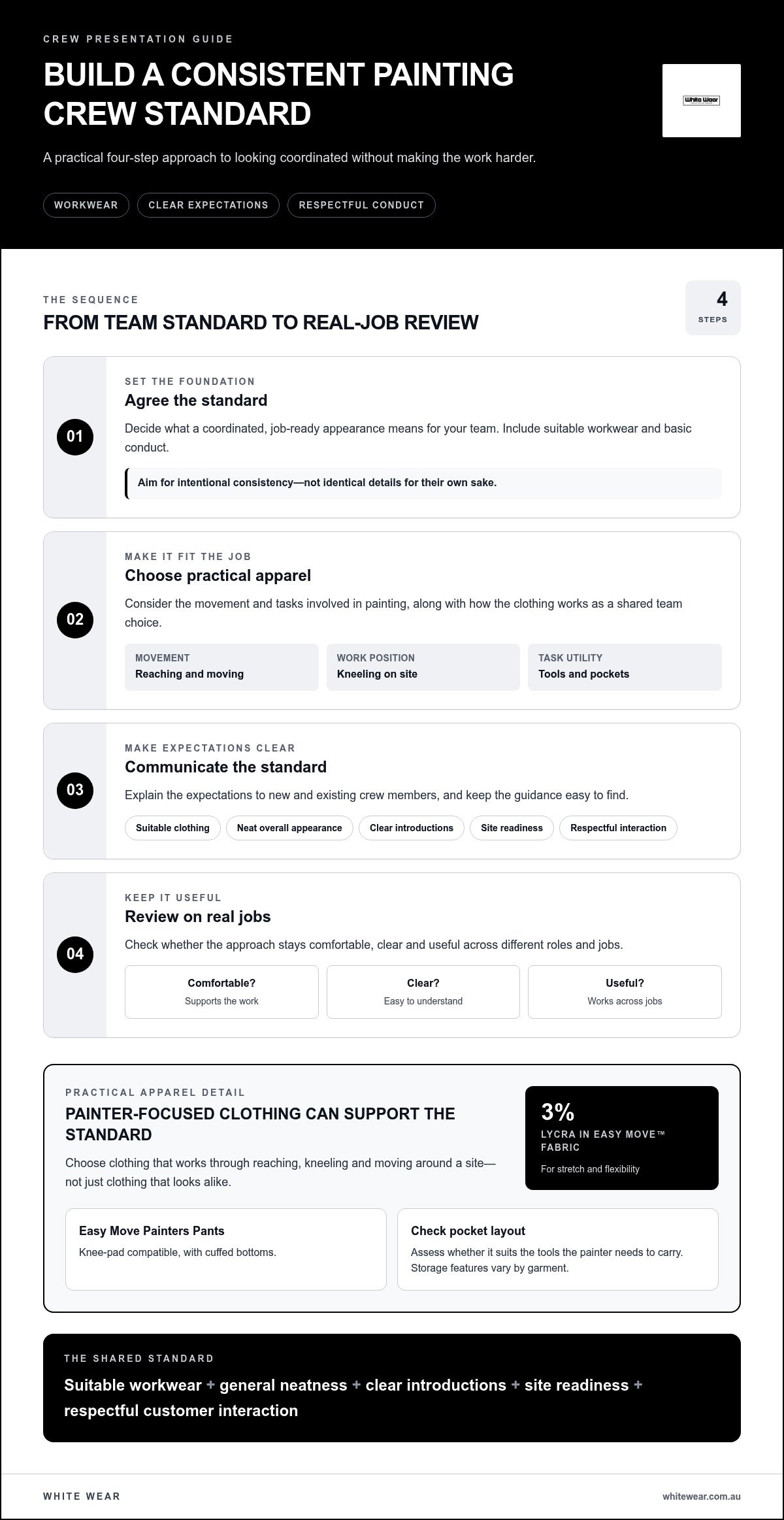
A reliable crew standard is easy to understand and practical to follow. Build it in four steps: agree what customers should see and experience, choose apparel suited to painting tasks, explain expectations clearly, then review the standard on real jobs. This keeps the brand visible without turning presentation into a rigid dress code.
- Agree the standard. Decide what a coordinated, job-ready appearance means for your team, including suitable workwear and basic conduct.
- Choose practical apparel. Consider the movement and tasks involved in painting, as well as how the clothing works as a shared team choice.
- Communicate expectations. Explain the standard to new and existing crew members, and make the guidance easy to find.
- Review consistently. Check whether the approach remains comfortable, clear and useful across different roles and jobs.
Use this checklist sentence: a consistent crew presentation covers suitable workwear, general neatness, clear introductions, site readiness and respectful customer interaction.
Which parts of the crew image should a business standardise?
Set expectations for suitable clothing, a neat overall appearance and customer-facing conduct. For example, agree that each painter wears workwear selected for the job, introduces themselves clearly and treats the customer’s property with care. Put the essentials in concise team guidelines that painters can refer to before a job. Keep core standards consistent, but allow for individual fit preferences, suitable layers and role-specific needs. Brand colours or logo use can be considered as general visual choices, but they are not a substitute for practical workwear.
How can painter-focused workwear support consistency?
Clothing designed with painting tasks in mind can help a crew look considered for the trade, rather than simply dressed alike. Practicality matters: garments need to work through reaching, kneeling and moving around a site. Easy Move™ fabric contains 3% Lycra for stretch and flexibility, and Easy Move Painters Pants are knee-pad compatible. When choosing apparel, assess the pocket layout for the tools a painter needs to carry. Do not assume every garment has the same storage features.
Keep functional details separate from the team’s visual standard. Crew members can have different fits or role-specific preferences while still following the same broad clothing expectations. For more perspective on choosing workwear that balances presentation with the demands of painting, explore this professional painter’s elevated workwear guide.
White Wear’s approach, “Designed In Australia. Made For Painters,” reflects the value of starting with clothing developed for the trade. Explore painter-focused workwear as one practical foundation for a consistent crew standard.
Compare Generic Workwear with Painter-Focused Crew Clothing
Coordinating a crew is not simply a matter of choosing matching outfits. The useful comparison is whether clothing suits painting tasks and supports a shared standard without limiting individual fit or comfort. Generic clothing can vary widely, so assess each garment on its own merits rather than assuming it will or will not suit the job. Painter-focused workwear takes painters’ needs into account from the design stage.
| Consideration | Generic clothing | Painter-focused workwear |
|---|---|---|
| Trade relevance | Suitability depends on the garment and the work it needs to support. | Designed with painting work and painters’ needs in mind. |
| Movement | Check how the fit and fabric feel during reaching, bending and kneeling. | Look for stated features that support movement, such as stretch fabric. |
| Task utility | Assess storage and whether the garment suits the tasks planned. | Compare practical details for each garment, including knee-pad compatibility where relevant. |
| Consistency | A shared standard may require more deliberate selection across different items. | Trade-specific choices can help form a coordinated workwear standard. |
This comparison does not mean all generic clothing performs the same way, or that painter-focused apparel automatically meets every crew’s needs. Use it to make a practical choice. Coordinated workwear is not merely cosmetic: useful criteria consider how clothing supports the work as well as how the crew presents itself. The aim of presenting a unified brand image for painting crews is a shared standard that remains useful throughout the job.
What should painting businesses compare when choosing crew workwear?
Think through the working day, not just the crew’s arrival at the customer’s property. Consider ease of movement, comfort over extended wear, useful storage and whether the pants are compatible with knee pads. Check these details garment by garment. Easy Move™ fabric contains 3% Lycra for stretch and flexibility, and Easy Move Painters Pants are knee-pad compatible. These are specific product features, not assumptions to apply to every item.
How can a crew look coordinated without losing practical flexibility?
Set shared expectations for suitable workwear, then allow choices that accommodate different fits, roles and tasks. Pants and shorts can both be part of a coordinated approach, but assess their individual details rather than transferring features from one type to another. Women’s Easy Move Painters Pants have a high-waisted, hip-friendly fit with extra room at the hips. That detail can help inform a choice for team members who prefer it, while the broader standard stays consistent.
Painter-focused clothing gives a crew a practical starting point for its shared appearance. White Wear apparel is designed in Australia with professional painters in mind. Explore painter-focused workwear as you shape a standard that balances trade relevance, comfort and a recognisable team presentation.
How to Introduce a Consistent Painting Crew Image
A crew standard works when painters can understand it, apply it on site and give useful feedback. Build the approach around real tasks, not an idealised picture of how a team should look. Involving painters early helps you identify whether clothing expectations allow them to move comfortably, carry what they need and do the work properly.
What steps help roll out a crew presentation standard?
- Define the impression. Write down what you want customers to notice: a prepared team, a clear introduction and a consistent approach to working in their property. Keep the description plain enough to guide everyday decisions.
- Set practical apparel expectations. Choose painter-focused clothing with the work in mind. Consider movement, useful storage and the tasks planned, then establish shared basics while allowing for different fits, roles and preferences.
- Show what the standard means. Use simple examples in your team guidelines. Explain what suitable workwear looks like, how crew members should introduce themselves and what readiness for a job involves. Clear examples are easier to follow than vague instructions such as “look professional”.
- Build it into onboarding. Walk new team members through the expectations before they join a job. Explain which parts are consistent across the crew and where individual choices are appropriate, so nobody has to guess.
Keep the guidance concise and accessible. A short written standard can cover clothing, neatness, customer greetings and how the team prepares to begin work. Ask painters to flag issues during the rollout. If a requirement restricts movement or does not suit a particular task, use that feedback to refine the standard while maintaining a consistent approach.
How can managers maintain consistency across jobs?
Team leads set the tone by applying the same expectations to each job and explaining them respectfully. A brief pre-job check can confirm that the crew is wearing agreed workwear and is ready for the customer-facing start. It can also prompt the lead to confirm that introductions and site preparation are clear. Keep the check brief so it supports the routine rather than becoming a separate burden.
After jobs, invite specific feedback: Was the clothing suitable for the tasks? Did the guidelines leave room for different needs? Did everyone know who would greet the customer? Review the answers with the crew and adjust expectations when practical issues come up. Consistency should mean a dependable shared approach, not ignoring the realities of painting work.
For broader business-branding context, White Wear’s guide to painters uniforms for company branding explores how workwear can contribute to a professional presentation. Use those ideas alongside feedback from your own team to shape a standard that feels credible on site.
Ready to put painter-focused clothing at the heart of your team standard? Explore workwear for professional painters.
Make Painter-Focused Workwear Part of Your Brand Image
Workwear can make a crew’s shared standard tangible. Choose clothing that looks considered as a team and includes details suited to painting tasks, so presentation and function support each other through the workday. White Wear’s painter-focused apparel is designed in Australia for professional painters, giving businesses a practical foundation for a coordinated crew appearance without relying on custom logos or identical styling.
Easy Move Painters Pants bring together features suited to painting work. The Easy Move™ fabric contains 3% Lycra for stretch and flexibility. These pants are knee-pad compatible and have cuffed bottoms. Their elastic waistband, belt loops and built-in elastic and Velcro belt offer adjustability, while a 4-knot duster brush holster is positioned to stay out of the way when bending or kneeling.
Which White Wear details align with painters’ everyday work?
Small details can matter across a full day on site. Easy Move Painters Pants include a front slip pocket and a dust-resistant iPhone Plus-size phone holder with a secure flap. The 4-knot duster brush holster is positioned to stay out of the way during bending and kneeling. These features give a painting business specific details to weigh against the crew’s tasks and preferences, rather than choosing workwear on appearance alone.
Use the same practical lens for each team member: consider fit, movement and the work they do most often. A coordinated approach does not require every painter to choose an identical fit. It means selecting suitable painter-focused clothing within a shared standard, while giving people room to choose what works for them. The result is a team presentation grounded in the trade, not simply matching garments.
What is a practical next step for a painting business?
Review your crew’s day-to-day clothing needs alongside the presentation expectations you have set. Consider which tasks call for knee-pad compatibility, where a secure phone holder or brush holster could be useful, and how the team can maintain a coherent appearance while accommodating individual fit preferences. Then compare those needs with the features of painter-focused workwear. A considered choice should make sense both at the customer’s door and while the crew is working.
That is the practical value of presenting a unified brand image for painting crews: choosing apparel that reflects a shared professional standard and recognises the demands of painting. White Wear’s “Designed In Australia. Made For Painters” approach puts the trade at the centre of that choice.
Explore White Wear painter-focused workwear and find clothing details to consider for your crew’s presentation standard.
Set a Standard Your Crew Can Wear With Confidence
Your next step is to turn the appearance you want into a practical choice your painters can support through a full day on site. Invite the team to consider fit and task needs, then agree on workwear expectations that feel consistent without making every person or role identical. That shared decision can make presenting a unified brand image for painting crews part of how the business works, not just an idea on paper.
As you assess options, keep painter-specific details in view: WhiteWear’s “Designed In Australia. Made For Painters” approach, Easy Move™ fabric with 3% Lycra for stretch and flexibility, and pants compatible with knee pads. These give your team practical points to weigh against its agreed standard.
Choose a considered foundation for your crew’s presentation. Explore painter-focused workwear from WhiteWear and take the next step towards a coordinated look that works on the job. Your team can build a professional image that feels like its own.
Frequently Asked Questions
How can a painting crew present a unified brand image?
Presenting a unified brand image for painting crews starts with decisions the team can apply consistently on actual jobs. Agree on clothing suitable for painting, how crew members identify themselves at the door and who explains the day’s plan. Record the approach in a short reference that painters can revisit. Ask the crew to flag unclear expectations before they become inconsistent habits across different jobs.
Why does workwear matter for a painting company’s brand image?
Workwear is a visible cue customers may notice as the crew arrives, before they can judge the completed paintwork. A coordinated appearance can help customers recognise the team, especially when painters arrive at different times. Treat clothing as one part of the experience, not proof of workmanship. A clear explanation of the work planned and considerate conduct on the property give that first impression substance.
What should painting businesses include in a crew uniform policy?
A useful policy should state what clothing is appropriate for the work, what a neat presentation means and how staff should interact with customers. Make expectations specific enough to guide decisions, such as whether a garment suits the scheduled tasks, but avoid rules that dictate personal fit. Invite painters to review the policy after using it on site, then clarify any instruction that proves impractical during real work.
Can a painting crew look coordinated without wearing identical clothing?
Yes. A team can share a presentation standard while choosing garments and fits that suit different people or roles. For instance, a business might set broad expectations for painter-focused clothing while allowing individual choices within that framework. Compare each item’s actual specifications rather than assuming every style has the same pockets, cuffs or adjusters. This keeps the shared standard clear without imposing details that do not suit everyone.
How do I choose workwear for a professional painting crew?
Compare garments against the tasks your crew performs and each person’s needs during the working day. Check freedom of movement, storage and whether knee-pad compatibility is stated for the pants being considered. Then assess whether the selected items fit one clear team standard. Use the product’s stated details, not assumptions based on its appearance or on features found in a different style.
Does coordinated workwear help a painting business win more jobs?
Coordinated workwear can support a professional impression, but it cannot guarantee enquiries or contracts. A customer’s decision may also reflect how the business communicates, the quality of its work and the overall experience. Treat clothing as one expression of your standards, then make sure the practical experience matches the impression. A polished arrival matters most when it is followed by clear explanations and careful work.
How can a painting business maintain a consistent crew image over time?
Make the standard part of everyday routines rather than relying on memory. Include it in onboarding, and give team leads a brief prompt to use before the crew leaves for a job. They can check that everyone understands the customer-facing plan and is dressed appropriately for the scheduled tasks. Ask painters what needs adjusting, and revisit the guidance when roles, apparel choices or work routines change.


