


Why does the industry accept that by 3 PM, a professional should look like a sweat-soaked relic of the job site? You've likely hit that thermal wall where heavy, saturated fabrics cling to your skin and turn every movement into a struggle against painful chafing. It's a common frustration that compromises both your physical endurance and your professional image. Finding the right lightweight painters pants for summer isn't just about basic comfort; it's about deploying a biological performance tool that protects your cognitive focus during the most grueling hours of the Australian workday.
We're moving beyond basic utility to examine the clinical science of heat management. You'll learn how advanced fabric density, moisture-wicking technology, and ergonomic airflow work together to maintain a refined, professional silhouette even in high humidity. We'll also explore the critical importance of AS 4399:2020 compliant UPF 50+ ratings to ensure your gear survives the abrasive reality of the trade while providing elite sun protection. This is a technical blueprint for the modern professional who refuses to sacrifice dignity for durability in the summer heat.
Key Takeaways
- Recognize heat management as a professional performance tool that preserves cognitive focus and ensures safety during the high-stakes 3 PM shift.
- Discover the technical "sweet spot" of fabric weight and ripstop evolution that allows lightweight painters pants for summer to survive abrasive surfaces without the bulk.
- Master the science of ergonomic airflow, utilizing strategic ventilation zones and the "Chimney Effect" to maintain a clinical silhouette in high humidity.
- Implement a refined maintenance protocol to protect the moisture-wicking properties and long-term dignity of your high-performance workwear.
- Elevate your professional standards by choosing gear that treats your workday as a mission rather than just another job on the site.
The Biology of the Long Shift: Why Thermal Regulation is a Professional Tool
The Australian sun is a relentless presence on the job site. By mid-afternoon, most professionals aren't just fighting the clock; they're fighting their own biology. This is the "3 PM Wall," a phenomenon where rising core temperatures begin to degrade cognitive function and motor skills. For a painter, this isn't just about discomfort. It's a matter of professional precision. When your body is trapped in heavy, non-breathable fabrics, your focus shifts from the perfect finish to basic survival. High-performance lightweight painters pants for summer are designed to interrupt this cycle, moving heat away from the body before it can impact your decision-making.
Safety on ladders and scaffolding relies on micro-adjustments and steady hands. Heat stress compromises this stability. Research into The Biology of Thermal Regulation shows that as the body struggles to cool itself, blood flow is diverted from the brain and muscles to the skin. This physiological shift can lead to delayed reaction times and poor judgment. Transitioning to technical apparel transforms your workday from a struggle against the elements into a high-performance operation where your gear works as hard as your hands. It is about maintaining a refined presence when the environment demands otherwise.
When gear fails to manage moisture, the consequences extend beyond the physical. Professional dignity suffers when a tradesperson is forced to work in sweat-soaked garments that cling and sag. This failure of equipment leads to:
- Increased friction and painful skin abrasions in high-movement zones.
- Loss of focus as the body prioritizes cooling over task accuracy.
- A visible decline in professional appearance during client interactions.
- Premature fatigue that compromises the quality of the final coat.
Heat Stress and Cognitive Precision
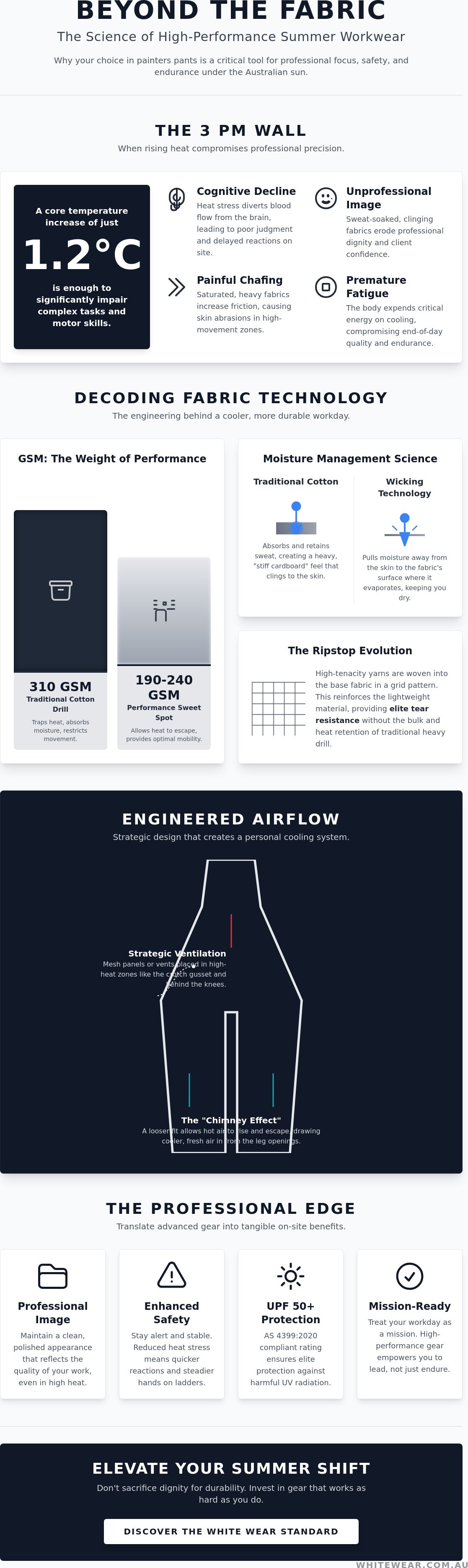
A core temperature increase of just 1.2 degrees is enough to significantly impair complex tasks. Traditional heavy cotton drill often absorbs sweat without releasing it, creating a "stiff cardboard" sensation that restricts movement and adds unnecessary weight. In contrast, modern lightweight painters pants for summer utilize advanced fiber blends to manage the thermal load. Thermal load in professional workwear is the cumulative heat trapped against the skin by fabric weight, weave density, and moisture retention. By reducing this load, you maintain the cognitive sharpness required for intricate cutting-in and flawless spraying.
The Psychology of Professionalism in Extreme Heat
Stepping into a high-end residential foyer covered in sweat stains doesn't just feel unprofessional; it erodes your authority as a master tradesperson. Staying dry and focused allows you to maintain a polished appearance that matches the quality of your work. High-performance gear is an investment in your career longevity. It's the difference between ending the week exhausted and ending it with the energy to lead your team. Choosing refined essentials ensures you remain the protagonist of your professional story, regardless of the temperature.
Decoding Fabric Technology: GSM, Fibre Blends, and Moisture Wicking
GSM isn't just a number on a spec sheet. It's the primary metric for thermal efficiency. In the painting trade, Grams per Square Meter (GSM) determines how much heat your clothing traps against your skin. For decades, the industry standard was a heavy 310 GSM cotton drill. While durable, it acts as an insulator in the Australian sun, turning your workwear into a portable sauna. High-performance lightweight painters pants for summer operate in the 190-240 GSM "sweet spot." This range provides enough density to resist paint bleed while remaining light enough to allow body heat to escape.
The evolution of ripstop technology has changed the professional landscape. By reinforcing a lightweight base fabric with a grid of thicker, high-tenacity yarns, manufacturers achieve high tensile strength without the bulk of traditional drill. This means your gear won't tear on a sharp corner, but it also won't feel like you're wearing a heavy blanket. Materials science has advanced significantly, and following expert advice on cooling fabrics is essential for anyone working in extreme conditions. Modern synthetics and technical blends outperform pure cotton because they don't just breathe; they actively transport moisture away from the skin. They don't get heavy when wet. They don't lose their shape. They work with your body's natural cooling systems.
The GSM Performance Matrix
Selecting the right weight depends on the intensity of your shift and the ambient temperature. Lower weight shouldn't equate to lower quality. It's about engineering a fabric that manages the micro-climate between your skin and the environment. Use the following guide to understand how weight impacts your performance.
| Fabric Weight | Ideal Temperature | Performance Profile |
|---|---|---|
| 310 GSM (Heavy Drill) | 10°C - 18°C | High insulation, slow drying, heavy when wet. |
| 240 GSM (Mid-Weight) | 18°C - 26°C | Balanced protection, moderate airflow. |
| 190-220 GSM (Technical) | 26°C - 40°C+ | Maximum heat dissipation, rapid moisture transport. |
Synthetic Blends and Skin Health
Mobility is a non-negotiable requirement for professional painters. Incorporating elastane into fibre blends creates flexible workwear that moves with you, rather than against you. This elasticity prevents the fabric from catching during deep squats or ladder climbs. Beyond movement, these technical blends protect your skin. Smooth-fibre technology reduces the friction that causes chafing, while rapid-drying properties prevent sweat from sitting against the skin for extended periods. This is a clinical approach to comfort that traditional cotton simply cannot match.
These fabrics are designed to maintain their refined silhouette through hundreds of wash cycles. They don't sag or lose their shape like traditional natural fibres. If you're ready to upgrade your kit, consider exploring professional painters clothing designed for the modern Australian climate. Investing in high-performance textiles is the most direct way to reclaim your dignity on the job site and ensure you stay focused until the final brushstroke.
Ergonomic Architecture: Design Features for Maximum Airflow
Design is as critical as fabric science. When selecting lightweight painters pants for summer, the physical architecture of the garment dictates how effectively your body sheds heat. It isn't just about the weight of the material; it's about the path air takes through the garment during movement. High-performance design prioritizes fluid motion and thermal escape routes. This clinical approach to construction ensures that your clothing acts as a ventilation system rather than a barrier, allowing you to maintain peak performance even when the Australian humidity is at its peak.
A modern silhouette facilitates this by balancing room for movement with a streamlined profile. Baggy, oversized garments are often mistaken for being cooler, but they actually create large pockets of stagnant air that trap heat against the skin. Conversely, a refined, ergonomic fit ensures the fabric stays in close enough proximity to the skin to facilitate moisture wicking while allowing enough space for air to circulate. This synergy between form and function is what separates premium painters clothing from generic utility wear.
The Physics of the Chimney Effect
The "Chimney Effect" is a fundamental principle of garment thermoregulation that many traditional manufacturers overlook. As you move, air is naturally drawn in through the ankle openings and pushed upward toward the waist. This vertical airflow carries heat and moisture away from the lower limbs. For this to work, the fit must be precise. Excessive fabric at the hem or a "choke point" at the knee can disrupt this flow. Articulated knees are essential in this architecture. They prevent the fabric from bunching behind the joint during a climb, which would otherwise create a physical blockade for rising heat and lead to discomfort.
Ventilation and Tool Management
Strategic ventilation zones are the relief valves of high-end workwear. Breathable gussets and mesh inserts in high-heat areas, such as the inner thigh and lower back, accelerate evaporation where it's needed most. While traditional mesh provides a functional solution, laser-cut ventilation offers a more sophisticated, clinical finish that maintains the garment's structural integrity. These micro-perforations allow for targeted cooling without sacrificing the professional look expected on high-end residential sites.
Tool management requires a similar level of restraint. Many designs prioritize an excessive number of pockets, but each layer of fabric and every reinforced tool loop adds bulk that traps heat against the body. A streamlined pocket architecture ensures you have the refined essentials for the job without creating unnecessary thermal barriers. Lightweight, breathable waistbands further this mission by preventing moisture build-up at your core. By reducing bulk in these critical zones, lightweight painters pants for summer allow for maximum heat dissipation, ensuring you stay dry and focused through the most demanding shifts of the season.
The Summer Maintenance Protocol: Longevity and Professional Care
Technical apparel is a high-performance asset. It requires a specific maintenance protocol to ensure the sophisticated engineering behind lightweight painters pants for summer continues to function during grueling shifts. Neglecting care doesn't just shorten the life of the garment; it compromises the very thermoregulation properties you rely on to stay focused. High-performance synthetics and ripstop blends are designed for durability, but they are not indestructible. Proper care preserves the clinical silhouette and technical integrity that defines a modern professional.
A professional rotation is essential for career longevity. Owning at least two pairs of technical pants allows the fibres to fully recover and dry between uses. This practice prevents the permanent breakdown of elastane and ensures the garment maintains its refined shape throughout a high-intensity Australian week. It also ensures you always have a fresh, dry kit ready for 7 AM starts, avoiding the unprofessional discomfort of damp gear.
Sun protection is a legal and health priority on every Australian job site. Under the AS 4399:2020 standard, a UPF 50+ rating signifies that the fabric blocks at least 98% of UV radiation. This protection is a result of both the weave density and technical treatments. However, this barrier degrades if the fabric becomes overly thinned by improper washing or damaged by harsh industrial chemicals. Protecting the weave is a direct investment in your long-term health and safety.
Washing Technical Workwear
Maintaining the breathability of your gear requires a departure from traditional laundry habits. Technical pores can easily become clogged, turning a breathable garment into a heat trap. Follow this three-step process to ensure your gear remains at peak performance:
- Cold Wash Only: Turn garments inside out and use a cold, gentle cycle to protect the outer finish and reflective elements.
- Eliminate Softeners: Never use fabric softeners. These products coat the fibres in a waxy residue that destroys moisture-wicking capabilities and clogs the fabric's "pores."
- Shadow Drying: Air dry your gear in the shade. High heat from tumble dryers is the primary cause of elastane failure, leading to saggy, ill-fitting workwear.
Stain Management and Professionalism
The "White Wear" standard is about more than just tradition; it's a visual indicator of professional precision. Ripstop technology helps localize spills, preventing them from spreading deep into the weave. For water-based paints, immediate rinsing with cold water is often sufficient. Solvent-based spills require targeted treatment with specialized cleaners, but avoid aggressive scrubbing that can fray the lightweight fibres.
Knowing when to retire a pair is a mark of professional dignity. While technical fabrics are rugged, permanent staining or frayed hems eventually compromise your professional image. Maintaining a polished kit is part of your mission as a master tradesperson. If your current gear is showing signs of permanent fatigue, it may be time to invest in new painters clothing that reflects the quality of your work.
The White Wear Standard: Elevating the Australian Summer Shift
White Wear isn't just a label. It's a standard. We've combined the clinical science of thermoregulation with an aesthetic of modern lifestyle elegance to redefine what it means to be a professional in the Australian trade. For the master tradesperson, choosing lightweight painters pants for summer is more than a job-site requirement; it's a signature of professional dignity. It's a commitment to maintaining a polished, clinical presence even when the mercury climbs toward forty degrees. By aligning your gear with the high-end nature of your projects, you transform from a laborer into a specialized consultant.
Our approach is fundamentally different because it is peer-led. We understand the specific duration of a grueling summer shift because we've lived through the 3 PM wall ourselves. This firsthand experience drives the development of every reinforced seam and breathable gusset. When you integrate our technical painters pants into your daily kit, you're adopting a system designed to preserve your cognitive focus and physical endurance. It's about gear that works as hard as you do, ensuring that your performance never falters due to equipment failure.
Aspirational Design for the Modern Trade
High-end residential clients and commercial stakeholders notice the details. A cohesive professional painters uniform establishes immediate authority and justifies the premium pricing you command. It signals a level of precision that generic workwear simply cannot communicate. As we look at the trajectory of painters workwear in 2026, the trend is clear. The most successful professionals are those who invest in a kit that reflects their upward mobility and respect for the craft. Lightweight painters pants for summer provide the technical foundation for this professional evolution, allowing you to win higher-value contracts through a refined first impression.
Join the Professional Evolution
We're building a national community of professionals who refuse to settle for the status quo. Our mission is to support your career longevity by providing the tools you need to survive the physical toll of the industry. We focus on the temporal reality of your workday, grounding our designs in the actual hours you spend on ladders and scaffolding. It's time to move past generic, sweat-soaked options and embrace a technical standard that respects your labor. You deserve better than survival mode. Explore the White Wear summer collection to redefine your professional comfort.
Redefining Your Summer Performance
The Australian summer demands a shift from basic utility to clinical precision. We've explored how technical fabric weights and the physics of the chimney effect work together to protect your cognitive focus and physical endurance. By prioritizing high-performance lightweight painters pants for summer, you're investing in a kit that respects the grueling reality of the 3 PM wall. Maintaining your dignity on the job site is a matter of choosing gear that combines sophisticated aesthetics with peer-led engineering. This is about more than staying cool; it's about preserving the professional standards that define your reputation as a master tradesperson.
You deserve a uniform that performs as well as you do. With our commitment to a sophisticated clinical aesthetic and national Australian shipping, your transition to better workwear is seamless. Upgrade your summer kit with White Wear’s high-performance painters pants. It's time to lead the professional evolution and reclaim your comfort during the most demanding months of the year. You've earned the right to work with authority and ease. Take the next step toward a more refined, high-performance workday today.
Frequently Asked Questions
What is the ideal GSM for lightweight painters pants in Australia?
The ideal GSM for lightweight painters pants for summer in Australia falls between 190 and 240. This specific weight range provides the necessary density to prevent paint bleed while maintaining a high level of thermal dissipation. It's the technical "sweet spot" that allows for rapid moisture transport without sacrificing the structural integrity required on a professional job site.
Are lightweight synthetic pants more durable than heavy cotton drill?
Modern lightweight synthetics, particularly those utilizing ripstop technology, are often more durable than traditional heavy cotton drill. By reinforcing lightweight base fabrics with high-tenacity yarns, these technical blends achieve superior tensile strength and abrasion resistance. They provide a refined, long-lasting solution that avoids the bulk and heat retention of older, rigid materials.
How does the "chimney effect" help keep painters cool?
The chimney effect functions as a natural ventilation system by drawing cooler air in through the leg openings and pushing heat upward toward the waist. This vertical airflow is facilitated by an ergonomic fit that avoids "choke points" at the knees or ankles. It's a fundamental design principle that ensures body heat is continuously exhausted rather than trapped against your skin during movement.
Do lightweight painters pants provide adequate UV protection?
High-quality lightweight painters pants for summer provide excellent UV protection when engineered to the AS 4399:2020 standard. Many premium technical fabrics achieve a UPF 50+ rating, which blocks at least 98% of harmful UV radiation. This protection is achieved through specialized weave construction rather than fabric thickness, ensuring you stay safe without the weight of traditional gear.
Can I get paint out of technical lightweight fabrics easily?
Paint removal is often more efficient on technical lightweight fabrics because the smooth, non-porous fibres prevent spills from soaking deep into the weave. Water-based paints can usually be rinsed away with cold water if treated immediately. For solvent-based spills, the ripstop structure localizes the damage, though you should always use cleaners that won't degrade the technical finish of the garment.
How often should I rotate my summer workwear to prevent wear?
You should rotate your summer workwear every 24 hours to allow the technical fibres and elastane to fully recover. Maintaining a professional rotation between at least two pairs prevents permanent sagging and ensures moisture-wicking properties remain effective. This practice is essential for preserving the clinical silhouette and long-term durability of your kit during high-intensity Australian work weeks.
Are flexible painters pants better for summer than rigid styles?
Flexible painters pants are superior for summer because they incorporate elastane to provide unrestricted movement during ladder climbs and deep squats. Rigid styles often catch on the skin when damp with sweat, leading to discomfort and restricted airflow. A flexible, ergonomic design ensures the fabric moves with you, maintaining the chimney effect and preventing heat traps from forming in bunched material.
What features should I look for to prevent chafing during a long shift?
To prevent chafing during a long shift, look for smooth-fibre technology and breathable, seamless gussets in high-friction zones. Rapid moisture transport is the most critical feature, as it keeps the skin dry and reduces the friction caused by sweat-soaked fabric. Choosing a refined fit that minimizes excess material also prevents the repetitive rubbing that leads to painful skin abrasions.


