


Your work boots are a significant investment in your safety, but they're only as effective as the layer between your skin and the leather. For a professional, a sock is a technical tool rather than a mere accessory. Finding the best socks for painters in work boots is the most direct way to bridge the gap between your body and your equipment to ensure long-term endurance.
We understand the physical toll of a standard ten hour shift. You've likely dealt with the sharp pressure of ladder rungs against your arches or the burning friction of a heavy boot during repetitive cutting-in. It's exhausting when damp, sweaty feet lead to mid-shift discomfort and the premature degradation of your premium footwear. You deserve a solution that works as hard as you do and reflects the pride you take in your trade.
This guide reveals how the right technical socks transform your workday by protecting your feet from the rigors of ladder work and long shifts. We'll explore the science of moisture-wicking materials and strategic cushioning that keep you comfortable until the final cleanup. Discover how to maintain a professional look that matches your white workwear while extending the life of your boots.
Key Takeaways
- Understand why technical socks are a vital professional tool for managing the physical strain of long shifts on ladders and scaffolding.
- Learn how to evaluate material blends like Merino wool and bamboo to identify the best socks for painters in work boots for year-round thermoregulation.
- Identify the specific anatomical cushioning and reinforced support features required to protect your arches and heels during repetitive movements.
- Discover how to preserve the integrity of your professional look by selecting socks that prevent dye migration and staining on your white workwear.
- Shift your perspective from basic utility to an elevated workwear philosophy that prioritizes dignity and comfort during grueling hours of labor.
The Foundation of the Shift: Why Painters Need Specialised Boot Socks
A professional painter's wardrobe is more than a uniform; it is a high-performance toolkit. While much attention is paid to the quality of brushes or the durability of trousers, the technical interface between your foot and your boot is often overlooked. Finding the best socks for painters in work boots is about more than avoiding a hole in the toe; it's about preserving your most valuable asset. Your feet carry the weight of your career, and they deserve better than the status quo of generic hosiery.
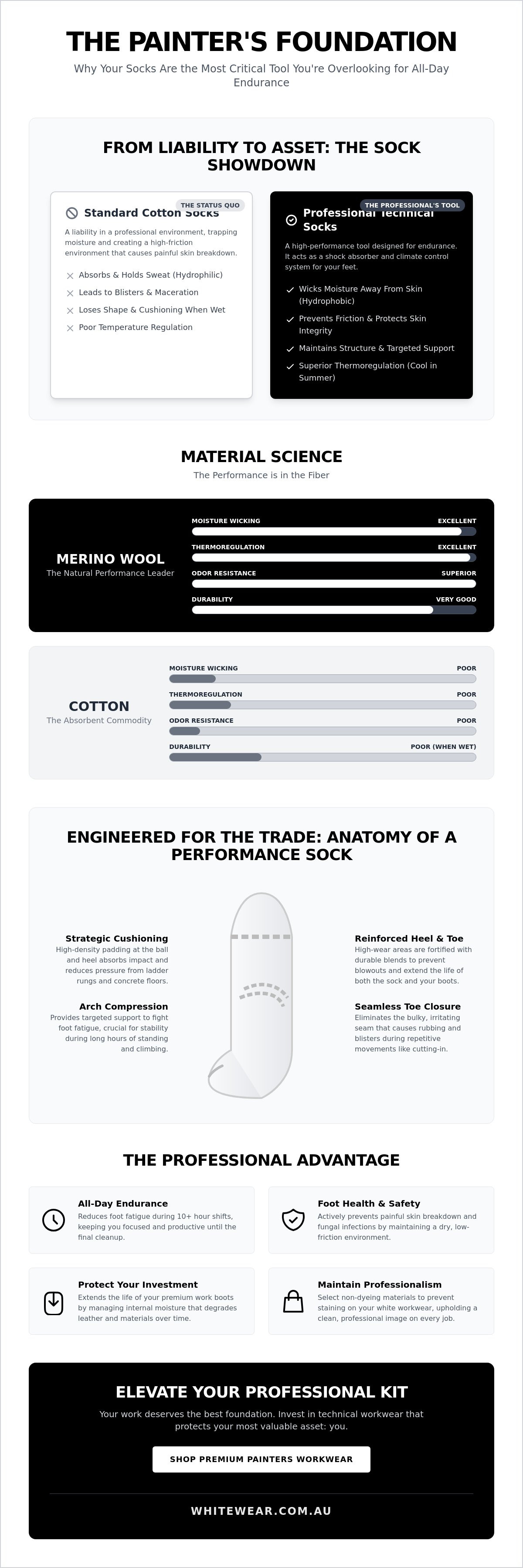
The physical toll of a ten hour shift is relentless. Whether you're standing on uncompromising concrete, balancing on narrow ladder rungs, or navigating scaffolding, the mechanical stress on your lower limbs is constant. Standard cotton socks are a liability in this environment. Cotton is inherently hydrophilic; it absorbs moisture and holds it against your skin. This creates a damp, high-friction environment that leads to blisters and fatigue. A professional grade sock acts as a shock absorber and a climate control system, ensuring that your focus remains on the finish of the wall rather than the ache in your arches.
The Painter’s Foot Environment: Heat, Humidity, and Friction
Inside a leather work boot during an Australian summer, the micro-climate can reach extreme levels of heat and humidity. This moisture is exacerbated by the repetitive climbing and descending of ladders, which creates unique friction points at the heel and the ball of the foot. Without a technical barrier, this combination of heat and movement causes skin breakdown. Maceration occurs when skin is in constant contact with moisture, causing it to become soft, white, and fragile, which leads to painful breakdown and susceptibility to infection. Protecting yourself against these conditions is essential for professional longevity and daily productivity.
Beyond the Basic: The Evolution of Trade-Specific Hosiery
We've seen a significant shift from basic utility to high-performance textiles in the modern workplace. Modern innovations in sock materials and construction have moved beyond simple fibers to create technical barriers against the elements. Wearing gear designed specifically for your craft provides a psychological edge, reinforcing the dignity of your labor. These refined essentials do more than provide comfort; they protect the significant investment you've made in your professional work boots. This is why the best socks for painters in work boots prioritize moisture management and impact protection, allowing you to end your shift with the same confidence you had at the start.
Material Science: Finding the Optimal Blend for Australian Painters
Excellence in the trade starts from the ground up. Selecting the best socks for painters in work boots requires an understanding of how specific fibers interact with your skin under pressure. While OSHA foot protection standards define the external safety requirements for your footwear, your internal comfort is dictated by material science. The goal is a sophisticated balance of thermoregulation, moisture management, and durability.
The distinction between moisture-wicking and moisture-absorbing is critical. Cotton is an absorbent fiber; it pulls sweat into its core and holds it there, creating a heavy, damp environment that leads to friction blisters. Technical fibers and high-end natural wools are hydrophobic. They move moisture vapor away from the skin before it can condense into liquid. This process keeps your feet dry and eliminates the bacterial growth responsible for end of shift boot odour. Investing in professional painters clothing and technical hosiery ensures you maintain your dignity and performance throughout the longest days.
Merino Wool: The Natural Performance Leader
Merino wool is the gold standard for professional tradespeople. Its molecular structure features a keratin protein that naturally resists bacteria, making it inherently antimicrobial. It's a common misconception that wool is only for winter. In reality, Merino is a master of thermoregulation; it keeps your feet cool in the Australian summer by facilitating evaporative cooling. For the painting trade, durability is paramount. Look for a blend of approximately 75% Merino wool and 25% nylon. This combination provides the moisture management of wool with the structural integrity of a synthetic, ensuring your socks won't thin out at the heel after a few weeks of ladder work.
Bamboo and Coolmax: Alternatives for Extreme Heat
Bamboo has emerged as a premium alternative for painters with sensitive skin. Its fibers are exceptionally smooth, reducing the risk of contact dermatitis during high-intensity shifts. Bamboo is highly absorbent, which feels cool against the skin, though it works best when paired with a breathable boot to allow for moisture release. Conversely, technical synthetics like Coolmax use specially engineered four-channel fibers to pull sweat away from the skin with clinical efficiency. These materials accelerate evaporation, which is essential when working in poorly ventilated interior spaces or under the direct sun.
| Material | Moisture Strategy | Odour Resistance | Best Environment |
|---|---|---|---|
| Merino Wool | Wicks vapor efficiently | Superior (Natural) | All-season / High-intensity |
| Bamboo | High absorbency | Good (Antibacterial) | Sensitive skin / Humid heat |
| Cotton | Traps liquid sweat | Poor (Retains bacteria) | Not recommended for boots |
Engineering for the Trade: Essential Features for Ladder and Scaffold Work
The efficiency of your workday is often dictated by the structural integrity of your gear. While material choice is the first step, the engineering of the garment determines its ultimate success in the field. For the professional tradesperson, "one-size-fits-all" is a liability rather than a convenience. A sock that's too large will inevitably bunch inside the boot, creating pressure points that lead to dermal irritation and lost productivity. The best socks for painters in work boots utilize technical knitting techniques to provide a secure, anatomical fit that mirrors the contours of the foot, ensuring the fabric moves with you, not against you.
Compression is a vital component of this engineering. By applying graduated pressure to the lower limb, technical hosiery facilitates blood flow and reduces the swelling often associated with standing on unforgiving surfaces for eight to ten hours. This focus on occupational foot health and safety is what separates a refined essential from a generic utility item. When your legs feel lighter at the end of a grueling shift, you've experienced the value of trade-specific design. High-performance construction ensures that the sock remains in place, preventing the heel from sliding down and causing the friction that leads to painful hotspots.
Zoned Cushioning for Ladder Stability
Painters face a unique physical challenge: the concentrated pressure of ladder rungs. Standing on a narrow metal bar for extended periods places immense strain on the plantar fascia, which can lead to chronic inflammation. Premium hosiery mitigates this through strategically placed Terry loops under the ball and heel of the foot. This high-density cushioning acts as a shock absorber between your arch and the ladder. Integrated arch support provides a gentle lift that maintains the foot's natural alignment, significantly reducing the risk of plantar fasciitis during repetitive climbing tasks.
Seamless Toes and Reinforced Impact Zones
The interaction between a sock and a steel-capped boot is a frequent source of irritation. Traditional socks feature a bulky seam across the toes that can rub against the rigid interior of safety footwear, causing painful abrasions. A "True Seamless" toe construction eliminates this ridge entirely, providing a smooth interface that's essential for all-day comfort. To ensure longevity, reinforcement is applied to the Achilles and the toe box, matching the specific wear patterns of painters who spend hours crouching and reaching. Integrated mesh ventilation panels are then engineered into the top of the foot to facilitate airflow where heat buildup is most intense.
The Aesthetic and Functional Harmony: Socks and White Workwear
A professional painter's presentation is a silent resume. When you arrive at a high-end residential site, your appearance communicates your attention to detail before you even open a tin of paint. Maintaining the 'White Wear' standard is about more than just avoiding paint splatters; it's about the cohesion of your entire kit. The best socks for painters in work boots are those that support this aesthetic while providing technical performance. A mismatched or poorly fitted sock can disrupt the crisp, professional silhouette that clients associate with top-tier craftsmanship and refined expertise.
Preventing Dye Migration and Bleed
Dye migration is a common but preventable frustration for those dedicated to the white uniform. Cheap, low-quality socks often use reactive dyes that bleed when exposed to the high-heat, high-moisture environment inside a leather boot. The chemistry of sweat, containing urea and salts, can break down these unstable pigments, causing them to leach into the surrounding fabric. This leads to unsightly grey or black staining on the inner ankles of your trousers. Choosing colour-fast technical socks that respect your painters workwear is essential for maintaining a pristine look. To preserve your whites, always wash your technical socks in a separate cycle or use a laundry bag to prevent stray fibers from dulling your bright white trousers over time.
Length and Fit: The Professional Profile
Sock height is a functional choice with aesthetic consequences. Crew-length socks are typically the optimal choice for mid-height professional boots, providing enough coverage to prevent the boot collar from rubbing against the calf. A 'no-slouch' fit is non-negotiable for the modern tradesperson. Finding the best socks for painters in work boots means looking for high-rebound elastics that maintain their position throughout a ten hour shift. Socks that slide down during the day create a messy appearance and cause the fabric to bunch around the ankle, leading to discomfort. This attention to detail should extend across your entire wardrobe, as discussed in our guide on painters pants, to ensure a seamless transition from boot to waist.
Refining these details transforms a standard uniform into a statement of professional intent. When every element of your attire is purposeful, you project a level of authority that builds immediate trust with discerning clients. You aren't just wearing clothes; you're wearing a system designed for excellence. Explore our full range of painters clothing to complete your professional kit with gear that matches your standards for dignity and performance.
Elevating the Professional: Completing Your White Wear Kit
The philosophy of elevated workwear centers on the belief that a tradesperson’s dignity is directly linked to the quality of their equipment. We don't view a sock as a consumable item to be replaced every few weeks. Instead, we see it as a refined essential that completes the professional system. By focusing on the subtle details of your daily life, you transition from a mindset of basic utility to one of professional investment. Choosing the best socks for painters in work boots is the final step in curating a wardrobe that prioritizes your health, comfort, and performance over the long term.
The Peer-Led Design Difference
Our commitment to excellence is rooted in firsthand experience. White Wear products are developed by painters, for painters. We understand that the Australian site environment is an unforgiving testing ground where generic apparel often fails within the first few months. By utilizing premium materials that stand up to the rigours of ten hour shifts, we ensure that every piece of gear serves a decisive purpose. This peer-led approach means our designs account for the small but critical realities of the trade, such as the specific way a boot interacts with the shin during a full day of interior cutting-in. It's about providing a high-performance solution that respects the demands of your craft.
Maintenance for Longevity
Technical hosiery requires a level of care that reflects its sophisticated construction. Ensuring your gear lasts as long as your painters overalls requires a disciplined approach to maintenance. When washing technical wool and bamboo blends, always use a cold, gentle cycle. Never use fabric softeners. These chemicals coat the fibers and clog the microscopic pores of the fabric, effectively destroying the moisture-wicking properties you rely on for comfort. We also recommend the 'two-pair' rule: rotate your socks daily. This allows the fibers to fully recover their shape and ensures the moisture trapped in your boot soles has time to evaporate, significantly extending the life of your footwear.
Your morning ritual sets the tone for your daily performance. Before you head to the site, ensure your kit is prepared to support your goals. A professional's checklist should include:
- Inspecting your technical socks for any signs of thinning at the pressure points.
- Ensuring your boots are clear of debris that could cause friction against the fabric.
- Confirming your socks are pulled taut to prevent bunching during ladder work.
- Matching your hosiery to your white workwear to maintain a polished, cohesive silhouette.
When you invest in the best socks for painters in work boots, you're not just buying clothing. You're securing your ability to work with precision and comfort until the final brushstroke is complete. It's a commitment to your trade that pays dividends in every step you take.
Master Your Shift with Refined Essentials
The transition from a standard workday to a high-performance career begins with the details you choose to prioritize. You've seen how the best socks for painters in work boots combine advanced material science with trade-specific engineering to protect your physical longevity. By selecting technical blends like Merino wool and ensuring targeted cushioning for ladder stability, you're investing in your endurance. These aren't just utility items; they're the foundation of a professional system that respects the grueling hours you spend on site.
A polished appearance and all-day comfort shouldn't be mutually exclusive. Our peer-led development process ensures that every garment meets the specific demands of the Australian painting trade. We take pride in creating gear that provides dignity while standing up to the rigours of professional boots. Whether you're navigating scaffolding or meeting with high-end clients, your kit should reflect your expertise. Explore the White Wear Collection of Professional Apparel today. We offer Australia-wide shipping on all our gear, designed by professional painters for maximum site performance. Step into your next shift with the confidence that your equipment is as dedicated as you are.
Frequently Asked Questions
What are the best materials for work socks to prevent sweaty feet?
Merino wool and bamboo are the gold standard for moisture management on the job site. These fibers are hydrophobic, meaning they pull moisture vapor away from your skin before it condenses into liquid. This process keeps your feet dry and prevents the bacterial growth responsible for end of shift odor. Avoid cotton at all costs, as it absorbs liquid and holds it against your skin, leading to discomfort and blisters.
Do painters need specific socks for standing on ladders all day?
Painters require high-density zoned cushioning to mitigate the concentrated pressure of ladder rungs. Standing on narrow metal bars for extended periods places immense strain on the arches and plantar fascia. Technical socks with reinforced Terry loops under the ball and heel act as vital shock absorbers. This specific engineering protects your feet from chronic fatigue and ensures you maintain your focus on the finish of your work.
How do I prevent my dark work socks from staining my white painters pants?
Select colour-fast technical blends that use stable pigments rather than cheap reactive dyes. Low-quality socks often leach color when exposed to the heat and sweat generated inside a leather boot. This dye migration causes grey or black staining on the ankles of your white workwear. Using a laundry bag and avoiding high-heat drying cycles will also help preserve the pristine look of your professional uniform throughout the work week.
Are Merino wool socks too hot for Australian summers?
Merino wool is an exceptional choice for the Australian summer due to its natural thermoregulating properties. Unlike thick traditional wool, fine Merino facilitates evaporative cooling by moving heat away from the skin. This keeps your feet significantly cooler than synthetic alternatives. It's a key feature in the best socks for painters in work boots, providing year-round comfort regardless of the temperature on the site.
How often should a professional painter replace their work socks?
We recommend refreshing your technical hosiery every six to twelve months to ensure maximum performance. Over time, the structural fibers and elastic components begin to degrade, reducing the effectiveness of the arch support and cushioning. If you notice the fabric thinning at the heel or the socks sliding down during your shift, it's time to invest in a new set of refined essentials to protect your long-term foot health.
What is the best sock height for standard work boots?
Crew-length is the preferred height for the modern professional. This height provides a secure barrier between your skin and the boot collar, preventing the painful friction and chafing often caused by heavy leather footwear. A well-fitted crew sock also maintains a crisp, cohesive line with your trousers, ensuring you project an image of authority and attention to detail while working on high-end residential or commercial sites.
Do compression socks actually help with leg fatigue during long painting shifts?
Graduated compression is a clinically effective tool for reducing the leg fatigue associated with long shifts on concrete or scaffolding. By applying gentle pressure to the lower limbs, these socks facilitate blood flow and prevent the swelling caused by gravity during ten hour shifts. This technical support helps your legs feel energized and lighter, allowing you to maintain your productivity from the first coat to the final touch-up.
Can the wrong socks cause my work boots to wear out faster?
Poorly chosen hosiery can significantly shorten the lifespan of your professional boots. When you use the best socks for painters in work boots, you ensure that moisture is effectively wicked away rather than being absorbed into the boot's internal lining. Excess dampness from cotton socks can cause leather to rot and internal seams to fail prematurely. High-quality technical socks protect your footwear investment by maintaining a dry, stable internal environment.


