


What if the logistical nightmare of outfitting a dozen new painters felt less like a chaotic scramble and more like a refined, automated process? For many Australian trade business owners, the reality is far messier. You likely spend hours tracking individual crew sizes on spreadsheets, only to have a new apprentice show up on site without the right gear. Learning how to build a workwear purchasing system for a growing team is no longer just a luxury for the elite; it's a fundamental requirement for maintaining your professional dignity and operational flow.
We understand that inconsistent brand presentation across different job sites erodes the professional authority you've worked so hard to build. It's frustrating to watch administrative hours vanish into clothing requests while stockouts delay your onboarding timelines. This guide will show you how to design a seamless, scalable apparel pipeline that eliminates onboarding friction and reduces procurement overhead. We'll walk through the repeatable framework needed to transform your workwear from a recurring headache into a polished, unified corporate identity that projects elite authority on every project.
Key Takeaways
- Identify the operational tipping point where manual apparel tracking shifts from a minor chore to a significant financial drain on your trade business.
- Learn how to build a workwear purchasing system for a growing team by establishing a centralized sizing registry and fixed annual garment quotas for predictable budgeting.
- Evaluate the efficiency of modern, employee-led procurement models against traditional centralized systems to determine which best reduces your administrative overhead.
- Map a complete procurement pipeline with explicit lead-time expectations to ensure new starters have high-performance gear ready before their first day on site.
- Elevate your professional authority by partnering with a national supplier that integrates premium painters workwear into a streamlined, scalable commercial system.
The Scaling Dilemma: Why Chaotic Workwear Ordering Stalls Team Growth
Growth is the goal, but it often carries a heavy administrative tax. When your crew was small, a quick text to check a shirt size was a minor chore. As you scale, that informal approach transforms into a significant operational bottleneck. Understanding how to build a workwear purchasing system for a growing team is no longer optional for the modern Australian trade leader. It's the foundation of a scalable business. The tipping point usually occurs when you realize your management team is spending more time on apparel logistics than on project oversight.
The Hidden Costs of Disorganised Trade Apparel Procurement
The financial drain of ad-hoc ordering is often invisible until it's too late. Administrative hours vanish when you're forced to chase crew members for sizing information before a major project kick-off. These delays aren't just annoying; they're expensive. Holding unallocated, incorrect inventory ties up company working capital that could be better spent on equipment or marketing. In the Australian market, where shipping costs and logistics are significant factors, the price of returns for incorrect fits adds up quickly. Most importantly, delayed apparel arrivals stall new starters. A new apprentice sitting at home because their gear hasn't arrived represents a direct hit to your project delivery timelines. Implementing a structured procurement process eliminates these friction points before they stall your momentum.
Aligning Brand Dignity with Operational Efficiency
Your team's appearance is a direct reflection of your company's standards. Premium, clean painters workwear acts as a moving billboard, projecting an image of elite professional authority to clients and competitors alike. There's a psychological cost to mismatched, substandard clothing. Providing refined essentials designed for the physical reality of the workday restores dignity to the crew during grueling hours of labor. This isn't just about aesthetics; it's about commercial leverage. Elite presentation allows you to command higher rates in premium commercial painting tenders. A unified team projects a sense of reliability and purpose that justifies a higher price point. When you treat apparel as a core component of employee retention, you build a culture of professional pride that makes your business the preferred choice for both talent and clients.
Establishing Your Core Workwear Allocation Framework and Sizing Matrix
Tiering is essential for a refined operation. A field painter's requirements differ significantly from a project manager's. While field staff need high-durability fabrics, managers might require polished, site-ready apparel that balances utility with a professional aesthetic. Incorporate seasonal rotation schedules into this architecture. By planning for winter layers and breathable summer essentials ahead of time, you ensure year-round operational comfort. This approach aligns with broader responsibilities regarding personal protective equipment (PPE), ensuring that every item serves a specific functional purpose on site.
Defining Allocation Rules per Painter for Maximum Longevity
A robust system begins with a baseline initial kit for new starters. This should include heavy-duty trousers and breathable shirts designed for high-intensity labor. Beyond the initial kit, outline an ongoing top-up schedule. Trade materials like paint and solvent inevitably degrade garments; a scheduled replacement every six months maintains professional standards. For businesses looking to extend their presentation beyond daily workwear into branded merchandise that functions as mobile advertising, discover KP Innovations. An effective allocation quota framework balances the upfront investment against the expected garment lifespan, ensuring your team always looks elite without unnecessary waste.
Creating a Standardised Sizing and Fit Protocol
Varying fits are a common procurement hurdle. Utilizing standardized trade sizing charts within your registry eliminates the guesswork that leads to returns. Inclusivity is also a marker of a sophisticated operation. Ensure your system accounts for diverse crew demographics by integrating specialized cuts, such as womens work wear, which provides the correct fit for female tradespeople. Finally, implement a rapid size validation protocol during onboarding. Verifying measurements on day one prevents return shipping delays and ensures your new hires are site-ready immediately. To see how these refined essentials look in practice, you can explore the full range at White Wear.
Procurement Models: Centralised vs. Employee-Led Purchasing Systems
Deciding how to build a workwear purchasing system for a growing team often involves a strategic choice between absolute control and delegated autonomy. The model you select dictates your administrative burden and the speed at which your crew is outfitted. For smaller enterprises, a centralised approach provides a tight grip on every dollar spent. However, as your roster expands across the country, the friction of manual management can become a significant drag on your operational efficiency.
The Case for Centralised Inventory Management
Traditional models rely on management controlling every aspect of selection and dispatch. This approach excels at securing volume discounts. By purchasing bulk painters uniforms for company branding upfront, you reduce the per-unit cost significantly. Centralisation also guarantees absolute brand consistency. You know exactly what your team is wearing on every commercial job site because you dispatched it yourself. The trade-off is the internal logistics burden. Maintaining a company "uniform cage" requires dedicated storage space and staff hours to pack and ship individual orders. For firms with a single headquarters, this control is often worth the effort; for national operations, it frequently becomes a bottleneck.
Transitioning to Managed Corporate Portals
Choosing Your Model: A Decision Matrix
- Centralised Model: Best for teams under 15 where storage is available and brand control is the primary concern.
- Employee-Led Model: Ideal for rapidly scaling firms with 20+ staff who want to eliminate administrative overhead and empower their tradespeople.
- Hybrid Model: Useful during seasonal shifts, where bulk orders are centralised for peak periods while top-ups remain employee-led.
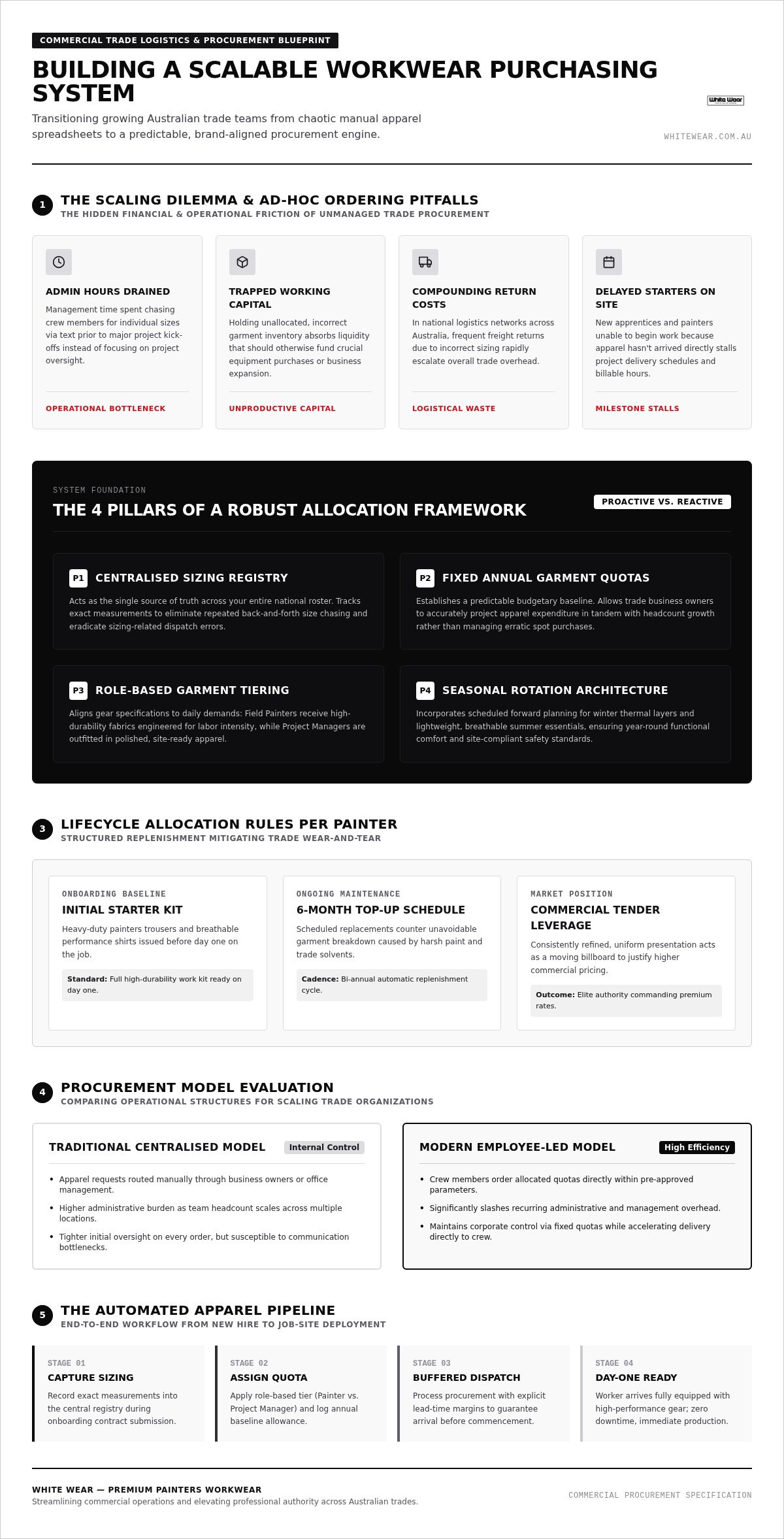
Implementing Your Automated Workwear Pipeline: A Step-by-Step Blueprint
Moving from theory to execution requires a precise process map. When considering how to build a workwear purchasing system for a growing team, you must visualize the journey from a newly identified garment need to final on-site delivery. This pipeline should be frictionless, moving swiftly from requisition to dispatch without manual intervention. Start by establishing explicit lead-time expectations across your supply chain. If you wait until the first heatwave to order breathable gear, you've already lost the battle against operational friction. Instead, design an onboarding workflow that automatically triggers apparel production the moment an employment contract is signed. This ensures a new starter arrives on day one with a full kit, projecting authority rather than looking like an afterthought. Finally, integrate feedback loops. Your field staff are the ultimate stress-testers; their reports on garment utility under real-world conditions are the clinical data points that drive your system's refinement. By treating your team as peer-partners in the design process, you ensure the system evolves with the task.
Forecasting Seasonal Demand Across Australian Climates
Australia's diverse climate demands strategic foresight. You must plan procurement cycles at least eight weeks ahead of intense summer conditions to secure lightweight, highly breathable apparel that protects your crew from heat stress. Similarly, a winter transition timeline ensures your crews receive protective layers before the cold sets in nationally. Proactive seasonal ordering prevents stockout friction during peak trade periods by aligning procurement volumes with regional weather forecasts and historical project surges. This level of planning ensures that your team remains comfortable and productive, regardless of the external environment.
Establishing Quality Control and Replacement Triggers
A premium brand identity requires uncompromised standards. You must define objective criteria for garment retirement, focusing on fabric wear, safety compliance, and aesthetic presentation. If a shirt is permanently stained or a pair of trousers loses its structural integrity, it must be replaced immediately to maintain professional dignity. Create a simplified digital submission process where crew members can request replacements for damaged painters pants directly from their mobile devices while on site. Regular quality audits then serve to verify that every field team member meets your high-end corporate presentation standards. These audits shouldn't be punitive; they're a supportive mechanism to ensure every tradesperson has the tools they deserve. Implementing these triggers is a core part of how to build a workwear purchasing system for a growing team that maintains its polish over time.
Partner with White Wear to automate your team procurement.
Streamlining Commercial Operations with Premium White Wear Procurement Solutions
Scaling a trade business requires more than just skilled labour; it demands an infrastructure that supports your ambition. White Wear stands as the premier national partner for Australian painting and asset maintenance enterprises looking to modernise their operations. We understand that how to build a workwear purchasing system for a growing team is a question of both logistics and brand identity. By aligning with a supplier that prioritises clinical trade authority alongside modern lifestyle elegance, you transform a utility expense into a strategic asset. Our refined essentials are engineered to provide dignity and comfort during the most grueling hours of labour, ensuring your crew feels as elite as the work they produce.
Premium Commercial Support for Expanding Painting Crews
Growth often leads to geographic fragmentation, but your brand presentation must remain unified. We've built a national distribution infrastructure designed for rapid commercial dispatch to any job site across Australia. This ensures that whether your team is working on a high-rise in the city or a commercial facility in the suburbs, their appearance remains consistent. Our peer-led design process focuses on durable fabric innovation, specifically engineered to withstand the demanding realities of professional painting applications. These aren't generic garments; they're high-performance tools designed for the trade. Providing your crew with sophisticated, well-fitted apparel isn't just about looks. It's about providing the comfort and professional pride required to sustain high-intensity workdays.
Seamless Logistics and Reliable National Distribution
Operational efficiency is the heartbeat of a successful trade firm. White Wear simplifies the bulk ordering process to eliminate the administrative friction that often plagues operations managers. We've committed to a reliable supply chain that ensures your growing team remains consistently outfitted without delay. Implementing a reliable supply partner is the final step in mastering how to build a workwear purchasing system for a growing team that delivers long-term results. We invite trade directors to establish a commercial relationship that prioritises long-term reliability over transactional convenience. This proactive approach to system optimisation ensures that as your headcount rises, your overhead doesn't follow suit. Ready to transition away from chaotic ordering? Discover how to elevate your crew's presentation by partnering with White Wear.
Future-Proof Your Trade Identity with Systematic Procurement
Scaling your business shouldn't mean sacrificing your professional standards or your administrative sanity. By moving away from reactive ordering and establishing a structured framework, you protect your working capital and your crew's dignity. You've learned how to build a workwear purchasing system for a growing team that prioritizes efficiency through clear allocation rules and automated pipelines. This strategic shift ensures your brand remains a moving billboard for quality, even as you expand across the country.
White Wear provides the high-performance foundation your enterprise needs to thrive. Our peer-led design process is engineered specifically for professional Australian painting operations. We combine a premium aesthetic with heavy-duty structural durability, supported by a reliable national distribution network optimized for commercial trade crews. You deserve a supply partner that understands the science of the task and the human desire for a polished appearance.
Build your scalable trade apparel system with White Wear today. It's time to equip your team with the refined essentials they deserve and lead your market with uncompromised authority.
Frequently Asked Questions
What is the most efficient way to track uniform sizes for a rapidly growing trade team?
A centralized, digital sizing registry is the most effective solution for expanding crews. Instead of relying on fragmented spreadsheets, use a managed portal where measurements are updated in real-time by the staff themselves. This eliminates sizing errors and costly return shipping fees. It's a foundational step in learning how to build a workwear purchasing system for a growing team, ensuring every order is accurate from the first day on site.
How many sets of workwear should be allocated to a new painter upon onboarding?
A standard initial allocation usually consists of five sets of breathable shirts and three pairs of heavy-duty trousers. This ratio allows for a full work week rotation while accounting for laundering time. Providing a complete kit on day one ensures the new starter feels like a professional peer immediately. It also projects an image of elite authority to your clients from the very first project kick-off.
What are the benefits of a centralized workwear purchasing system compared to ad-hoc ordering?
Centralized systems offer predictable budgeting and absolute brand consistency across all Australian job sites. Ad-hoc ordering often leads to inconsistent presentation and hidden costs like multiple shipping fees. A structured system reduces administrative overhead and transforms apparel from a chaotic expense into a streamlined operational asset. This approach supports your long-term growth strategy by ensuring your team always reflects your company's high standards.
How often should a professional painting company replace field crew uniforms?
Professional painting companies should typically replace field crew uniforms every six to twelve months. Daily exposure to harsh trade materials like solvents and acrylics inevitably degrades fabric integrity and aesthetic polish. Monitoring wear and tear ensures your team maintains a refined, unified corporate identity. Regular replacement cycles prevent a tattered appearance from undermining your professional authority during high-stakes commercial tenders or client meetings.
Can an automated workwear system accommodate specialized clothing options for female painters?
Modern automated systems easily integrate gender-specific cuts to ensure a proper fit for every crew member. Using a system that includes specialized womens work wear is essential for compliance with modern fit regulations and individual crew comfort. This inclusive approach avoids the outdated "one-size-fits-most" model. It provides the dignity and mobility required for grueling hours of labor while maintaining a sophisticated, professional silhouette on site.
How do seasonal climate shifts across Australia impact workwear procurement cycles?
Australia's diverse climate requires procurement cycles to be planned at least eight weeks in advance of seasonal changes. You must secure lightweight, breathable gear before intense summer heatwaves and protective layers before winter sets in nationally. Proactive ordering prevents stockout friction during peak trade periods. This foresight ensures your team remains comfortable and productive regardless of the local weather conditions they face during their workday.
What features should an operations manager look for in a commercial workwear supply partner?
Look for a partner with a national distribution infrastructure and a peer-led design process. They should offer high-performance fabrics engineered for the trade and a streamlined portal for bulk ordering. A reliable partner like White Wear provides the clinical trade authority needed to manage complex rosters. Ensure they prioritize both structural durability and a premium aesthetic to elevate your team's professional presentation and operational efficiency.


