


A static sizing tag will never reveal how clothing performs when someone is reaching, bending, and kneeling across a demanding ten-hour shift. If you are outfitting a full crew, mastering how to measure your team for a bulk uniform order requires focusing on functional movement rather than relying on off-the-rack retail guesswork. Every trade leader dreads passing around a generic clipboard, only to watch team members hazard guesses based on high-street brands that fit completely differently on site.
You already know the headache that follows: costly restocking fees, wasted hours managing exchanges, and frustrated workers wearing gear that binds during active physical tasks. With the right protocol, you can measure each crew member in minutes, comfortably accommodate diverse body types across both male and female staff, and eliminate sizing returns entirely. Here is your definitive blueprint for measuring your workforce with clinical precision before placing your next bulk order.
Key Takeaways
- Understand the operational cost of retail tag guesswork, protecting your bottom line from restocking fees and delayed project launches.
- Master the precise five-step protocol on how to measure your team for a bulk uniform order using consistent, soft-tape anatomical benchmarks.
- Factor in dynamic garment ease so painters clothing accommodates bending, reaching, and kneeling across demanding shifts without binding.
- Establish a streamlined internal sizing process with a designated lead to capture reliable data across diverse crew members in minutes.
- Utilise the Australian trade size curve and strategic inventory buffers to outfit new hires seamlessly without placing disruptive reorders.
The True Cost of Sizing Errors in Bulk Uniform Ordering
A crew's workwear functions as essential equipment, not generic merchandise. When bulk deliveries arrive with sleeves that pull tight across the lats or waistbands that pinch during a low squat, progress halts on site. Sizing miscalculations derail scheduled handovers, leaving painters working in faded personal gear while replacement shipments clear. True trade fit strikes an exacting balance between crisp presentation and daily ergonomic freedom; failing to reach it quietly inflates budgets through administrative drag.
Financial and Operational Impact of Uniform Misfits
Coordinating apparel exchanges drains productive project hours. Supervisors spend valuable mornings cataloguing mismatched garments, repacking boxes, and managing courier logistics rather than directing crews on site. The financial risk escalates sharply with customisation: once company branding or trade insignia is applied to specialised painters workwear, miscalculated pieces become permanent, non-refundable inventory losses. As custom apparel specialists like A1 Promotions Ltd. emphasize, decorated garments cannot be returned or restocked once branded, making preliminary accuracy vital.
The operational cost extends directly into shift performance. When trade garments restrict arm elevation or bind at the knee during repetitive prep work, workers face unnecessary fatigue and diminished focus. Poor fit doesn't just look sloppy to high-end residential and commercial clients; it chips away at crew stamina and morale throughout a grueling workday.
Why Worker Self-Reporting Almost Always Fails
Circulating a clipboard across the workshop floor invites costly errors. Modern retail sizing varies wildly between consumer brands, leading employees to assume their casual clothing size translates directly into functional apparel. As documented in the evolution of U.S. standard clothing sizes, the shift away from uniform sizing standards left commercial brands to define dimensions arbitrarily, creating profound variations across labels.
Left to their own devices, crew members tend to report aspirational sizes or reference stretchy weekend garments. They rarely account for the structural durability required in specialised painters clothing, which demands adequate room for constant bending and kneeling. Mastering how to measure your team for a bulk uniform order requires eliminating individual guesswork entirely. Establishing a disciplined, calibrated measuring standard across your entire workforce protects your apparel investment and guarantees an exacting fit on delivery day.
Step-by-Step: How to Measure Your Team for a Bulk Order
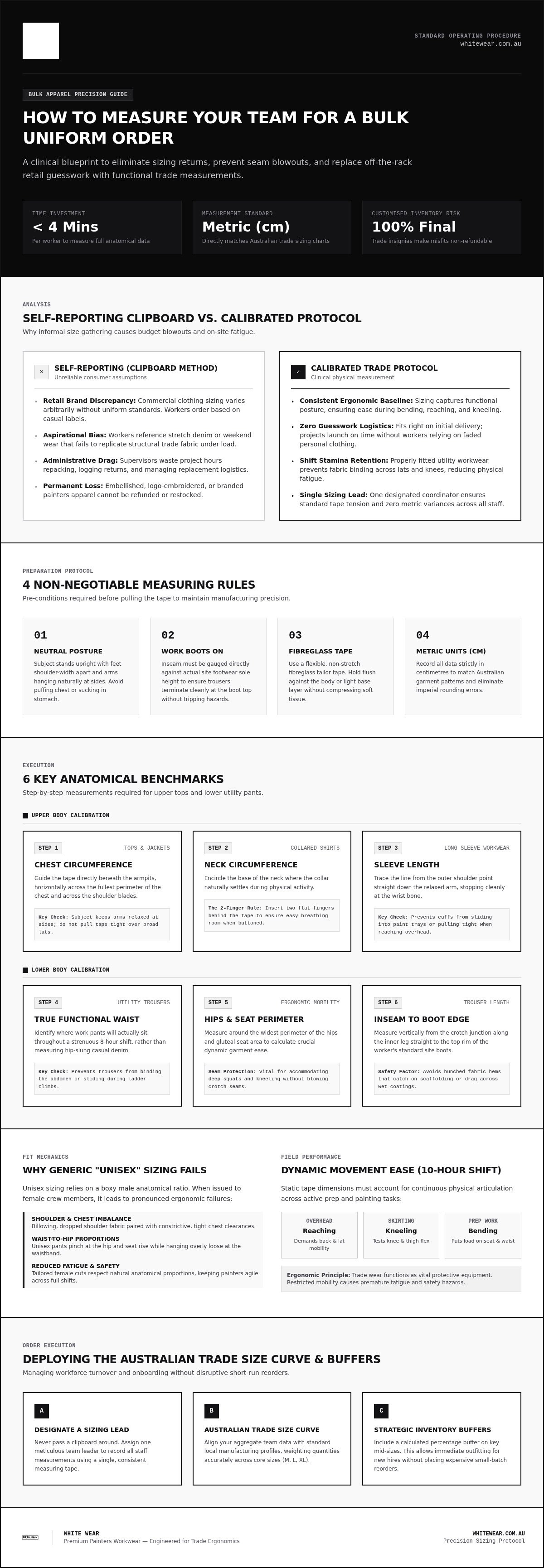
Precision sizing begins with repeatable mechanics. Have each team member stand in a natural, neutral posture, feet shoulder-width apart, wearing their standard work boots. Use a flexible fibreglass tailor tape held flush against the skin or over light base layers, making sure never to compress soft tissue. Record every dimension in metric centimetres for accurate alignment with Australian manufacturing charts. Learning how to measure your team for a bulk uniform order takes under four minutes per worker when you follow a structured, clinical protocol. Just as workplace safety authorities stress the necessity of properly fitting personal protective equipment to prevent site hazards, exacting apparel measurements protect workers from fabric binding, tripping hazards, and restricted mobility.
Upper Body Measurements: Chest, Neck, and Sleeve
Start with the chest circumference. Guide the measuring tape under the armpits, spanning across the widest part of the chest and shoulder blades while the worker keeps their arms relaxed at their sides. For collared painters tops, circle the base of the neck, inserting two fingers flat behind the tape to ensure natural breathing room when fully buttoned. Finally, trace the sleeve length starting from the outer shoulder point, extending down the relaxed arm to rest cleanly at the wrist bone.
Lower Body Measurements: True Waist, Hips, and Inseam
Accurate lower body sizing requires pinpointing functional waistband placement rather than relying on hip-slung casual denim habits. Record the true waist where utility trousers will actually sit on the painter's torso during an eight-hour shift. Next, circle the widest perimeter of the hips and seat; this critical metric accommodates deep squats and kneeling without blowing out crotch seams. Finish by running the tape down the inside seam, starting from the crotch junction down to the top edge of their work boots.
Crucial Nuances Between Men's and Women's Sizing
Generic unisex sizing fundamentally fails female crew members. Off-the-shelf unisex cuts assume a boxy, male anatomical ratio, leading to billowing shoulder fabric paired with severe restriction across the chest, hips, and seat rise. Female painters require specific waist-to-hip contours and higher rise dimensions that keep garments comfortably in place when climbing scaffolding or bending down. Explore our comprehensive guide to women's work wear for specialised pattern considerations. Selecting gender-specific cuts from dedicated painters clothing collections ensures every trade professional on your team enjoys uncompromised mobility and dignity on site.
Accounting for Movement Ease Across Different Garment Types
Raw skin measurements never equal finished garment dimensions. Garment ease represents the critical tolerance designed between anatomical contours and tailored textiles. Corporate desk workers might manage in tailored apparel with minimal clearance, but active trade professionals require deliberate dynamic allowances. Without calibrated ease, high-stress focal points like crotch gussets, knee panels, and rear shoulder yokes blow out prematurely under the physical strain of daily prep work.
Textile composition directly influences this calculation. Heavyweight, non-stretch cotton drills require built-in pattern space so the wearer can flex comfortably. Modern technical fabrics blended with performance elastane provide inherent give, permitting a cleaner, more refined silhouette without binding. Incorporating these functional tolerances into how to measure your team for a bulk uniform order prevents ordering restrictive gear that compromises on-site stamina.
Trousers and Shorts: Sitting, Squatting, and Kneeling Ease
Painters spend countless hours kneeling along skirting boards and squatting on low staging. Add four to six centimetres of ease across the seat and upper thigh to avoid sudden seam failures during deep crouches. Factoring in heavy tool clips, multi-tool loading, and belt tension is equally vital. For an in-depth breakdown of structural tolerances, review our specialised resource on choosing the best painters pants.
Work Shirts and Polos: Overhead Extension and Reach
Ceiling cutting and pole rolling place extreme rotational tension across the upper back. Upper garments require deliberate shoulder pleat allowances so sleeves don't yank upward and expose forearms during overhead work. Look for dropped rear hems that remain securely tucked into the waistband when bending fully forward. High-breathability weaves further reduce fabric cling, ensuring workers stay comfortable through humid conditions.
Bibs and Overalls: Torso Girth and Vertical Rise
One-piece workwear introduces a vertical dimension absent in separates: the total trunk loop. Measure from the top of the shoulder, down across the sternum, through the crotch, and up the back to the starting point. Ensure the torso rise includes generous vertical ease so straps don't pull into the neck when leaning down. Generous chest and waist tolerances also accommodate winter thermal undergarments. Review our comprehensive painters overalls guide to master this specialised full-body tailoring protocol.
Developing an Internal Sizing Protocol for Your Painting Crew
Operational consistency demands a centralised process. Rather than relying on scattered text messages or hurried conversations in the car park, establish a structured internal protocol completed in a single shift. Designate a single sizing officer, such as a trusted leading hand or operations coordinator, to conduct every measurement. Having one individual manage the tape ensures uniform tension and consistent anatomical benchmarks across the entire roster.
Log raw measurements into a master roster spreadsheet that captures chest, waist, hips, and inseam alongside each worker's role. Pair these anatomical metrics with physical sizing kits. Trying on unbranded sample garments eliminates subjective guesswork, giving painters tangible confidence in their fit before committing to decorated runs. Implementing this protocol transforms how to measure your team for a bulk uniform order into an efficient, professional milestone.
Setting Up an On-Site Fitting Station
Integrate sizing into scheduled morning toolbox talks to protect site productivity. Run disciplined five-minute windows per worker in a private site trailer or workshop annex. Instruct crew members to wear their daily work undergarments and standard trade boots during the session, ensuring real-world baseline conditions. This private fitting environment allows painters to test sample garments through squats and overhead reaches without rushing.
Auditing and Cross-Referencing Master Sizing Data
Review the spreadsheet before dispatching figures to production. Audit the data by flagging anomalies, such as slender apprentices marked down for extra-large trousers or veteran tradespeople matched with tight chest specifications. Once verified, require each team member to review and sign off on their documented sizing. This quick sign-off establishes mutual accountability, ensuring total buy-in across the business.
Aligning these final dimensions with your visual identity ensures a unified crew image, as detailed in our guide on painters uniforms for company branding. Ready to outfit your crew in immaculate, durable apparel built for the physical demands of the trade? Visit White Wear to source specialised painters workwear designed to elevate your company's presentation nationwide.
Finalising the Bulk Order: Size Curves, Buffers, and White Wear Quality
Volume sizing across Australian trade businesses traces a predictable bell curve. Medium, Large, and Extra Large inevitably represent the vast majority of your order volume. While smaller and extended sizes remain essential for specific crew members, over-indexing on outer extremes locks up cash flow in idle inventory. Mastering how to measure your team for a bulk uniform order provides exact figures for your current roster, but translating those raw numbers into a smart procurement plan requires understanding this trade distribution.
Trade workwear must withstand aggressive scrubbing, harsh solvents, and frequent high-temperature commercial laundering. Selecting purposefully engineered painters clothing ensures that the precise fit you measured on day one retains its structural integrity, seam strength, and polished appearance across months of demanding site conditions.
Calculating Strategic Buffer Stock for New Hires
Turnover and apprentice onboarding are constant realities in contracting. When placing your bulk run, add a 10 to 15 percent buffer quantity weighted heavily toward core sizes: Large and Extra Large. This strategic reserve lets you hand a new hire an immaculate, branded uniform kit on their first morning, projecting instant company professionalism. For businesses that also pair workwear with welcome packs or company gear, partnering with a bulk branded merchandise specialist such as SwagStore.NET helps ensure every branded touchpoint looks cohesive. Keeping a modest safety stock at head office also ensures immediate replacements if a team member tears a seam or stains their gear beyond recovery on a difficult commercial job.
Streamlining Distribution and Rollout Across the Team
Depot delivery morning can descend into disorder if hundreds of loose garments arrive in unlabelled cartons. Request that your uniform order arrives pre-sorted into individually labelled worker bundles. Handing each tradesperson a packaged set marked with their name and verified measurements prevents chaotic mix-ups and stops workers from swapping garments on a whim.
Institute an immediate 48-hour try-on policy once parcels are distributed. Having crew members test their apparel under actual working conditions ensures that every piece meets the highest standard of mobility and comfort. When you are ready to outfit your workforce with specialized painters workwear built for performance and durability across Australia, equip your crew directly through White Wear.
Equip Your Crew for Uncompromised Performance
Eliminating bulk sizing errors isn't merely about avoiding tedious return logistics. It is about providing your workforce with refined apparel that commands client trust and delivers unhindered mobility across grueling shifts. By establishing a disciplined internal protocol and accounting for dynamic movement ease, you take total command of your procurement. Mastering how to measure your team for a bulk uniform order guarantees that every tradesperson steps onto the job site in gear calibrated for active physical labour.
Once your master sizing roster is audited, choose workwear crafted to match your crew's professional standard. White Wear delivers specialised trade-engineered workwear designed specifically for professional painters, blending modern tailoring with durable, high-performance fabrics built for continuous jobsite motion. Backed by fast nationwide delivery across Australia for commercial trade fleets, getting the right fit the first time has never been simpler. Outfit your crew with professional painters workwear at White Wear today and set a new benchmark for trade presentation.
Frequently Asked Questions
Should workers measure themselves or have someone else take their uniform measurements?
Someone else should always take the measurements. Self-measuring forces workers to bend, tilt their heads, or twist their torsos, distorting tape placement and creating inaccurate data. A designated sizing officer ensures consistent tension and keeps the measuring tape level across every person. Standardising this single-measurer rule is central to how to measure your team for a bulk uniform order without introducing human error.
How much extra room should I add to team measurements for active trade workwear?
Add four to six centimetres of ease across dynamic zones like the chest, hips, and seat. Trade tasks require deep squats, kneeling, and extended overhead reaching that instantly strain rigid fabrics. If garments match raw skin dimensions exactly, seams pull tight during physical movement and risk blowing out. Built-in pattern ease lets painters move naturally while maintaining a clean, professional aesthetic on site.
What should we do if a crew member's measurements fall between two standard uniform sizes?
Always size up to the larger garment dimension for trade uniforms. Garments that fit slightly looser allow for comfortable mobility, whereas undersized apparel restricts joint extension and accelerates fabric fatigue. In trade roles like painting, where active bending and ladder work are constant, slight excess room is easily managed with a belt or tucked styling, while tight garments cause immediate chafing.
How do we account for seasonal layering when ordering crew uniforms in bulk?
Account for seasonal undergarments by factoring an additional two to three centimetres into upper body measurements for winter outerwear and bibs. Crew members working in cooler climates frequently layer thermal tops and long johns underneath their painters workwear. If you measure team members during summer while wearing thin shirts, select one size up for cold-weather outerwear and heavy-duty overalls.
Can we order a sizing sample kit before placing our complete bulk uniform order?
Yes, securing sizing sample garments before finalizing a large production run is industry best practice. Trying on physical garments lets crew members confirm how the cut, rise, and fabric drape feel during actual movement. It provides absolute certainty before applying embroidery or screen printing, safeguarding your business from costly, non-refundable errors when mastering how to measure your team for a bulk uniform order.
Why do painters' work pants often fit differently than standard casual denim or chinos?
Specialised painters trousers feature higher rises, articulated knees, and reinforced gussets designed for continuous physical mechanics rather than static standing. Casual retail trousers sit low on the hips and often rely on fashion stretch that degrades quickly. Workwear trousers rest higher on the natural waist so tool pockets remain accessible and the waistband stays anchored securely while kneeling or climbing scaffolding.
How many uniform sets should be allocated per full-time crew member in a bulk order?
Allocate three to five full uniform sets per full-time tradesperson. A five-set allocation ensures a clean, professional outfit for every workday without forcing employees into daily domestic laundering cycles. A rotation of multiple high-performance painters clothing sets also prolongs fabric life, preventing premature pigment wear and keeping your crew looking pristine in front of commercial and residential clients.


