


What if the strongest case for premium workwear isn’t that it costs less, but that it better suits the work you do every day? Justifying premium workwear to your spouse can feel awkward when the upfront price is clear and the value is harder to measure. That’s a fair concern, especially when household spending has to work for everyone.
Painters’ clothing is a work essential, not an impulse fashion purchase. A fair comparison looks beyond the price tag to the tasks your clothes need to handle, comfort, expected use and household priorities. It also avoids treating a possible tax deduction as a guaranteed saving: Australian work-clothing rules depend on the garment and your circumstances.
This guide will help you make a calm, evidence-based case. You’ll identify what your workwear needs to handle, compare options using practical cost-per-wear thinking, and discuss the purchase without promising savings you can’t prove. With a clearer picture of the trade-offs, you and your spouse can decide together whether painter-specific workwear fits your workday and budget.
Key Takeaways
- Frame the purchase as a shared decision: your work needs and household priorities both deserve consideration.
- Assess “premium” by the garment’s documented durability, functionality, comfort and suitability for painting tasks, not by its label alone.
- Compare a lower-cost option fairly, considering how each choice may suit your expected use and everyday work demands.
- When justifying premium workwear to your spouse, use practical cost-per-wear thinking rather than relying on unproven savings.
- Keep tax eligibility separate from the value decision, and check current ATO guidance before assuming workwear is deductible.
How to talk about premium painters workwear without turning it into an argument
A workwear purchase brings together two priorities: what you need to do your job and how your household chooses to spend. Start by recognising both. The need for suitable clothing is one question; whether a premium option is worth choosing over a lower-cost one is another. Keeping those decisions separate helps make the conversation fair.
Rather than opening with the price or broad claims about quality, describe the work your clothes need to handle. Specific examples give both of you something practical to assess, rather than making the purchase feel like a preference that must simply be defended.
Start with the workday, not the price tag
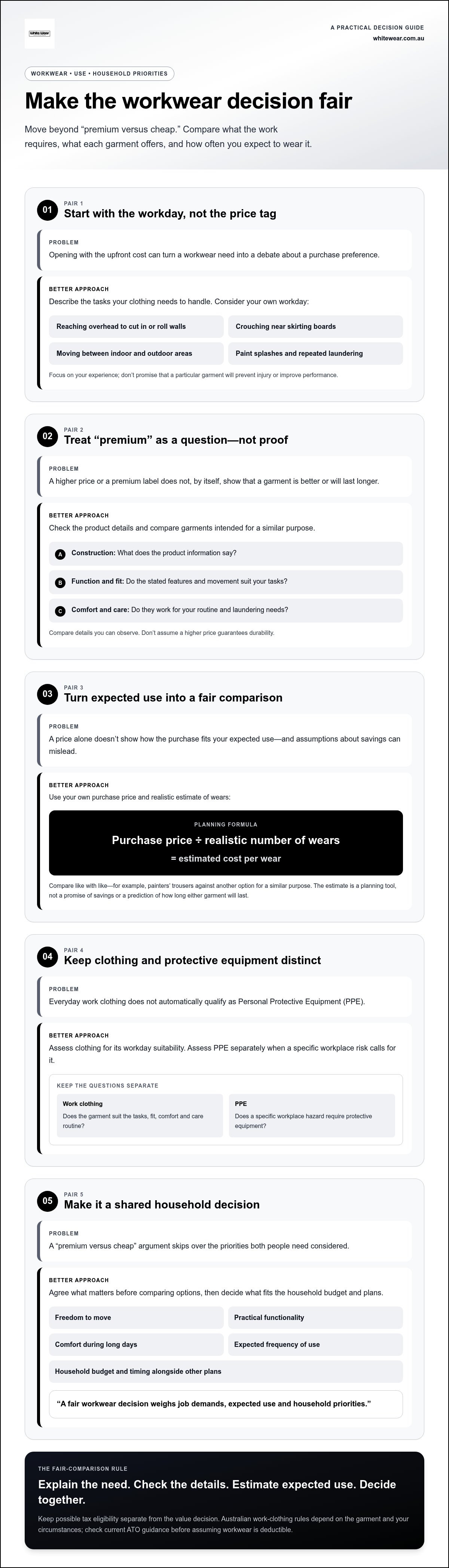
Think through a typical day: reaching overhead to cut in or roll walls, crouching to work near skirting boards, moving between indoor and outdoor areas, and dealing with paint splashes or repeated laundering. Clothing that feels restrictive or uncomfortable may make those tasks less comfortable over a full shift. Focus on your own experience, not a promise that a particular garment will prevent injury or improve performance.
Be precise about safety, too. Some equipment is designed to protect against specific workplace risks and is classed as Personal Protective Equipment (PPE); everyday work clothing doesn’t automatically qualify. Explain what your workwear needs to do, then assess clothing and protective equipment according to their separate purposes.
Agree on what would make the purchase worthwhile
Before comparing options, ask each other what matters most. Is it freedom to move, practical functionality, comfort during long days, expected frequency of use, or staying within a particular household budget? Agreeing on priorities first can keep the discussion from becoming a simple “premium versus cheap” debate.
Then set a spending limit or decide when the purchase fits best with other household plans. Compare the garment’s details with how often you expect to wear it, without assuming it will last longer or save money unless you have evidence. For a broader look at painter-focused style and function, explore this professional painter’s elevated workwear guide.
A useful line to keep the conversation grounded is: “A fair workwear decision weighs job demands, expected use and household priorities.” That’s the heart of justifying premium workwear to your spouse: explain the need, listen to shared concerns and compare suitable options together. The goal isn’t to win an argument. It’s to make a considered choice you can both feel comfortable with.
What makes premium painters workwear worth considering?
“Premium” is a starting point for comparison, not proof that a garment is better. Its value depends on what the product details show and how well it suits the painting work it’s intended for. Look for information about construction, function, comfort and care, then compare those details with a lower-cost garment serving the same purpose.
For example, consider whether the garment’s stated features suit the tasks you regularly do, whether the fit allows comfortable movement, and whether its care requirements work for your routine. Don’t assume a higher price guarantees greater durability or that workwear is protective equipment. If a specific workplace hazard calls for PPE, refer to Safe Work Australia’s guidance on personal protective equipment (PPE) and assess that need separately from a clothing upgrade.
Compare expected use with the upfront investment
Cost-per-wear offers a simple way to compare a purchase price with how often an item is used. The formula is:
Purchase price ÷ realistic number of wears = estimated cost per wear
Use your own figures, based on the price you’re considering and how often you realistically expect to wear the garment. Compare like with like: assess painters’ trousers against another option for a similar purpose, taking construction details and intended work conditions into account. An estimate is a planning tool, not a promise of savings or a prediction of how long either garment will last.
This can make justifying premium workwear to your spouse more practical. You’re comparing expected use and documented details, not treating a higher price as automatic evidence of better value.
Consider comfort and function across a full shift
Fit matters over the hours you spend bending, reaching, kneeling or moving between tasks. Assess ease of movement and comfort against your own routine, and use the garment’s product information to judge its practical features. Painter-specific clothing is designed with painting work in mind, while generic casual clothing may not address the same work requirements. Suitability still depends on the individual garment, so compare its details rather than relying on the category name alone.
For a closer look at what to assess in this garment category, read this painter’s guide to choosing work trousers. You can also browse painters workwear and clothing from White Wear as you compare options against your needs.
A fair comparison: premium workwear versus the cheaper alternative
A useful comparison doesn’t assume that premium is better or that cheaper means unsuitable. It asks whether each garment fits the work it needs to do, how often it’s likely to be worn and what the purchase means for the household. Judge details you can observe, such as stated construction, fit and care instructions, separately from preferences like colour or appearance and assumptions about how long something will last.
Compare workwear against the job it needs to do
Set two options side by side for the same purpose. Painter-specific clothing may be worth considering for regular painting work, while general clothing or a lower-cost garment may suit occasional tasks or a limited budget. The right choice depends on the garment’s actual details and your routine, not its label alone. For broader wardrobe context, explore this painters workwear guide.
| What to compare | Painter-specific or premium option | Lower-cost or general option | Household question |
|---|---|---|---|
| Purpose | Review whether the product information describes features relevant to painting tasks. | Check whether it serves the same task, rather than comparing it with a garment meant for a different use. | Does either option meet the actual work requirement? |
| Expected use | Consider whether you’ll wear it regularly across workdays. | It may be a sensible fit for occasional jobs or less frequent use. | How often is this item likely to be worn? |
| Comfort | Assess fit and ease of movement against your working routine. | Use the same criteria; a lower price doesn’t automatically mean poor comfort. | Which option feels suitable for the tasks involved? |
| Functionality | Compare stated construction and practical details with the job’s demands. | Look at its features in the same way, rather than assuming they’re inadequate. | Are the differences useful, or mostly personal preference? |
| Household impact | Weigh the upfront purchase against the need and other planned spending. | A lower initial outlay may leave more room for other priorities. | Which choice fits the agreed budget now? |
Make household trade-offs visible
Put the purchase alongside upcoming household expenses, such as a bill, planned repair or another shared priority. If only one item needs replacing, consider buying that piece first rather than upgrading an entire work wardrobe at once. This keeps the decision specific and avoids spending more simply because a premium option is available.
When justifying premium workwear to your spouse, a balanced conclusion is more persuasive than a sales pitch: choose the garment that best matches your work demands, expected use and budget. Sometimes that will be a painter-specific option. Sometimes a lower-cost alternative will be enough.
Can premium workwear be claimed on tax in Australia?
Tax eligibility and household value are separate questions. A garment may be useful for your work without qualifying for a deduction, and a possible deduction shouldn’t be treated as a guaranteed refund or a reason to buy a more expensive option. Assess the practical value of the garment on its own, then consider tax only if the garment and your circumstances meet Australian Taxation Office (ATO) requirements.
Understand the clothing categories without assuming eligibility
The ATO’s work-clothing rules distinguish qualifying garments by their purpose or status. In broad terms, the categories include:
- Protective clothing: clothing designed to protect against a work-related risk, such as illness or injury. Simply wearing ordinary clothes on a painting job doesn’t make them protective.
- Occupation-specific clothing: distinctive clothing that identifies a particular occupation, rather than conventional everyday wear.
- Compulsory uniforms: clothing an employer requires employees to wear that identifies them as working for that employer or organisation.
- Registered non-compulsory uniforms: uniforms that meet the ATO’s requirements, including registration of the design with AusIndustry.
These categories don’t mean all painters’ clothing is deductible. A painter-specific garment may be designed for work, but ordinary jeans, shirts or other conventional clothing aren’t automatically deductible just because they’re worn on the job. Work-related use alone does not establish that clothing qualifies for a tax deduction. Eligibility depends on the garment’s characteristics and the circumstances of the claim.
Keep records and check your circumstances
If you’re considering a claim, keep relevant purchase and laundry records and follow current ATO requirements for evidence and calculation. You generally need to have paid the expense yourself, not been reimbursed, and show its connection to earning your income. Record-keeping rules can vary by expense and claim, so don’t assume that one method or threshold applies to every situation.
Before relying on a deduction, read the latest ATO guidance on work-related clothing and laundry expenses, or speak with a registered tax professional about your circumstances. This section is general information, not personalised tax advice. A tax outcome shouldn’t be promised or factored into the purchase as certain.
Once you’ve separated tax eligibility from the household decision, compare painters workwear against your actual job needs and budget. Explore painters workwear and clothing as part of that practical comparison.
How to reach a workwear decision you can both feel good about
A good decision doesn’t require one partner to win. It comes from agreeing on what the work calls for, what the household can comfortably spend and how you’ll judge whether the purchase suits your needs. A considered workwear purchase fits both the job and the household budget.
Use a shared five-step buying conversation
- Name the need. Identify the item that needs attention and the painting tasks it must support, such as reaching, bending or working through a full shift.
- Set the budget together. Agree on a spending limit or a suitable time to buy, taking other planned household expenses into account.
- Compare relevant options. Look at garments intended for similar work and review their product information, including stated construction, function, fit and care details. Separate observable features from assumptions about durability or future savings.
- Choose one first purchase. If several pieces could be replaced, decide together which item is most needed now. There’s no need to update the whole work wardrobe at once.
- Review its use. After you’ve worn and cared for the item through a reasonable period of your normal work routine, discuss how well it met the agreed needs. Use that experience to guide any future purchase, without assuming a particular result in advance.
This sequence makes justifying premium workwear to your spouse less about defending a price and more about sharing a practical decision. If the garment fits the work but not the agreed budget, consider a different option or timing. If it suits both, you can make the purchase with a clearer understanding of why it was chosen.
Explore painter-specific options with White Wear
Once you’ve agreed on what matters, compare your needs with product details. White Wear is an Australian specialist in painters workwear and clothing, with a focus on functional, durable apparel designed for painting work. That painter-specific focus gives you a trade-focused option to assess against the tasks your clothing needs to support. White Wear provides nationwide shipping across Australia.
Ready to compare options against your shared priorities? Explore painters workwear from White Wear.
Make your next workwear decision together
Justifying premium workwear to your spouse is easier when the conversation centres on shared priorities, not winning a price debate. Start with the tasks your clothing needs to support, compare garments using their actual details and expected use, then agree on a budget that fits household plans.
Cost-per-wear can help you compare options, but it’s an estimate, not a guarantee of savings. Keep tax eligibility separate from the purchase decision, too: wearing clothing for work doesn’t automatically make it deductible in Australia, so check current ATO guidance for your circumstances.
When you’re ready to explore painter-specific options, White Wear offers clothing designed for professional painters, with a focus on durable, functional workwear for painting. Nationwide shipping is available across Australia. Explore painters workwear from White Wear and compare the options with your agreed needs in mind.
A considered choice can respect the demands of your work and the priorities you share at home. Take the next step together with confidence.
Frequently Asked Questions
How do I convince my spouse that premium workwear is worth it?
Build the case together around the work the clothing needs to handle and the household budget. Describe your regular painting tasks, then compare relevant garment details, expected use and comfort rather than relying on broad claims about quality. Justifying premium workwear to your spouse is easier when you acknowledge the upfront cost and listen to shared concerns. Agree on what would make the purchase worthwhile before deciding whether a premium option fits.
Is expensive workwear always better?
No. A higher price doesn’t automatically prove that a garment is more durable, comfortable or suitable for painting work. Compare product information such as construction, intended purpose, fit and care instructions, and weigh those details against your own work routine. A lower-cost garment may be a sensible option for your needs or budget. Choose based on evidence and suitability, not price or the word “premium” alone.
Can painters claim workwear on tax in Australia?
Sometimes, but being a painter or wearing clothing at work doesn’t automatically make it deductible. Current Australian Taxation Office rules distinguish categories such as protective clothing, occupation-specific clothing, compulsory uniforms and registered non-compulsory uniforms. Ordinary clothing, including conventional shirts or jeans, generally doesn’t qualify just because it’s worn on the job. Eligibility depends on the garment and individual circumstances, so check current ATO guidance or speak with a registered tax professional.
How can I compare premium workwear with cheaper clothing?
Compare garments intended for a similar purpose and use. Review their product details, then consider fit, functionality, care and how often you realistically expect to wear each option. You can estimate cost per wear by dividing the purchase price by your expected number of wears, using your own figures. Treat that estimate as a planning aid, not proof of future savings or a guarantee of how long either garment will last.
What makes painters workwear different from ordinary clothing?
Painters workwear is designed specifically with painting tasks in mind, while ordinary clothing is made for general wear. Relevant features vary by garment, so check product information and consider your day-to-day requirements, such as movement, fit and practical function. Workwear isn’t automatically protective equipment or tax-deductible. White Wear specialises in painters clothing focused on durability and functionality for painting work, offering a trade-specific option to assess against your needs.
Should I buy all my workwear at once?
Not necessarily. Start with the item you need most, then consider the rest of your work wardrobe later. This keeps the immediate decision focused and lets you compare one purchase with your household budget before committing to more. After wearing and caring for the garment through your usual work routine, review whether it met the needs you agreed on. That experience can inform future choices without assuming a particular outcome.
What records should I keep for a workwear tax claim?
Keep purchase evidence, such as receipts, and relevant records for laundering or repairs if you intend to claim those expenses. The ATO’s evidence requirements depend on the expense and current rules, so check its latest guidance rather than relying on a general assumption. You generally need to have paid the expense yourself and not been reimbursed. For advice that reflects your circumstances, speak with a registered tax professional.


