


Your professional silhouette shouldn't be compromised by a momentary spill in the studio. What if that plastic polymer bond currently hardening on your sleeve wasn't a permanent sentence for the bin? We know the frustration of seeing a premium uniform marked by a stubborn stain. It's an intrusion on the elevated image you work hard to maintain. Mastering the process of getting acrylic paint out of fabric is about more than just cleaning; it's a clinical restoration of your professional identity.
You likely fear that aggressive scrubbing will destroy the sophisticated fibers of your workwear. You're right to be cautious. Traditional methods often fail because they don't respect the science of the textile. We'll show you exactly how to break those chemical bonds without sacrificing the four-way stretch or the flattering fit of your favorite pieces. From using $5.49 isopropyl alcohol to navigating EPA-regulated disposal for stronger solvents, you'll gain the insider knowledge to handle any spill. We’re going to cover precise extraction techniques and professional-grade solutions that ensure your apparel remains as resilient and polished as your career.
Key Takeaways
- Understand how acrylic polymers transform into a permanent plastic layer during the curing process, making immediate action essential.
- Learn the professional "Spoon and Lift" technique to remove excess paint without driving pigment deeper into the textile fibers.
- Master the clinical "Blot-and-Dissolve" method for getting acrylic paint out of fabric using Isopropyl Alcohol to break dried plastic bonds.
- Identify fabric-specific protocols to protect the integrity of your apparel, from heavy-duty cotton drill to sophisticated moisture-wicking blends.
- Discover how investing in high-thread-count workwear provides a natural defense against deep pigment penetration and long-term staining.
Understanding the Polymer Bond: Why Acrylic Paint Defies Standard Cleaning
To master the art of getting acrylic paint out of fabric, you must first understand the chemistry of the enemy. Acrylic paint is a high-performance, water-borne emulsion of acrylic polymer emulsions. While it's fluid in the tube, its chemical architecture changes the moment it hits the air. This isn't a simple surface stain like coffee or mud; it's a synthetic material designed to be permanent. When you're wearing premium apparel, this bond becomes a structural challenge that demands a clinical approach to restoration.
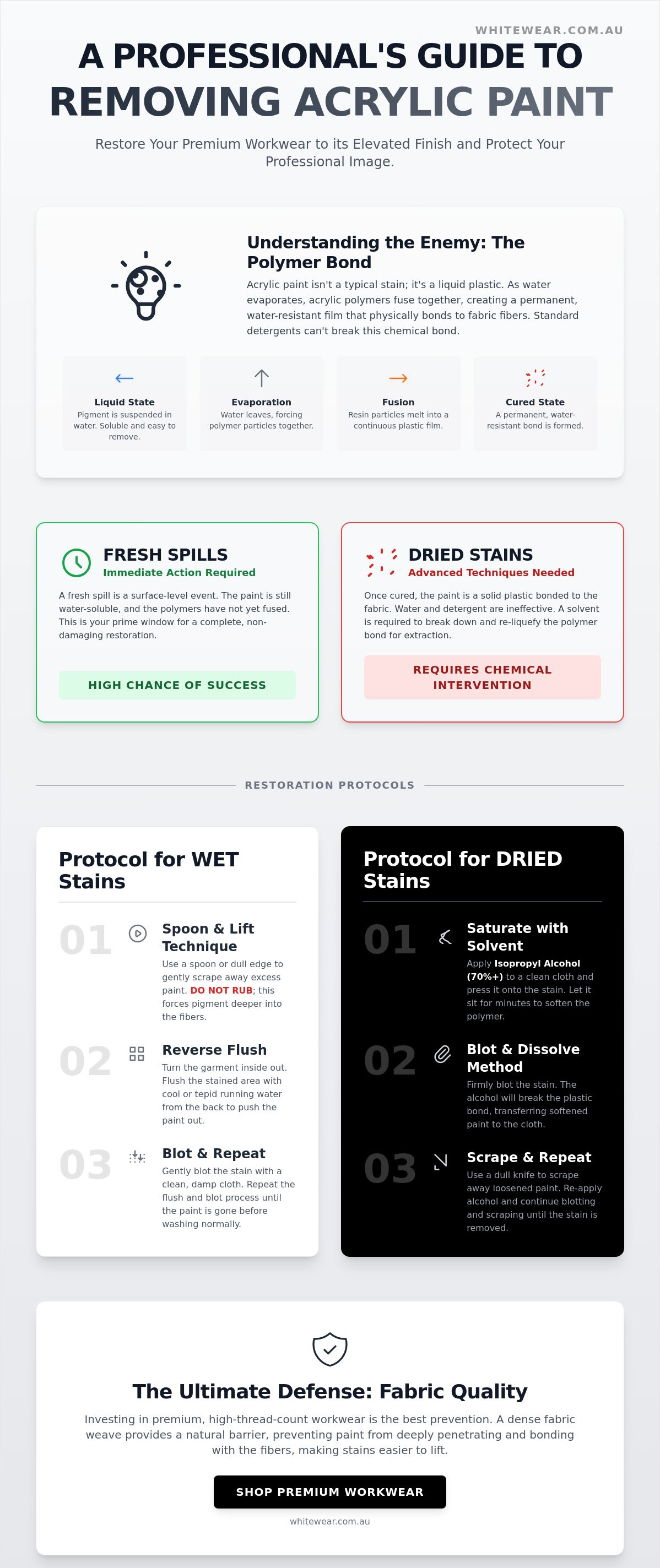
As water evaporates from the paint, the suspended resin particles move closer together. They don't just dry; they fuse. This process, known as curing, creates a permanent, flexible plastic layer that anchors itself into the very weave of your garment. Traditional cleaning methods fail because they treat the stain as a surface residue rather than a fused plastic polymer. Successful restoration requires a tactical "re-liquefying" of this bond to release the pigment from the fibers. You aren't just washing a shirt; you're performing a chemical extraction to preserve your professional silhouette. The curing process follows a specific trajectory:
- Liquid State: The pigment is suspended in water and easily soluble.
- Evaporation: Water leaves the emulsion, forcing resin particles to pack together.
- Fusion: Resin particles melt into each other, creating a continuous film.
- Cured State: A permanent plastic bond that resists water and standard surfactants.
The Window of Opportunity: Wet vs. Cured Acrylic
The difficulty of getting acrylic paint out of fabric is dictated by the clock. A fresh spill is a surface-level event where the pigment is still suspended in water. This is your prime window for intervention. Once the paint reaches its cured state, it undergoes a chemical transition into a water-resistant plastic. For delicate synthetic blends, the point of no return often arrives within minutes. Heavy-duty fabrics like cotton drill offer a slightly longer "open time" due to their density. However, once that window closes, you're no longer dealing with a liquid, but a solid plastic mass integrated into the textile.
Why Traditional Detergents Fall Short
Standard laundry detergents rely on surfactants to lift oils and organic matter. They are fundamentally ill-equipped to handle synthetic resins. A surfactant can't penetrate a cured plastic shield; it simply slides over the surface. Worse, placing a stained garment in a dryer is a terminal error. The intense heat acts as a catalyst, permanently setting the acrylic polymer into the fabric's weave. The polymer bond acts as a plastic shield that requires specific solvents to penetrate. Relying on a standard wash cycle often results in a permanent blemish on an otherwise elevated uniform. This frustration is why many professionals believe their garments are ruined after a single shift, but with the right chemical knowledge, restoration is still possible.
Immediate Intervention: Rescuing Fabric from Fresh Acrylic Spills
Success in getting acrylic paint out of fabric is defined by the first sixty seconds. When a spill occurs, your instinct might be to grab a paper towel and scrub. Resist that impulse. Rubbing is a mechanical error that drives pigment deep into the yarn's core, turning a surface issue into a structural stain. Instead, adopt the clinical "Spoon and Lift" technique. By using a dull edge to scrape away the bulk paint, you remove the majority of the polymer before it has a chance to anchor to the fibers. It's a precise movement that saves the integrity of your garment.
Once you've cleared the excess, the next step is a strategic flush. Always treat the stain from the reverse side of the garment. This uses water pressure to push the pigment out the way it came in, rather than forcing it further through the weave. Industry experts at Plaid suggest various methods for removing acrylic paint, but for fresh spills, tepid water is your most effective tool. Avoid hot water. High temperatures can inadvertently accelerate the curing process you're trying to prevent, effectively "cooking" the plastic into the fibers.
Step-by-Step Wet Stain Removal
- Step 1: Scrape excess paint immediately using a spoon or dull knife. Work from the outside of the spill toward the center to prevent spreading.
- Step 2: Turn the garment inside out and flush the area with high-pressure tepid water.
- Step 3: Apply a high-surfactant dish liquid or a mix of soap and glycerine directly to the remaining pigment. This breaks the surface tension of the paint.
- Step 4: Agitate the area gently with a soft-bristled brush. Use small, circular motions to lift the pigment without damaging the fabric’s sophisticated finish.
The Role of Moisture in Preventing Curing
If you can't reach a sink immediately, you must stall the evaporation process. A cured stain is significantly harder to treat. Keeping the area damp with a wet cloth is a temporary fix, but for those on a long shift, the "Plastic Wrap" trick is a professional secret. Covering the wet stain with a small piece of plastic wrap and securing it with medical tape prevents air contact. This keeps the polymer in its liquid state until you can perform a full restoration at home. When your professional painters workwear is designed for longevity, these small interventions preserve the garment's elevated look for years to come.
You'll know the stain has transitioned to a semi-dry state when it loses its sheen and feels tacky to the touch. At this point, simple soap and water lose their efficacy. You're no longer washing away a liquid; you're attempting to dissolve a forming plastic bond. Acting while the paint is still glossy ensures the highest probability of a complete, invisible restoration. It's the difference between a minor inconvenience and a permanent mark on your professional silhouette.
Restoring the Elevated Finish: Advanced Techniques for Dried Acrylic
When the window of opportunity for wet removal closes, you face a different challenge. The paint has now fused into a rigid plastic film. At this stage, getting acrylic paint out of fabric requires a solvent that can penetrate the polymer without compromising the textile's sophisticated structure. High-concentration Isopropyl Alcohol (Rubbing Alcohol), typically available for approximately $5.49 for a 32 fl oz bottle, is the professional gold standard for this task. High-concentration alcohol acts as a molecular wedge between the paint and the fiber, softening the bond so the pigment can be lifted away. For those wearing heavy-duty painters workwear, Australian Methylated Spirits provides a high-performance alternative that handles dense cotton drill with clinical efficiency.
Avoid the common online advice suggesting hairspray. While it contains alcohol, modern hairsprays are loaded with resins and lacquers that can introduce entirely new stains to your premium garments. Your goal is a clean extraction, not a chemical cocktail. Once the solvent is applied, the "Blot-and-Dissolve" method becomes your primary tool. This involves saturating the dried paint and patiently allowing the solvent to break the plastic's grip. It's a process of precision, ensuring your professional silhouette remains intact even after a significant spill.
Solvent Selection: What Actually Works
Success depends on the purity of your solvent. Isopropyl Alcohol at 91% or 99% concentration is far more effective than hand sanitisers, which often contain thickeners and fragrances that leave residues. Acetone, priced around $2.97 for 16 fl oz, is a potent alternative for 100% cotton drill. However, you must exercise extreme caution. Acetone saves cotton but destroys synthetics like polyester or moisture-wicking blends by melting the fibers. Always perform a spot test on an inconspicuous hem to ensure the fabric's integrity remains uncompromised before proceeding with the full restoration.
The "Scrub and Soften" Protocol
Once the solvent has softened the acrylic, use a stiff-bristled toothbrush to gently flake away the layers. You must "chase the stain" by constantly moving to a clean section of your blotting cloth. This prevents the dissolved pigment from re-depositing into the weave of your garment. Work from the edges toward the center to contain the area. After the pigment is lifted, a thorough rinse in tepid water is essential to remove all solvent residue. This post-solvent care ensures the chemicals don't linger and degrade the fabric's flattering fit, allowing your getting acrylic paint out of fabric efforts to result in a garment that looks as elevated as the day you bought it.
Fabric-Specific Protocols: From Premium Cotton to Heavy-Duty Drill
Maintaining the dignity of your uniform is a non-negotiable aspect of professional branding. A pristine appearance signals competence and pride in your craft. When getting acrylic paint out of fabric, the success of your restoration depends heavily on the textile's construction. Whether you're dealing with a classic silhouette or a high-performance blend, each material requires a specific clinical approach to avoid permanent damage. Proper restoration isn't just about cleaning; it's about preserving the elevated state of your professional essentials.
Treating Professional Cotton Drill
High-quality painters workwear often utilizes a dense cotton drill weave. This construction is remarkably resilient. The tight interlacing of yarns acts as a natural barrier, protecting the core of the fiber from deep pigment saturation. Because cotton is a robust natural fiber, it can withstand more aggressive mechanical agitation than synthetic counterparts. You can safely use a soft-bristled brush to work solvents into the weave. To avoid "fuzzing" or pilling the surface, always brush in the direction of the grain. This preserves the smooth, professional finish of the garment while effectively lifting the polymer bond without shredding the fibers.
Delicate and Synthetic Considerations
Modern uniforms often feature technical innovations like moisture-wicking properties and four-way stretch. These materials are sophisticated but vulnerable to chemical and thermal stress. When getting acrylic paint out of fabric that contains elastane or polyester, cold-water flushing is essential. Heat can cause these fibers to lose their memory, resulting in a distorted silhouette or a sagging fit. You'll also need to be wary of aggressive scrubbing, which can break the delicate micro-fibers responsible for moisture management.
Before applying any solvent, identify a discreet spot test location. The inside of a hem or the interior of a pocket bag are ideal for verifying colorfastness. This step ensures your restoration doesn't leave behind "yellow halos" or chemical rings that compromise the White Wear aesthetic. If you're working with these technical fabrics, patience is more effective than force. By respecting the science of the material, you ensure your clothing remains a flattering, high-performance asset rather than a liability. If your current gear can't withstand a standard restoration, it's time to upgrade to premium painters clothing designed for the rigors of the modern shift.
The Professional Standard: Investing in Paint-Resistant Workwear
Your workwear is a visual testament to your professional authority. While the techniques for getting acrylic paint out of fabric are essential skills, the resilience of your garment determines the ultimate success of the restoration. High-performance apparel isn't just about style; it's about the technical capacity to withstand the rigors of the trade. When you invest in garments with a high-thread-count, you're choosing a textile that naturally resists deep pigment penetration. The density of the weave acts as a physical barrier, keeping the polymer on the surface where it can be treated effectively rather than allowing it to migrate into the core of the yarn.
Specialized finishes found in professional painters pants provide an additional layer of defense. These innovations are designed to repel liquids, buying you that critical "open time" discussed earlier. By slowing the rate of evaporation and absorption, these technical fabrics make the process of getting acrylic paint out of fabric significantly more predictable. White Wear is engineered with this reality in mind, ensuring that our garments can survive the aggressive cleaning protocols required to maintain a clinical, elevated appearance throughout a demanding career.
Why Fabric Quality is Your First Line of Defence
Generic workwear often relies on loose, low-density weaves that act like a sponge for synthetic resins. Once the polymer anchors into these cheap fibers, removal often results in a frayed, translucent patch. In contrast, high-density textiles maintain their structural integrity even after multiple solvent treatments. This durability is what allows professional gear to retain its crisp, clinical white look shift after shift. You deserve a uniform that doesn't just survive the work but thrives under the pressure of professional maintenance, preserving your silhouette and your dignity.
Building a Durable Painting Wardrobe
Efficiency in the studio or on-site requires a strategic approach to your wardrobe. We recommend rotating your garments to ensure you have the necessary time for proper stain treatment. Rushing a restoration during a short break often leads to errors like heat-setting a stain in the dryer. Premium workwear typically lasts three times longer than standard retail options, offering a superior cost-benefit ratio for the serious professional. By choosing quality over convenience, you ensure your apparel remains as polished as your reputation. Explore the White Wear collection of elevated professional apparel to find essentials designed by professionals, for professionals.
Preserving Your Professional Silhouette
You've moved beyond the frustration of a ruined uniform. By understanding the chemistry of the polymer bond and mastering the "Spoon and Lift" technique, you now possess the clinical authority to rescue your apparel from any spill. Whether you're treating fresh pigments with tepid water or utilizing high-concentration solvents for cured stains, getting acrylic paint out of fabric is a skill that protects your professional branding. It’s about more than simple maintenance; it’s about preserving the dignity of your craft through every hour of a grueling shift.
Your dedication to excellence deserves a uniform that works as hard as you do. Our heavy-duty fabrics are engineered specifically for durability and ease of restoration. Designed by trade professionals who understand the physical reality of the long shift, our garments provide the resilience you need to stay polished. With nationwide Australian shipping available for the modern painter, you can upgrade to professional-grade apparel that stands up to the shift at White Wear. Stay focused on your masterpiece and trust that your workwear is built to endure.
Frequently Asked Questions
Can I use vinegar to get acrylic paint out of my clothes?
Vinegar is generally ineffective for removing cured acrylic paint. While it's a staple for organic stains, it lacks the chemical strength to break the sophisticated plastic polymer bond of dried acrylic. You should reserve vinegar for a final rinse to help neutralize odors or as a mild fabric softener rather than a primary solvent for restoration.
Will hairspray really remove dried acrylic paint stains?
Hairspray is a risky, outdated remedy that we don't recommend for premium workwear. It only works if it contains high levels of alcohol; however, modern formulas are often alcohol-free or loaded with lacquers and resins. These additives can leave a sticky residue or create a secondary stain that's even harder to extract from your garment's fibers.
Is it possible to remove acrylic paint after it has been through the dryer?
It's significantly more difficult because the dryer's heat permanently sets the plastic polymer into the weave. You can still attempt restoration using 91% Isopropyl Alcohol or denatured alcohol, which costs approximately $12.99 per quart. Expect to perform multiple rounds of the "Blot-and-Dissolve" method to penetrate the heat-set shield without compromising the fabric's integrity.
What is the best solvent for removing dried paint from cotton drill?
91% Isopropyl Alcohol is the clinical gold standard for heavy-duty cotton drill. It provides the necessary "molecular wedge" to lift the paint while remaining gentle enough to preserve the fabric's professional silhouette. For exceptionally stubborn spots on 100% cotton, acetone is a powerful alternative, provided you've verified the garment contains no synthetic blends.
Can I use nail polish remover on my painters trousers?
You can use acetone-based nail polish remover only if your trousers are 100% cotton. If your apparel features four-way stretch or moisture-wicking synthetics, acetone will melt the fibers and destroy the garment. Always check the care label for polyester or elastane content before applying this solvent to your professional gear.
How do I get paint out of my clothes without ruining the colour?
The secret to getting acrylic paint out of fabric without losing color is the "Blot-and-Dissolve" technique. Avoid aggressive scrubbing, which causes mechanical abrasion and lightens the dye in that specific area. Always perform a spot test on an inconspicuous hem to ensure the solvent doesn't affect the garment's sophisticated finish or colorfastness.
What happens if I leave the solvent on the fabric for too long?
Prolonged exposure to harsh solvents can weaken the textile fibers and potentially degrade the flattering fit of your uniform. If a solvent like acetone or alcohol sits for too long, the dissolved paint may also re-settle and create a permanent "halo" around the original stain. Limit treatment windows to ten minutes before rinsing with tepid water.
Do I need to wash my clothes immediately after using alcohol to remove a stain?
Yes, a standard laundry cycle is the final step in the restoration process. Once you've successfully finished getting acrylic paint out of fabric, washing removes any lingering chemical residue and dissolved pigment. This ensures your apparel returns to its elevated, clinical state and is ready for your next demanding shift.


