


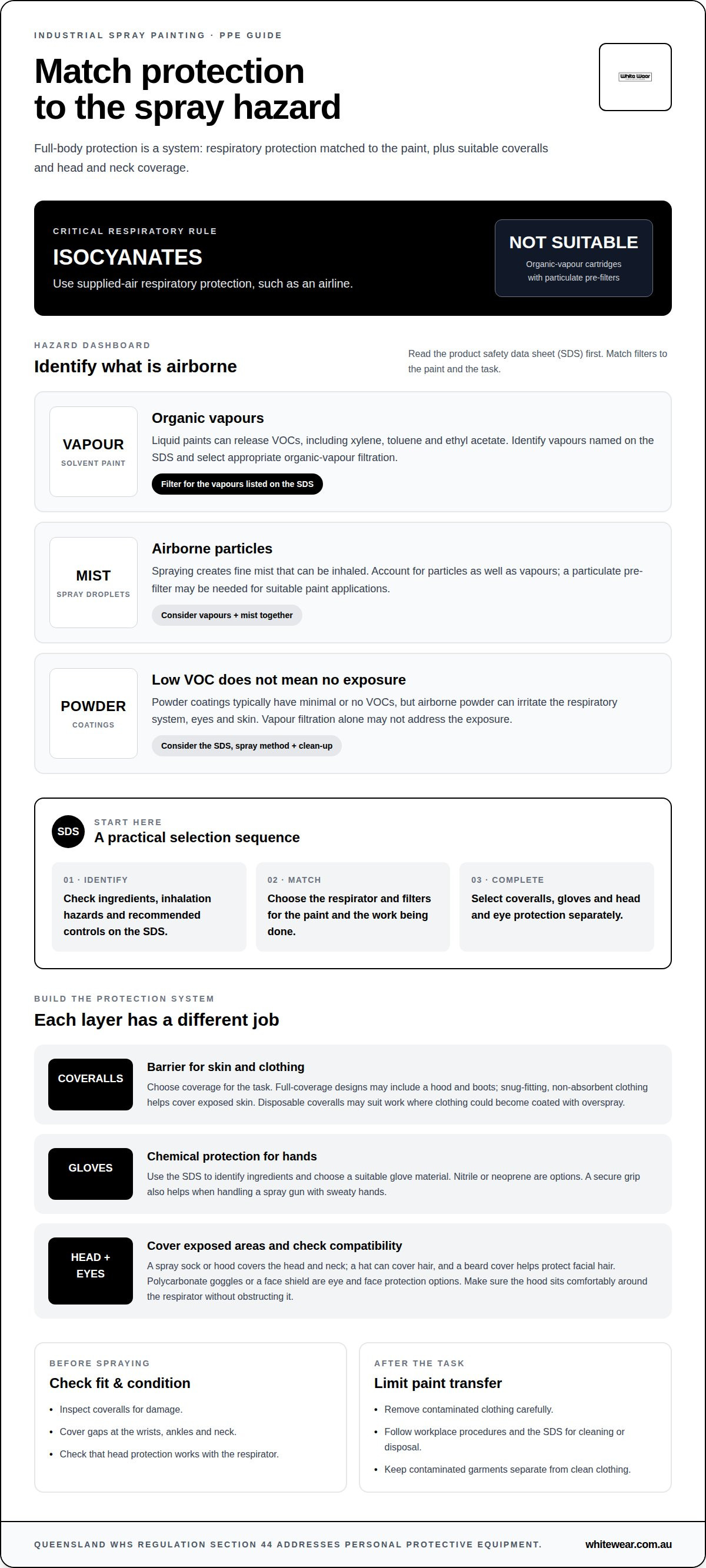
Full body protection for industrial spray painting is a system, not just a suit. It combines respiratory protection matched to the paint with suitable coveralls and head and neck coverage. For sprays containing isocyanates, supplied-air respiratory protection, such as an airline, is required; organic-vapour cartridges with particulate pre-filters aren’t suitable.
Keeping paint off your clothes is only part of the task. Spray mist and paint chemistry matter just as much, so protection needs to suit the material being sprayed and the way the work is done.
This guide explains how to choose filters for organic vapours and particles, when disposable coveralls may be suitable, and how a spray hood or sock can help shield your head and neck from overspray. It also covers practical criteria for comparing protective products and choosing equipment for the demands of the workday.
Key Takeaways
- Match respiratory filters to the paint and its hazards; sprays containing isocyanates require supplied-air respiratory protection.
- Choose disposable coveralls for the coverage the task needs, and consider how fit and material help shield skin and clothing from spray mist.
- Use a spray hood or sock to cover the head and neck, and think about facial hair and respirator compatibility when selecting head protection.
- Compare products by their protective role and suitability rather than assuming one price fits all; Queensland Government notes that WHS Regulation section 44 addresses personal protective equipment.
Organic vapour and particulate filters
Start with the paint, not the mask. Liquid paints can release volatile organic compounds (VOCs), including xylene, toluene and ethyl acetate. Spraying also creates fine mist droplets that can be inhaled. Respirators need filters suited to the airborne hazards; coveralls address separate skin and clothing exposure.
To select spray-painting PPE, read the product’s safety data sheet (SDS) and identify its ingredients, inhalation hazards and recommended controls. Use this information to match the respirator and filters to the paint and task, then choose the remaining PPE separately.
Organic-vapour cartridges are used for solvent vapours, often with particulate pre-filters for spray mist. However, this combination isn’t suitable for spraying isocyanates because it doesn’t provide adequate protection. Safe Work Australia identifies supplied-air respiratory protection, such as an airline, for spraying paints and materials containing isocyanates. Use the SDS’s hazard information to guide your choice.
- Solvent-based liquid paint: identify the vapours named on the SDS and select a respirator with appropriate organic-vapour filtration.
- Spray mist: account for airborne particles as well as vapours. A particulate pre-filter may be needed for suitable paint applications.
- Isocyanates: use supplied-air respiratory protection, not organic-vapour cartridges with particulate pre-filters.
Powder coatings typically have minimal or no VOCs, yet airborne powder can irritate the respiratory system, eyes and skin. Their different hazard profile means vapour filtration alone may not address the exposure. Consider the SDS, spraying method and clean-up tasks when selecting protection. In Queensland, WHS Regulation section 44 addresses the use of personal protective equipment, according to Queensland Government. Match each item to the identified hazard, rather than treating a respirator as complete body protection.
Respiratory masks and respirators are designed to filter airborne hazards, particularly those found in spray paints or oil-based paints. Use a respirator with organic vapour cartridges when spray painting.
Disposable spray-painting suits
Disposable coveralls create a barrier between paint, spray mist and the wearer’s clothes. Full-coverage designs may include a hood and boots, while snug-fitting, non-absorbent clothing helps cover exposed skin. For oil-based or solvent-based painting, full-coverage coveralls can help keep paint off the body and work clothes.
Choose between reusable and disposable PPE by considering the paint, task and contamination. Disposable coveralls suit work where clothing may become coated with overspray; reusable PPE may suit repeated use when it can be maintained appropriately. In Australia, match the choice to the product’s safety data sheet and workplace risk controls.
For chemical-resistant gloves, use the safety data sheet to identify the paint’s ingredients and select a suitable glove material. Nitrile or neoprene gloves are options for protecting hands from paint chemicals. A secure grip also helps when handling a spray gun with sweaty hands.
Australian WHS requirements vary by jurisdiction. In Queensland, WHS Regulation section 44 addresses personal protective equipment, and AS/NZS 2161 provides guidance for occupational protective gloves. AS/NZS ISO 13994 addresses testing protective clothing material for resistance to liquid penetration under pressure.
Before spraying, inspect coveralls for damage and cover gaps at the wrists, ankles and neck. After the task, remove contaminated clothing carefully to limit paint transfer, then follow workplace procedures and the safety data sheet for cleaning or disposal. Keep contaminated garments separate from clean clothing.
Isocyanates and solvent-based paints can create harmful airborne exposures during spraying. Fine mist can be inhaled, and paint chemicals can irritate skin. For materials containing isocyanates, supplied-air respiratory protection, such as an airline, is required; ordinary coveralls don’t replace respiratory protection.
- Choose coveralls for the coverage needed, including hooded or booted designs where suitable.
- Match glove material to the chemical information and task, not appearance alone.
- Use workplace procedures for removing and handling contaminated garments.
Head and neck protection from overspray
Overspray can settle on exposed hair, skin and facial hair. A spray sock or hood covers the head and neck, while a hat can cover hair. A beard cover helps protect facial hair from paint. Choose coverage that works with the respirator and the task.
For eye and face protection, use suitable eye protection, such as polycarbonate goggles. A face shield can provide full-face coverage, including eye protection, during spray painting. These options provide different levels of coverage, so consider the spray direction and the work being performed.
Check that the equipment fits together as a system. A hood’s edge should sit comfortably around the respirator without obstructing its use. A face shield should stay in position as the wearer moves. Gloves matter too: paint on the hands can transfer to headgear or goggles during adjustments.
- For head and neck coverage: use a spray sock or hood, and cover hair with a hood or hat.
- For facial hair: add a beard or moustache cover to reduce paint settling on hair.
- For full-face coverage: consider a face shield, including its eye-protection role.
Facial hair can affect the seal of a tight-fitting respirator. Some powered air-purifying respirator configurations use loose-fitting painter’s hoods or helmets, which can suit wearers with limited facial hair. A loose-fitting headpiece used with a powered air-purifying respirator doesn’t require a fit test. The configuration still needs to match the exposure and equipment instructions.
During the workday, inspect headgear and eye protection for paint build-up, damage or obstructed vision. Follow the manufacturer’s cleaning and replacement instructions for reusable equipment. Keep clean items separate from contaminated clothing, and avoid touching your face with paint-covered gloves. These steps help maintain clear vision and keep overspray off skin.
Product availability and prices
Build a product list around the hazards and tasks rather than assuming one universal kit suits every job. A spray-painting setup may include respiratory protection, coveralls, head and eye protection, and gloves. For full body protection for industrial spray painting, compare each item by its role and compatibility with the rest of the equipment.
The right equipment depends on the product type, size, filter or component compatibility, and whether an item is disposable or reusable. A reusable respirator, for example, needs compatible filters, while disposable coveralls are replaced after use. Read product instructions and the paint safety data sheet before choosing a configuration.
- Respiratory protection: compare respirator type, filter compatibility and replacement requirements.
- Body coverage: consider coveralls by coverage, including hooded or booted designs.
- Head and eye protection: assess spray socks, hoods, goggles or face shields for the task.
- Hand protection: match glove material to the chemicals identified for the work.
Prices vary by equipment category, included components and intended use. Compare like with like: a respirator and filter set isn’t directly comparable with coveralls or a face shield. Note what each option includes, which compatible items are needed, and whether components require replacement or maintenance.
For a clear budget, list all the equipment needed for the task before comparing prices. Separate initial purchases from recurring consumables, then account for the number of items required in the workplace. This makes the cost of full body protection for industrial spray painting easier to assess, rather than treating the cheapest individual product as the best-value setup.
Include hearing protection in your comparison. Earplugs can help protect hearing from noise produced by spray painting. Airless sprayers can produce especially intense noise, so include earplugs when assessing the equipment needed and comparing overall costs.
Spray painting produces tiny mist droplets that can be inhaled and are harmful to health. Include respiratory protection alongside the other products required for the job. Assess the complete set of protective items together, rather than focusing only on the main spray-painting equipment, so hearing protection and protection from inhalable mist are both considered.
White Wear: Painters workwear
White Wear offers painters workwear and clothing for professionals who want practical apparel suited to painting work. Choose this range for everyday work clothing to complement task-specific protective equipment. Coveralls, respirators, gloves and eye protection address distinct hazards; painters clothing supports the broader needs of the working day.
For a well-considered setup, separate protective equipment selected for the paint and task from workwear chosen for regular use. This keeps each role clear: PPE addresses identified exposure, while painters workwear provides clothing designed for the painting trade. The right combination helps you prepare for each shift without treating ordinary clothing as a substitute for hazard-specific protection.
Visit White Wear online to explore painters clothing.
Make your next shift a considered one
Use your next preparation to review how your clothing and protective equipment work together. The right setup for full body protection for industrial spray painting starts with the hazards of the task, then distinguishes PPE from workwear for the working day. Keeping those roles separate helps clarify each item’s purpose as jobs, materials and routines change.
White Wear offers painters workwear and clothing for professionals choosing apparel for painting work. Explore these options as part of your broader preparation, while selecting hazard-specific PPE according to the paint and task. This approach supports readiness on the job and a practical working wardrobe.
Explore White Wear painters workwear and clothing and take a confident next step towards a workday setup that suits your trade.
Frequently Asked Questions
What PPE is required for industrial spray painting in Australia?
Industrial spray-painting PPE depends on the paint hazards and work method. A setup may include respiratory protection, coveralls, gloves, eye protection and head coverage. Spraying paint containing isocyanates, for example, requires supplied-air respiratory protection, such as an airline. Choose equipment based on the safety data sheet and workplace risks, including related tasks such as handling paint or cleaning equipment.
What type of coveralls protect against industrial paint overspray and solvents?
Choose coveralls that provide full-body coverage and suit the paint’s hazards. Full-length, snug-fitting, non-absorbent clothing can help protect skin from spray mist and chemical splashes; hooded or booted designs add coverage. For solvent exposure, check the safety data sheet and the protective clothing material’s resistance to liquid penetration. Don’t assume a disposable suit offers chemical resistance simply because it covers the body.
How much does full-body spray-painting PPE cost in Australia?
The total cost depends on the equipment needed for the paint, task and exposure controls. A setup may combine a respirator and compatible filters with coveralls, gloves, eye protection and head coverage. Ongoing costs also depend on which items are disposable and which need replacement components or maintenance. Compare complete, task-suitable equipment sets rather than treating the price of one item as the cost of full protection.


