


Can providing better uniforms reduce employee turnover, or is workwear being asked to do too much? For a painting team, uncomfortable or unsuitable clothing can add avoidable friction to an already demanding workday. It may not be why someone leaves, but it can affect how supported and equipped they feel at work.
It’s reasonable to question whether a uniform upgrade should take priority when pay, management and workplace culture also influence retention. Better workwear isn’t a standalone fix, and it can’t guarantee that employees will stay. Clothing designed for professional painters can, however, support comfort and practical needs through long, active days, making it one part of the employee experience worth assessing.
This article looks at the credible connection between everyday workwear and how employees experience their jobs, where that influence ends, and how to decide whether a uniform change is worthwhile. You’ll compare practical improvements, plan a trial with your team and gather feedback to assess whether the change makes a meaningful difference alongside wider retention efforts.
Key Takeaways
- Can providing better uniforms reduce employee turnover? Suitable painters workwear may support a better daily employee experience, but it can’t guarantee people will stay.
- Separate positive feedback about comfort and fit from measurable changes in retention. One doesn’t automatically prove the other.
- Weigh a uniform upgrade alongside management, remuneration, workload, safety and development, rather than treating clothing as a standalone solution.
- Test changes with a planned trial: consult your team, record a baseline and review feedback and turnover data over a defined period.
- Use task suitability, comfort, fit, durability and employee input to guide your workwear review, including when considering specialist painters clothing.
Can better uniforms reduce employee turnover in painting businesses?
Suitable uniforms may support employee retention, but they can’t guarantee lower turnover. Employee turnover describes employees leaving an organisation over a period and being replaced. Voluntary departures, such as resignations, differ from involuntary exits, such as dismissals or redundancies. Internal moves may change a team without the employee leaving the business. Keeping these categories distinct helps painting businesses understand what their turnover figures measure. For a foundational overview, see Employee retention.
So, can providing better uniforms reduce employee turnover? Better workwear is a plausible contribution to a better everyday work experience, not a proven standalone cause of lower turnover. Unless you have evidence that a specific uniform change improved retention in your team, treat workwear as one practical factor to assess, not a guaranteed solution.
What makes workwear relevant to a painter’s daily experience?
Painters wear their work clothes through repeated reaching, bending, kneeling and movement between tasks. Across a full workday, they can readily notice whether clothing fits, feels comfortable, lasts and suits the job. Clothing that restricts movement, feels uncomfortable or doesn’t hold up to routine demands may create avoidable frustration. More suitable workwear may help address that friction.
These are direct, observable parts of the employee experience. They don’t, by themselves, establish that a uniform feature improves morale or keeps someone in the job. A useful distinction is: “Workwear can plausibly improve daily comfort, but that alone doesn’t prove it reduces turnover.”
What uniforms cannot fix on their own
A uniform is a visible workplace signal and a practical tool, not a substitute for good employment conditions. Management quality, remuneration, workload, safety and opportunities to develop can all shape how an employee experiences a job. If someone is leaving because expectations are unclear, the workload feels unsustainable or there’s no path to progress, changing their clothing won’t resolve the underlying issue.
Ask employees what’s influencing their experience before investing in an upgrade. If workwear is a recurring concern, specialist painters clothing may be worth considering as part of a broader review. If feedback points elsewhere, address those concerns too. Retention is better understood through workplace conditions and employee feedback than through uniform changes alone.
How can better painters uniforms influence the employee experience?
A uniform is part of the workday, not just the team’s appearance. If clothing suits the painting tasks and the people doing them, it may reduce everyday discomfort and help workers feel considered. That’s a reasonable pathway to a better employee experience, but feedback about comfort isn’t the same as evidence that turnover has fallen.
Comfort, fit, and function across a long workday
Reaching overhead, bending, kneeling and moving between jobs can quickly reveal whether workwear fits well and feels practical. The right choice depends on the tasks, working conditions and varied needs of the team. Rather than guessing, ask painters about specific issues: Does clothing restrict movement? Does it become uncomfortable as the day goes on? Does it wear out sooner than expected?
Specific answers make a uniform review more useful than a general question about whether staff like their clothing. White Wear’s professional painter’s elevated workwear guide offers a related perspective on choosing clothing for the demands of painting work.
Respect, identity, and feeling equipped for the job
Providing considered workwear may signal that an employer has paid attention to the realities of the role. A consistent, polished appearance can also help a crew present itself professionally. But appearance and a worker’s positive impression don’t prove stronger belonging or greater retention. Ask employees directly whether their uniform helps them feel comfortable, ready for the work and proud of their professional role.
A practical uniform improvement may support retention by making the workday more comfortable and helping employees feel equipped, but it can’t ensure they’ll stay. To find out whether a change matters, compare staff-reported experience with workforce outcomes over time. Treat them as separate measures, and don’t assume that a change in one caused a change in the other.
Uniforms also sit alongside broader ways of supporting employees. Effective employee retention strategies include approaches such as recognising staff, offering opportunities to grow and providing flexibility. Workwear may contribute to how valued and prepared people feel, but it won’t replace those wider employment conditions.
For a uniform review, start with the tasks and staff feedback, then consider painters clothing designed for professional use. White Wear specialises in painters workwear and clothing, which may be relevant as you assess what your team needs. Browse painters workwear as one part of that evaluation, not as a promise of a retention outcome.
Uniform upgrades versus other employee-retention measures: what matters most?
A uniform upgrade is most useful when it responds to a real, recurring problem. If painters consistently report poor fit or clothing that gets in the way of routine tasks, reviewing workwear is a practical step. But it shouldn’t outrank urgent concerns about safety, fair pay or management. The right priority depends on what employees are experiencing, not on an assumed retention benefit.
Use feedback and workforce information to compare the frequency and seriousness of concerns. The table is a starting point, not a ranking. Each action’s relevance depends on the issue your team identifies.
| Option | Potential influence | Evidence to gather | Practical limitation |
|---|---|---|---|
| Workwear | May address reported discomfort or clothing that hinders tasks. | Staff feedback on fit, wearability and suitability for everyday work. | Better clothing won’t resolve unrelated workplace problems. |
| Management | May improve clarity, communication and day-to-day support. | Employee feedback, recurring concerns and exit feedback. | Changes in behaviour and trust take consistent effort. |
| Remuneration | May address concerns about pay and perceived fairness. | Pay discussions and relevant workforce comparisons. | Pay changes alone may not address other reasons for leaving. |
| Workload | May respond to concerns about pace, hours or demands. | Staff reports and patterns in workload or absence data. | Adjustments may need to account for project and business needs. |
| Safety | Addresses work hazards and whether controls are suitable. | Task-specific risk assessment and worker input. | Must be considered separately from uniform preferences. |
| Development | May help employees see opportunities to build skills or progress. | Development discussions and employee goals. | Opportunities need to be relevant and realistically available. |
Where a uniform change may be a practical priority
Repeated reports of restrictive, uncomfortable or short-lived clothing point to a concrete issue worth investigating. Check whether current garments suit the team’s painting tasks and everyday conditions. In demanding commercial settings, such as the specialized lining and protective applications managed by BIS Group, distinguishing between standard workwear and required safety hazard controls is especially critical. Determine necessary PPE through an appropriate assessment of the work and applicable guidance, rather than treating uniform preferences as a safety decision.
How to weigh uniforms against wider retention work
Compare possible actions by how directly they address the problem employees describe, how often it occurs and what workforce information shows. If staff raise both uncomfortable clothing and unclear expectations, a uniform review may be reasonable, but it shouldn’t distract from management concerns. For presentation considerations, see the painters uniforms branding guide.
So, can providing better uniforms reduce employee turnover? It may contribute when workwear is a genuine source of friction, but broad claims about cause and effect need reliable HR or workforce research. Assess each action against the issue it’s meant to address, then track staff feedback and workforce outcomes without assuming one caused the other.
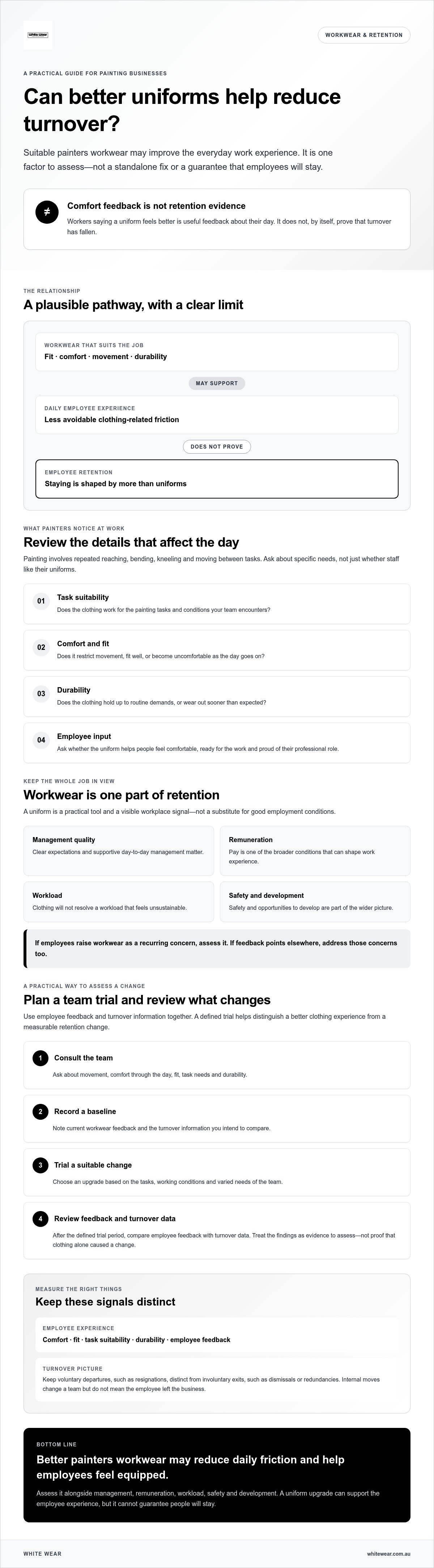
How to test whether better painters workwear supports retention
A structured trial can show whether a workwear change addresses a problem your painters actually experience. It won’t prove on its own that uniforms caused a change in retention, especially in a small team, but it can give you clearer evidence for your next decision.
Build a useful uniform trial with the team
Start with the people who wear the clothing. Ask about task demands, fit, movement and specific frustrations. Then agree on what you’ll test and how you’ll assess it before the trial begins.
- Identify the problem. Describe the workwear issue in concrete terms, such as discomfort during particular tasks or garments wearing out sooner than expected.
- Consult staff. Gather input across roles and body types. Ask which tasks expose the problem and what a practical improvement would look like.
- Select suitable clothing. Choose painters workwear that appears appropriate for the team’s actual tasks and conditions. Keep required PPE and hazard controls separate, and don’t use a clothing trial as a substitute for workplace safety assessment.
- Agree on the trial. Decide who will take part, what questions they’ll answer and how feedback will be recorded. Keep the trial manageable, but note the number of participants.
- Review the results. Compare staff feedback and workforce information with the baseline, then decide whether to keep, adjust or stop the change.
Measure employee feedback and retention responsibly
Before introducing new clothing, record the team’s size, the measurement period and the current picture. Use consistent questions before and after the trial so the comparison is meaningful. Track feedback on comfort, fit, durability, wearability and replacement needs, alongside workforce outcomes such as staff departures. Where possible, distinguish voluntary departures from other exits.
Keep the limits visible. A small team may have few departures to compare, while a short trial may capture clothing feedback but not meaningful retention patterns. Pay, workload, management or other changes during the same period may also affect who stays. Record these factors rather than attributing an observed shift to uniforms alone.
Use careful language in your review: employees reported improved comfort, or departures changed during the period. Avoid saying uniforms caused retention to improve unless stronger evidence supports that conclusion. If you’re asking, “can providing better uniforms reduce employee turnover?”, a well-documented pilot can help you decide whether workwear is worth improving for your team, but it can’t promise a particular outcome.
Use the trial findings to guide your selection of painters workwear and clothing suited to your team’s needs.
Choosing painters workwear as part of a stronger retention approach
Use what you’ve learned from staff feedback and any trial to create a clear selection brief. Describe the tasks the clothing needs to suit, the concerns it should address and what employees value in workwear. This keeps the decision grounded in the realities of the job, rather than assumptions about what might improve retention.
What to look for in painters clothing
Assess each option against the team’s actual work. Consider whether the fit allows comfortable movement, whether the clothing feels practical for routine tasks and whether its durability seems suited to everyday use. Ask workers to evaluate options where possible, and check available product details before deciding. For help thinking through one part of that choice, see the painters pants selection guide.
- Task suitability: Does the clothing make sense for the work employees do?
- Comfort and fit: Can staff move and work comfortably in it?
- Durability: Do the product details align with the demands your team reports?
- Employee feedback: Do workers consider it a practical improvement?
These criteria turn general feedback into a useful brief. They don’t replace a separate assessment of PPE or workplace safety requirements. Where a garment must meet a particular work or safety need, confirm that need through the appropriate process before selecting clothing. For staff who commute in low light or work in active urban environments where everyday visibility is a priority, practical solutions from MOONANDBACK illustrate how functional, reflective apparel can complement daily safety alongside standard workwear.
Make workwear one part of the employee experience
Workwear can be a considered part of how a business equips its people, but it works alongside listening, sound management, fair conditions and attention to safety. Before expanding a uniform trial, review what employees said and whether workforce indicators offer useful context. If the feedback points to other concerns, make room to address those too.
White Wear specialises in painters workwear and clothing for professional painters. Its focus on this category may make its apparel relevant as you compare options, but it isn’t evidence that a uniform change will reduce departures. The question, can providing better uniforms reduce employee turnover, is best approached with a specific team concern, worker input and realistic expectations.
Start by reviewing the workwear issues your team has raised, then explore White Wear painters workwear as one option to consider for your selection brief.
Make your next workwear decision count
Can providing better uniforms reduce employee turnover? Suitable painters workwear may support a more comfortable, considered employee experience, but it can’t guarantee people will stay. Its value depends on whether it addresses an issue your team actually reports.
Start with the evidence closest to the work: ask painters about fit, movement, durability and everyday practicality. If you trial an upgrade, compare consistent staff feedback and workforce information, while noting other changes that could affect retention. Keep workwear in perspective alongside fair conditions, good management, appropriate safety measures and opportunities to grow.
White Wear is an Australian specialist in painters workwear and clothing, with nationwide shipping across Australia. If your review points to a need for task-appropriate clothing, explore specialist painters workwear from White Wear as you consider options with your team. A thoughtful review won’t solve every retention challenge, but listening closely and acting on practical concerns is a strong step towards a better workday.
Frequently Asked Questions
Can better uniforms really reduce employee turnover?
Better uniforms may support retention if they address a problem employees experience, but they can’t guarantee fewer departures. Whether can providing better uniforms reduce employee turnover depends on your team’s circumstances. Workwear could improve daily comfort, while pay, management, workload and development also affect whether people stay. Treat a uniform change as one possible improvement, then compare employee feedback and workforce data rather than assuming a change in one caused a change in the other.
How do uniforms affect employee satisfaction at work?
Uniforms can shape everyday work experience because employees wear them through routine tasks and movement. Clothing that feels comfortable, fits well and suits the job may help people feel better equipped. A consistent appearance may also support a professional team image. These are possible benefits, not guaranteed outcomes. Ask workers directly whether their clothing affects comfort, readiness or professional pride, and keep their reported experience distinct from measurable retention results.
What should painting businesses consider when choosing employee uniforms?
Start with the work your team actually does. Consider whether clothing allows comfortable movement, feels practical across painting tasks, fits the people wearing it and seems durable enough for everyday use. Check product details and gather employee feedback before choosing for the whole team. Assess required PPE and hazard controls separately, since uniform preferences don’t establish whether clothing is suitable for a particular safety need or work condition.
Can uncomfortable workwear contribute to employees leaving?
It could contribute to dissatisfaction if clothing repeatedly feels uncomfortable, restricts movement or doesn’t suit the job, but it’s unlikely to explain every departure. Ask employees whether workwear is a recurring concern and which tasks make the issue noticeable. If people identify discomfort, consider a focused clothing review. Also investigate broader issues such as workload, management or pay, so an apparel change doesn’t distract from more pressing reasons employees may be considering leaving.
How can a business measure whether a uniform change is helping retention?
Record baseline employee feedback and workforce information before making a change, including team size and the period being measured. After a trial, ask the same questions about fit, comfort, durability and wearability, then compare staff departures over a consistent period. Note other workplace changes that may affect results. In a small team or short trial, outcomes can fluctuate, so describe patterns carefully rather than claiming the new uniforms caused them.
Should employers ask employees before changing their uniforms?
Yes. Employees can explain how clothing feels during actual painting tasks, where fit or movement is an issue and what they’d value in an alternative. Invite feedback across the team before selecting options, then ask trial participants to report on specific criteria. This grounds the decision in daily work and can uncover needs managers may not see. Consultation won’t guarantee everyone prefers the same choice, so weigh feedback against task suitability.
Are uniforms a substitute for personal protective equipment?
No. A standard uniform shouldn’t be assumed to provide the protection needed for a particular task or hazard. Employers should assess workplace risks and determine suitable PPE and controls separately, using current authoritative Australian guidance and applicable state or territory requirements. Ask a qualified safety professional or relevant authority if the requirements aren’t clear. Comfort and appearance matter in uniform selection, but they don’t replace a proper safety assessment.


