


Walking onto a high-stakes commercial site in 2026 only to be turned away at the induction gate isn't just a blow to your pride; it's an expensive failure in operational precision. You've likely felt the tension of trying to balance rigorous WHS compliance with the need for gear that doesn't fall apart after a single week of heavy labor. Navigating the current uniform requirements for commercial painting sites has become a complex technical challenge, especially with the 2025 OSHA PPE Fit Rule now mandating that apparel must accommodate every body type with clinical precision. It's no longer enough to provide gear that simply works; it must fit the person and the professional standard perfectly.
We're here to bridge the gap between mandatory safety and elite professional authority. You'll learn how to ensure your crew meets the new 2026 certification standards while providing them with painters workwear that offers both dignity and high-performance comfort. This article provides a definitive breakdown of the latest PPE fit regulations, the impact of new VOC standards on gear selection, and the aesthetic benchmarks required to command premium commercial rates. By the end, you'll have a blueprint for a crew that looks as sharp as the finishes they deliver.
Key Takeaways
- Understand why traditional "DIY whites" are being phased out in favor of technical apparel that meets 2026 Tier 1 site induction standards.
- Identify the core components of a compliant kit, including the specific long-on-long uniform requirements for commercial painting sites.
- Discover how to integrate mandatory high-vis safety classes with a refined aesthetic that projects clinical authority and commands premium rates.
- Learn to implement a fleet-wide apparel policy that simplifies the replacement lifecycle of your painters workwear while ensuring crew buy-in.
- Explore how peer-led design in premium painters clothing provides the technical innovation needed to maintain dignity and comfort during grueling shifts.
The Evolution of Commercial Site Entry Requirements
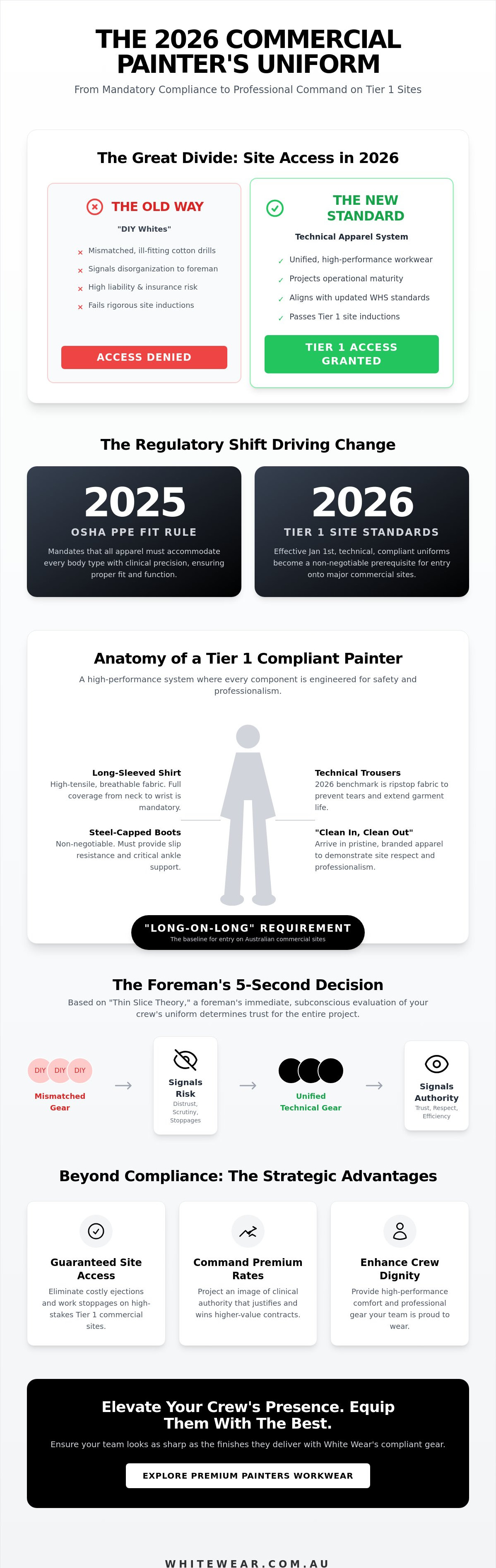
The landscape for commercial painting changed permanently on January 1, 2026. Entry onto a Tier 1 site now requires more than just a bucket and a brush; it requires a documented commitment to safety that begins with your appearance. The days of "DIY whites"—cheap, ill-fitting cotton drills bought from a local hardware store—no longer pass muster during rigorous site inductions. Site managers now view uniform requirements for commercial painting sites as a non-negotiable indicator of your company's internal culture. If your crew arrives in mismatched, paint-splattered rags, the assumption is that their work will be equally disorganized.
Today's standard has shifted toward high-performance systems. Elite painters workwear is designed to integrate seamlessly with other safety protocols, ensuring that protection is built into every fiber. This isn't just about looking good. It's about liability. Insurance providers and principal contractors are increasingly scrutinizing apparel choices to ensure they align with updated WHS standards. A compliant uniform acts as a visible shield against the risk of site-wide shutdowns or individual ejections. It's an investment in your business's standing as a refined, professional entity capable of handling high-value contracts.
Regulatory Frameworks and WHS Compliance
Compliance on Australian commercial sites is governed by a hierarchy of risk management where Personal Protective Equipment (PPE) serves as the final, critical line of defense. For high-risk environments, mandatory apparel often includes long-sleeved shirts and long trousers made from high-tensile, breathable fabrics. Adopting a "Clean In, Clean Out" methodology—where crew members arrive in pristine, branded painters clothing—fosters immediate respect from site safety officers. It demonstrates that your team respects the site boundaries and the professional nature of the project, significantly reducing the likelihood of safety audits or work stoppages.
The Psychology of the Commercial Foreman
The morning induction is a high-pressure environment where decisions are made in seconds. When a foreman sees a crew in unified, technical apparel, it signals a level of operational maturity that reduces friction before the first drop of paint is even mixed. This visual precision suggests that your team follows technical specifications with the same rigor they apply to their presentation. Thin Slice theory in the trades suggests that a foreman's immediate, subconscious evaluation of your crew's uniform determines their trust in your technical ability for the duration of the project. By meeting the uniform requirements for commercial painting sites with elite gear, you eliminate the "Professional Identity" gap and position your business as a Tier 1 partner from the very first hour.
Decoding the Anatomy of a Compliant Commercial Uniform
The anatomy of a compliant uniform is a precise balance of safety engineering and aesthetic discipline. On most Australian commercial sites, the "long-on-long" requirement serves as the baseline for entry. This means your crew must be covered from neck to wrist and waist to ankle, regardless of the temperature. Meeting the uniform requirements for commercial painting sites isn't just about covering skin; it's about selecting apparel that functions as a high-performance system during a grueling ten-hour shift. When every component of the outfit is purposefully chosen, it transforms from simple utility into a tool of the trade.
Footwear is the foundation of this system. Steel-capped boots are non-negotiable on commercial projects to protect against heavy equipment and falling debris. While local standards vary, referencing the broader OSHA Painting Regulations provides a clear global perspective on why specialized protective clothing is essential for hazardous environments. Proper footwear must offer slip resistance and ankle support, ensuring that a painter's focus remains on the finish rather than their footing. Investing in refined painters workwear ensures your crew remains compliant without sacrificing the brand’s visual identity.
Technical Trousers: Beyond the Basic White
The 2026 industry benchmark for durability is ripstop fabric. This cross-hatched weave prevents small snags from becoming catastrophic tears, extending the lifecycle of the garment significantly. Modern technical trousers must also feature integrated knee protection. While external pads are common, internal padding systems are increasingly preferred for their streamlined appearance and reduced snagging risk. A multi-functional pocket system is equally vital; it must provide secure, easy-access storage for scrapers, tape, and mobile devices without compromising the garment's 360-degree movement or refined fit.
Upper Body Protection and Breathability
The industry is rapidly moving away from 100% cotton in favor of advanced technical blends. These modern fabrics offer superior moisture-wicking properties, pulling sweat away from the body to manage thermoregulation during intense labor. For outdoor commercial projects, UV protection is a mandatory specification, requiring fabrics with high UPF ratings to shield workers from the Australian sun. These technical shirts maintain their professional structure and color even after repeated industrial laundering, ensuring your crew looks as polished at the end of the week as they did on Monday morning. By prioritizing these specific uniform requirements for commercial painting sites, you provide your team with the dignity of high-end gear that actually works as hard as they do.
Safety Standards vs. Professional Aesthetics: Finding the Balance
Commanding premium rates requires more than technical skill; it demands a visual presence that justifies the investment. When your crew arrives on site, their appearance is the first deliverable the client evaluates. If your safety gear looks sloppy or ill-fitted, it immediately undermines your authority. Balancing the rigid uniform requirements for commercial painting sites with a refined aesthetic is the hallmark of an elite contractor. You don't have to choose between being safe and looking professional. Modern design allows you to project clinical authority even while adhering to the most stringent high-visibility mandates.
Safety is non-negotiable, but the way you implement it defines your brand. High-performance safety gear should feel like a natural extension of your professional identity, not a cumbersome afterthought. Following recognized industry standards, such as the IUPAT Safety Guidelines, ensures your team remains protected while maintaining the high-end look necessary for Tier 1 commercial projects. This integration is where luxury lifestyle design meets industrial necessity, providing your crew with the dignity they deserve during grueling hours of labor.
High-Visibility Integration for Painters
Navigating AS/NZS 4602.1:2011 standards is essential for any commercial painting crew. You must understand the distinction between Class D (day use) and Class D/N (day and night use) to ensure your team is never turned away from a site induction. Night requirements mandate specific reflective taping patterns that must remain visible and intact. Elite painters clothing incorporates these safety colors through sophisticated paneling and high-quality reflective materials. This approach ensures your brand identity remains clear and polished, even when high-vis orange or yellow is a site-specific requirement.
Fabric Innovation: The Science of the Workday
The science of the workday is found in the fibers of your gear. Modern technical fabrics now feature specialized coatings designed to repel commercial-grade solvents and fine dust, keeping your crew looking pristine for longer. Reinforced stress points in high-movement areas, such as the crotch and knees, prevent the unsightly blowouts that often plague generic workwear. We focus on balancing fabric weight to provide maximum durability without sacrificing breathability. This ensures that even after ten hours of intense labor, your team maintains their physical dignity and professional silhouette. By meeting the uniform requirements for commercial painting sites with these innovations, you ensure your crew is equipped for both peak performance and elite presentation.
Implementing a Fleet-Wide Uniform Standard
Establishing a fleet-wide standard is the final step in mastering the uniform requirements for commercial painting sites. It's the difference between a group of individuals and a cohesive, elite unit. A successful policy doesn't feel like a restriction. Instead, it feels like an upgrade to the crew's professional toolkit. When your team understands that high-quality painters clothing is provided to ensure their comfort and safety, compliance becomes a matter of pride rather than a chore. You're not just enforcing a dress code; you're providing the gear that allows them to perform at their peak while maintaining their professional dignity.
The "Clean In, Clean Out" protocol is essential for maintaining site relationships. It mandates that every crew member arrives in pristine condition. This isn't just for show. It signals to the principal contractor that your team respects the workspace. Before the morning toolbox talk, conduct a quick "site-ready" audit. Check for proper footwear, intact high-vis elements, and clean whites. If a garment is frayed or permanently stained, it’s time for a replacement. Managing the lifecycle of your painters workwear ensures that your brand’s visual authority never wavers, helping you meet the long-term uniform requirements for commercial painting sites with ease.
The Professional Maintenance Protocol
Training apprentices is where the culture of precision begins. They must learn that technical whites are a refined investment, not a disposable utility. Knowing how to properly clean and care for white workwear is a vital skill that preserves the integrity of the garment. Technical fibers require specific care to maintain their stain-repellent properties and moisture-wicking breathability. When your team knows how to get paint out of work clothes without damaging the fabric, they extend the life of their gear and maintain a sharper silhouette on site. This attention to detail reflects the clinical authority of your entire operation.
Branding and Visual Consistency
Visual consistency is a powerful tool during the tender process. When a principal contractor sees a unified crew, they see a company that manages its details with clinical precision. Standardizing logo placement, typically on the left chest and center back, creates an elite appearance that generic crews can't match. This level of Painters Uniforms for Company Branding often becomes the deciding factor in winning high-value commercial contracts. It signals that your business is an insider expert that understands both the science of the task and the importance of a polished appearance.
Ready to equip your team with gear that commands respect? Explore our full collection of painters workwear and set a new standard for your business today.
Elevating Your Presence with White Wear Signature Gear
Choosing the right gear is a decisive act of leadership. White Wear has emerged as the preferred choice for elite Australian commercial crews because we understand the grueling reality of a ten-hour shift. Our apparel is the result of peer-led development. It's built by painters who've faced the exact same gate inductions and site audits you navigate daily. We've fused clinical authority with high-end luxury to ensure that meeting the uniform requirements for commercial painting sites feels like a badge of honor rather than a regulatory burden. Every stitch matters. Every pocket has a purpose.
Our technical whites set the 2026 industry benchmark for excellence. They provide the structural integrity required for heavy-duty labor while maintaining a silhouette that belongs on a high-end architectural project. This linguistic and visual duality reinforces your position as an insider expert. You understand the science of the task. You also respect the human desire to maintain a polished, refined appearance. We provide the trade with the dignity and comfort it has long been denied by generic, mass-produced workwear.
Refined Essentials for Commercial Success
Our ripstop painters pants are a masterclass in durability and form. The reinforced weave ensures that a minor snag on a scaffold doesn't end in a costly garment failure or a WHS violation. This isn't just about longevity. It's about providing your crew with a sense of upward mobility and refinement. When you provide gear that repels dust and resists the harshest commercial solvents, you're making a strategic business investment. It's an asset that pays dividends in reduced turnover and increased crew morale. High-performance apparel allows your team to focus on the precision of their craft, knowing their gear won't fail them during the most demanding hours of the workday.
Secure Your Crew’s Professional Legacy
Outfitting a full commercial team shouldn't be a logistical nightmare. White Wear simplifies the process, offering a streamlined system for maintaining visual consistency across your entire fleet. In a competitive market, your presentation is your silent resume. Superior apparel gives you the edge needed to secure Tier 1 contracts and command the rates your skill deserves. It's time to move beyond the status quo. Embrace a standard that reflects your technical mastery and your commitment to excellence. Meeting the uniform requirements for commercial painting sites is just the beginning; commanding the site is the goal.
Elevate your commercial presence with White Wear’s signature collection.
Mastering the Standard for a New Era of Commercial Precision
The evolution of the modern workspace demands a decisive shift from generic utility to technical excellence. You've seen how the 2026 standards prioritize both safety and anatomical fit, making the right choice in apparel a critical component of site access. By mastering the uniform requirements for commercial painting sites, you're doing more than checking a compliance box; you're equipping your team with the dignity and confidence required to handle high-stakes projects. This commitment to visual and functional precision is what distinguishes a standard crew from an elite commercial partner.
White Wear provides the refined essentials necessary to bridge the gap between mandatory WHS protocols and professional branding. Our gear is the result of peer-led development by professional painters, featuring advanced technical ripstop fabrics designed specifically for 2026 industry benchmarks. With national shipping available across Australia, outfitting your team with clinical authority has never been more accessible. It's time to invest in apparel that works as hard as your crew does.
Outfit your crew with Australia’s leading commercial-grade painters workwear and secure your position as a Tier 1 industry leader. Your journey toward a more professional, compliant, and comfortable workplace starts with the very first layer.
Frequently Asked Questions
What are the mandatory PPE requirements for commercial painting in Australia?
Mandatory PPE on Australian sites follows a strict hierarchy of risk control designed for maximum safety. This typically includes high-visibility apparel, steel-capped boots, and protective eyewear as the baseline. For painters, respiratory protection and chemical-resistant gloves are essential when handling specialized industrial coatings. Meeting the uniform requirements for commercial painting sites ensures your crew is induction-ready from the first hour. It provides a clinical line of defense against the physical demands of the project.
Can I wear painters shorts on a commercial construction site?
Most Tier 1 commercial sites enforce a strict "long-on-long" policy, which prohibits the use of shorts. This mandate protects workers from skin contact with hazardous chemicals, UV exposure, and physical abrasions. While shorts might seem cooler, technical trousers made from breathable ripstop fabric offer superior protection without compromising comfort. Choosing refined painters workwear ensures your team stays compliant while maintaining a professional silhouette throughout the grueling ten-hour workday.
How do I ensure my branded uniforms meet high-visibility safety standards?
High-visibility integration must adhere to AS/NZS 4602.1:2011 standards to remain site-compliant. This involves using specific fluorescent background materials and retroreflective tapes in approved patterns for Day, Night, or Day/Night use. We recommend selecting premium apparel that blends these safety colors with your brand identity with clinical precision. It’s a delicate balance of maintaining professional authority while ensuring your crew is visible in every light condition on site.
What is the difference between domestic and commercial painting uniform requirements?
Domestic projects often allow for relaxed attire, but commercial sites demand rigorous WHS adherence and visual consistency. Commercial uniform requirements for commercial painting sites often mandate specific high-vis classes and full skin coverage. Beyond safety, commercial work requires a level of visual precision that signals technical competence to large-scale contractors. It’s the difference between simple utility and a refined essential designed for high-stakes, professional environments.
How often should a commercial painting crew be issued new uniforms?
We suggest a replacement cycle of six to twelve months depending on the intensity of the labor. If a garment shows signs of structural failure, such as compromised reflective tape or frayed hems, it must be replaced immediately. Providing fresh painters clothing regularly ensures your crew maintains an elite appearance that justifies premium rates. It’s a strategic business investment that reinforces your commitment to dignity and professional standards during every shift.
Are there specific requirements for footwear on Tier 1 painting sites?
Steel-capped safety boots are a non-negotiable requirement for entry onto any Tier 1 commercial site. These boots must meet AS 2210.3 standards to protect against impact and compression risks from heavy equipment. Beyond the toe cap, look for slip-resistant soles and ankle support to handle the physical demands of the project safely. Proper footwear is the foundation of a safe, induction-ready kit that commands immediate respect from site managers.
Why are white uniforms still the standard for commercial painting in 2026?
White remains the industry benchmark because it provides immediate visual feedback on cleanliness and spill management. It allows painters to spot wet product before it transfers to finished surfaces, protecting the integrity of the project. Modern technical whites offer an aspirational twist on this tradition, using advanced fabrics that repel stains while projecting clinical authority. It’s a timeless aesthetic refined for the modern, fast-paced professional environment.
How does a professional uniform affect my ability to win commercial tenders?
A unified crew presentation acts as a silent resume during the high-stakes tender process. It demonstrates a level of operational maturity and attention to detail that principal contractors find reassuring. When your team arrives in premium painters workwear, it signals that you manage your business with the same precision you apply to your finishes. Elite presentation often becomes the deciding factor in securing high-value commercial contracts and commanding premium rates.


