


With 41% of Australian trade workers currently wearing inadequate or non-compliant protective clothing, the line between a professional finish and a safety liability has never been thinner. You understand that your workwear is more than just a uniform; it's a critical tool of the trade. Yet, many professionals still struggle with trousers that snag on scaffolding or restrict movement during delicate floor-level cutting-in. Mastering how to choose the right size painters pants is the first step in reclaiming your range of motion and your professional image.
We agree that looking the part is just as vital as the precision of your brushwork. You deserve a fit that offers both clinical authority and unhindered performance. This guide will help you master the technical art of finding the perfect fit to ensure your workwear enhances your safety and professional dignity. We'll explore the relationship between fabric weight and mobility, the impact of 2026 safety regulations, and how to achieve a polished, tapered silhouette that commands respect from your high-end residential clients.
Key Takeaways
- Master the professional measurement protocol to ensure your waist fit supports tool-carrying weight and your inseam length provides safety on ladders.
- Transition from traditional baggy fits to refined, tapered silhouettes that eliminate snagging hazards while maintaining a clinical, professional appearance.
- Learn how to choose the right size painters pants by accounting for the specific shrinkage factors and technical properties of premium drill cotton versus modern stretch blends.
- Understand why precision sizing is a critical investment in your professional branding, preventing the "broken window" effect of sloppy, oversized workwear.
- Implement a cohesive "White Wear" standard for your crew to project an image of reliability and technical mastery to high-end residential clients.
Why Precision Sizing is a Professional Necessity
Precision sizing is not a luxury; it is a technical requirement for the modern trade professional. Many contractors view sizing as a secondary concern, often opting for oversized garments under the mistaken belief that extra fabric provides better protection or mobility. This is a false economy. Ill-fitting workwear doesn't just feel cumbersome; it actively degrades your performance and compromises your safety throughout a ten-hour shift. When you prioritize learning how to choose the right size painters pants, you aren't just buying clothes. You are investing in a refined essential that supports your physical endurance and professional standing.
In the world of high-end residential painting, your appearance serves as your first quote. Excess, sagging fabric creates what we call a "broken window" effect in your branding. It signals a lack of attention to detail before you even open a tin of paint. Our philosophy is rooted in the belief that painters workwear should provide dignity and comfort during grueling hours of labor. A precise fit reflects the same level of mastery you bring to a finish coat, ensuring you look like the expert you are.
The Safety Liability of Poor Fit
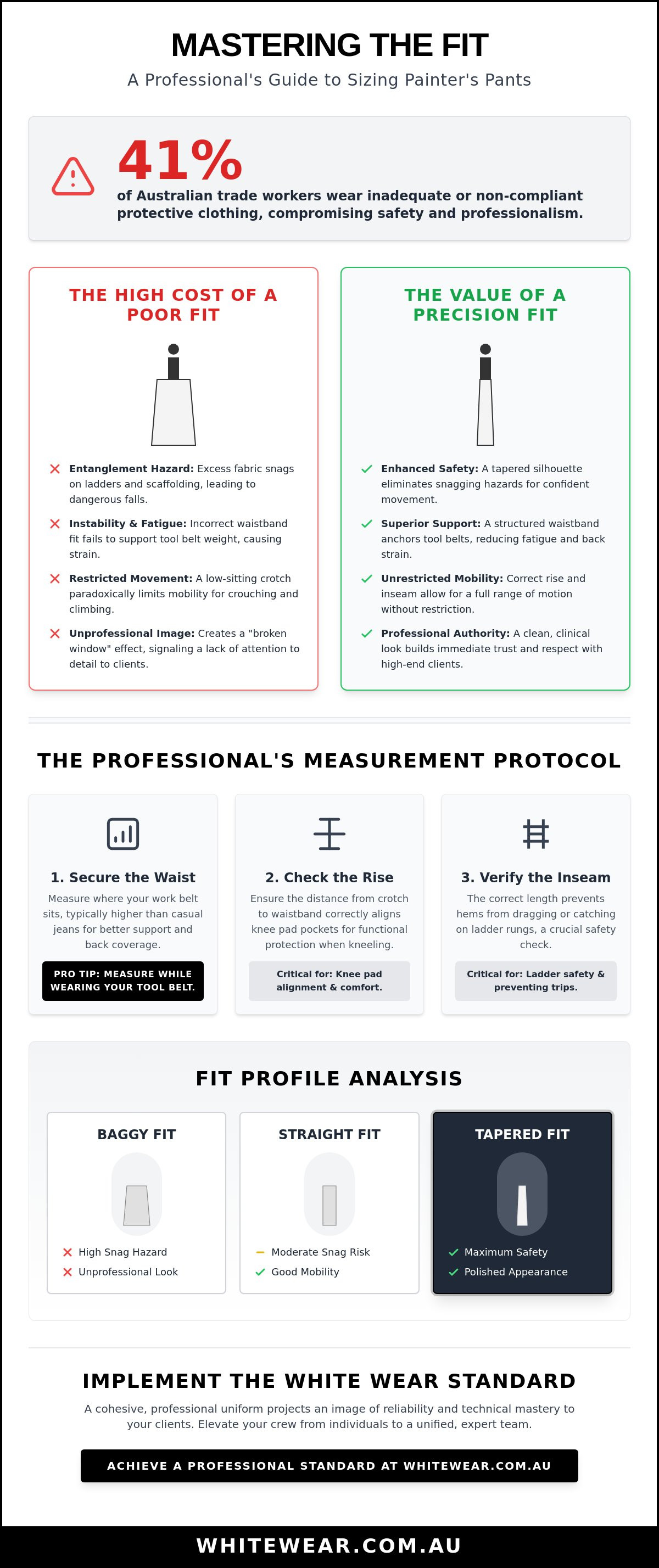
Loose hems and baggy silhouettes are more than a nuisance; they are genuine entanglement hazards on Australian commercial sites. Baggy trousers significantly reduce your spatial awareness, making it difficult to judge clearances when navigating narrow scaffolding or descending ladder rungs. A precise fit ensures that your clothing moves with your body, not against it. Consider these specific risks associated with poor fit:
- Entanglement: Excess fabric at the ankle can easily catch on scaffolding hooks or ladder feet, leading to dangerous falls.
- Instability: A structured, correctly sized waistband is critical for safely supporting the weight of a heavy tool belt. Without this stability, the constant shifting of weight leads to physical fatigue and potential lower back strain.
- Restricted Movement: Paradoxically, pants that are too large often restrict movement because the crotch sits too low, preventing you from stepping up or crouching comfortably.
Aspirational Professionalism and Client Trust
The psychological impact of your silhouette on a client cannot be overstated. A tailored, clinical look communicates discipline and technical authority. It immediately differentiates a career professional from a weekend hobbyist. When you present a polished, intentional image, you build immediate rapport and trust with high-end clients who expect excellence in every facet of the job. Understanding how to choose the right size painters pants allows you to maintain this elite standard without sacrificing the practical needs of the site. For a deeper look at how your gear defines your brand in the modern market, explore The Professional Painter’s Guide to Elevated Workwear in 2026.
The Professional’s Measurement Protocol
Static measurements often fail the reality of a ten-hour shift. To understand how to choose the right size painters pants, you must move beyond the standard tape measure approach used for casual attire. Professional workwear requires a dynamic assessment. It must account for the weight of your tools, the height of your reach, and the depth of your squat. This protocol ensures your gear remains a supportive partner rather than a restrictive barrier.
In the Australian trade environment, we deal with extreme heat and repetitive physical strain. Your clothing must facilitate airflow and movement. A precise measurement protocol is the only way to guarantee that your trousers won't bind at the hip or drag at the heel, both of which lead to premature wear and professional fatigue.
Securing the Waist and Rise
Your work trousers should sit higher than your weekend jeans. A higher rise provides essential lower back coverage and ensures your tool belt remains anchored during repetitive bending. When measuring your waist, do so exactly where you intend the belt to sit. For the most accurate result, take this measurement while wearing your standard tool pouch or belt. This accounts for the slight compression of the fabric under load.
The "rise" is the distance from the crotch seam to the top of the waistband. This technical specification is vital because it dictates the alignment of integrated knee pad pockets. If the rise is too short, the pads will sit too high on your thighs when you kneel, rendering them useless and causing discomfort. Investing in premium painters clothing with a considered rise ensures your protection stays exactly where it’s needed.
Determining the Correct Leg Length
Leg length is a balance between safety and protection. We distinguish between the outseam, which tracks the external length, and the inseam, which measures the inner leg from crotch to hem. For painters, the inseam is the primary metric. You require a slight "stack" of fabric at the boot. This extra length prevents "high-water" trousers that expose your ankles or allow paint to seep into your footwear when you are reaching at the top of a ladder.
- Measure with boots: Always take your leg measurements while wearing your professional work boots. The heel height and bulk of the boot change how the hem sits.
- The Squat Test: Once you have your numbers, perform a deep squat. If the fabric pulls tight across the seat or the hem rises above the boot collar, you need more volume or a longer inseam.
- Ladder Reach: Extend your arms fully upward as if cutting-in a ceiling. Your waistband should remain stable without pulling down, and your hems should still cover your boot tops.
This clinical approach to sizing prevents the common frustration of ruining high-quality gear due to poor fit. It ensures your movement remains fluid and your professional image remains intact from the first drop sheet to the final walkthrough.
Analysing Fit Profiles: Tapered vs. Straight vs. Baggy
The traditional image of the painter often involves billowy, oversized trousers. This legacy fit was born from a time when fabric lacked technical stretch, forcing manufacturers to add volume to allow for movement. Today, this approach is obsolete. When you understand how to choose the right size painters pants, you move toward a more refined, tapered silhouette that balances mobility with a clinical aesthetic. Modern fabric innovations, like mechanical stretch weaves, allow for a closer fit that doesn't compromise your range of motion.
One of the most overlooked technical hazards of baggy gear is the "brush-past" risk. In tight residential corridors or high-end foyers, excess fabric at the hip or thigh acts as an accidental sponge. A single stray fold of cloth can smear a wet surface, forcing an expensive and time-consuming rework. A structured silhouette eliminates this liability, keeping your focus on the finish rather than your hems. It’s a design choice that prioritises both the integrity of your work and your professional dignity.
This precision is equally critical for women’s work wear. For too long, the industry relied on "shrunk and pinked" unisex sizing that fails to account for female ergonomics. A proper fit for women isn't about style alone; it's about ensuring the waistband and seat provide the necessary support and coverage for a full range of motion without the bulk of a generic cut. A peer-led design approach ensures that every curve is accounted for, providing a polished appearance that commands respect on any site.
The Problem with Oversized Apparel
In the harsh Australian summer, excess fabric is your enemy. Baggy legs trap pockets of stagnant heat, significantly increasing thermal strain and workday fatigue. This leads to a constant cycle of "tugging" and readjustment as the weight of the fabric pulls against your movement. Modern painters clothing uses precision-tailored cuffs to ensure clean lines, preventing the hem from dragging through wet drop sheets or snagging on ladder feet. A clean cuff isn't just about aesthetics; it's about maintaining a clear, safe workspace.
The Advantages of a Structured Silhouette
A tapered leg offers superior spatial awareness. When you're navigating narrow scaffolding, being able to see your feet clearly is a fundamental safety requirement. A fitted seat also prevents the unprofessional "plumber's crack" during low-level cutting-in, maintaining your dignity in front of clients. For a detailed breakdown of how different cuts compare in the field, consult The Professional Guide to Choosing the Best Painters Pants in 2026. By choosing a structured fit, you project an image of upward mobility and technical mastery that resonates with high-end residential clients.
The Science of Fabric and Its Impact on Fit
Technical performance starts at the fiber level. When evaluating how to choose the right size painters pants, you must consider the interplay between fabric weight and structural integrity. In the Australian market, a fabric weight of 300-320 GSM (Grams per Square Metre) is the gold standard for professional duty. This specific weight provides a robust barrier against solvent penetration while maintaining the breathability required for high-intensity shifts. Thin, lightweight fabrics often compromise the fit by sagging under the weight of tools or allowing paint to bleed through to the skin, regardless of how well the trousers are initially sized.
Shrinkage is a reality of high-quality professional textiles, particularly with natural fibers. Premium drill cotton is specifically woven for durability, but it behaves differently than the fast-fashion blends found in generic retail. While we engineer our garments to minimize distortion, a small shrinkage factor should be expected after the first few high-temperature washes. If you find yourself between sizes, we recommend opting for the larger increment to ensure the trousers maintain their clinical silhouette and unhindered range of motion over the product's lifespan.
Drill Cotton vs. Flexible Synthetics
Specialized drill cotton acts as a technical shield for your skin. It provides a dense, protective layer that resists the abrasive nature of sanding and the chemical bite of strippers. This material requires a brief break-in period where the fibers soften and mold to your specific movement patterns. In contrast, modern stretch blends offer immediate flexibility but can sometimes lose their shape if the sizing is too tight, leading to a baggy appearance by midday. Choosing professional painters workwear ensures you receive a fabric that balances moisture-wicking properties with long-term shape retention.
Accounting for Movement and Gussets
A gusseted crotch is a non-negotiable technical feature for trade-specific sizing. This diamond-shaped insert redistributes stress away from the main seams, allowing you to crouch or climb without the fabric binding or tearing. Similarly, articulated knees incorporate pre-shaped folds that mirror the natural bend of your leg. This affects your leg length measurement; because the trousers are designed to sit correctly while you are in motion, you don't need to overcompensate with excessive length that might otherwise drag on the floor. Our specialized fabrics are engineered to maintain this precise geometry over countless wash cycles, ensuring your professional image remains as sharp as your cut-in lines.
Implementing the White Wear Standard for Your Crew
Professionalism is a collective pursuit. While an individual painter may master their craft, the true strength of a contracting business lies in its unified presentation. Transitioning your team to a standardized fit profile isn't merely a logistical task; it is a strategic branding move. When your entire crew understands how to choose the right size painters pants, the result is a clinical, high-performance aesthetic that resonates with premium clients. A cohesive appearance signals that your business operates with the same precision you apply to a heritage restoration or a modern architectural finish.
Establishing this standard requires a shift in mindset. We view painters workwear as a refined essential, a tool that supports the physical longevity of your staff. By moving away from the "one-size-fits-most" mentality of traditional suppliers, you empower your crew to work with greater safety and dignity. This commitment to quality transforms your workforce into a visible extension of your brand’s technical authority.
The ROI of Refined Essentials
Investing in durable, correctly sized gear offers a significant return on investment compared to the false economy of disposable alternatives. Ill-fitting trousers wear out faster due to friction and unnecessary stress on seams. By contrast, precision-fitted apparel maintains its structural integrity through hundreds of wash cycles. Beyond durability, the "uniform effect" plays a pivotal role in winning high-value commercial tenders. A polished team appearance builds immediate trust, suggesting a level of discipline that sets your business apart from less organized competitors. For a deeper analysis of this impact, see our guide on Painters Uniforms for Company Branding.
To implement this successfully, conduct a "sizing audit" for your business. This involves more than just collecting waist measurements. It requires ensuring every team member understands the dynamic measurement protocol, accounting for their specific role and tool-carrying requirements. This audit ensures that your team doesn't just wear a uniform, but wears it with the intention and pride of a specialist.
The White Wear Commitment
Our approach is rooted in peer-led development. We don't design in a vacuum; we design for the temporal reality of the Australian workday. Every seam, gusset, and pocket is the result of firsthand experience on the tools. We believe that trade professionals deserve better than the status quo of baggy, uninspiring utility wear. By providing apparel that balances modern lifestyle elegance with clinical authority, we support the protagonist of the job site, the painter who demands excellence from themselves and their gear. A painter’s trousers are not just a covering; they are the foundation of their professional operation. Treat your work wardrobe as a professional toolkit, and your business will reflect that same level of upward mobility and refinement.
Redefining the Standard of Trade Excellence
Mastering the technical nuances of how to choose the right size painters pants is a decisive step toward professional longevity. By prioritizing a dynamic measurement protocol and selecting structured silhouettes, you eliminate the safety hazards and branding liabilities inherent in baggy, oversized gear. You've learned that the science of fabric weight and the precision of a gusseted rise are not just details; they're the technical specifications of a high-performance toolkit.
Our peer-led development ensures that every garment is a refined essential designed to withstand the unique demands of the Australian climate. We provide sophisticated designs that offer the dignity and comfort you deserve during grueling hours of labor. Elevate your professional standard with White Wear’s refined painters workwear.
Your work reflects your mastery; your clothing should do the same. Step onto your next project with the confidence of a professional who understands that precision starts long before the first brushstroke.
Frequently Asked Questions
Can I wear jeans for professional painting jobs?
Jeans are inadequate for the technical demands of high-end professional painting. Standard denim lacks the specialized 300-320 GSM protection required to prevent solvent bleed-through and doesn't offer the necessary pocket layouts for 5-in-1 tools. Professional painters clothing is specifically engineered to reflect heat and highlight fresh paint smudges, helping you maintain a clinical appearance that casual denim simply cannot provide.
How much "extra room" should I leave for movement when measuring?
You shouldn't add arbitrary extra inches if the garment features a gusseted crotch and articulated knees. These technical design elements already provide the volume required for deep squats and ladder climbs. Focus on capturing an accurate, snug measurement of your waist and inseam. Adding unnecessary room leads to excess fabric that snags on scaffolding and creates an unprofessional, baggy silhouette.
Why is white the traditional colour for professional painters workwear?
White is the industry standard because it reflects solar heat during grueling Australian summer shifts and highlights wet paint to prevent accidental smudging. It projects a sense of clinical cleanliness and mastery to your clients. This standard allows you to spot spills immediately, ensuring you don't inadvertently track wet product across a client's expensive flooring or heritage finishes.
Do painters pants shrink after the first wash?
High-quality drill cotton typically experiences a minor shrinkage factor of approximately 2% to 3% after the initial high-temperature wash. This is a natural characteristic of premium natural textiles. When you are learning how to choose the right size painters pants, consider this slight contraction. If your measurements sit at the absolute top of a size bracket, moving up ensures long-term comfort.
Should I choose a larger size if I plan on wearing knee pads underneath?
No, you should select your standard size if the trousers feature integrated knee pad pockets. These technical compartments are engineered to accommodate standard pads without requiring additional waist or leg volume. Sizing up specifically for pads often results in a sagging seat and misplaced knee protection, which compromises both your professional silhouette and your safety during floor-level work.
What is the best way to measure the inseam for work trousers?
The most accurate method is to measure from the crotch seam to the top of your work boot while standing upright. This ensures you account for the "stack" required to prevent paint from entering your footwear. Never measure your leg length without your professional boots on; the heel height and bulk of the boot significantly change how the hem should sit.
Is there a difference in sizing between painters pants and painters overalls?
Overalls require a more generous fit through the midsection to allow for the continuous fabric spanning from the waist to the chest. While waist measurements might remain similar, the torso length is a critical metric for overalls to prevent binding when you crouch. Trousers offer a more tailored, modern silhouette that many professionals prefer for a clinical, upwardly mobile appearance.
How should I choose a size if I am between waist measurements?
We recommend selecting the larger size to maintain unhindered movement during high-intensity physical labor. A slightly larger waist can be comfortably secured with a professional tool belt, whereas a size that is too small will restrict your range of motion and increase thermal strain. This approach ensures your workwear remains a refined essential that supports your performance throughout the workday.


