


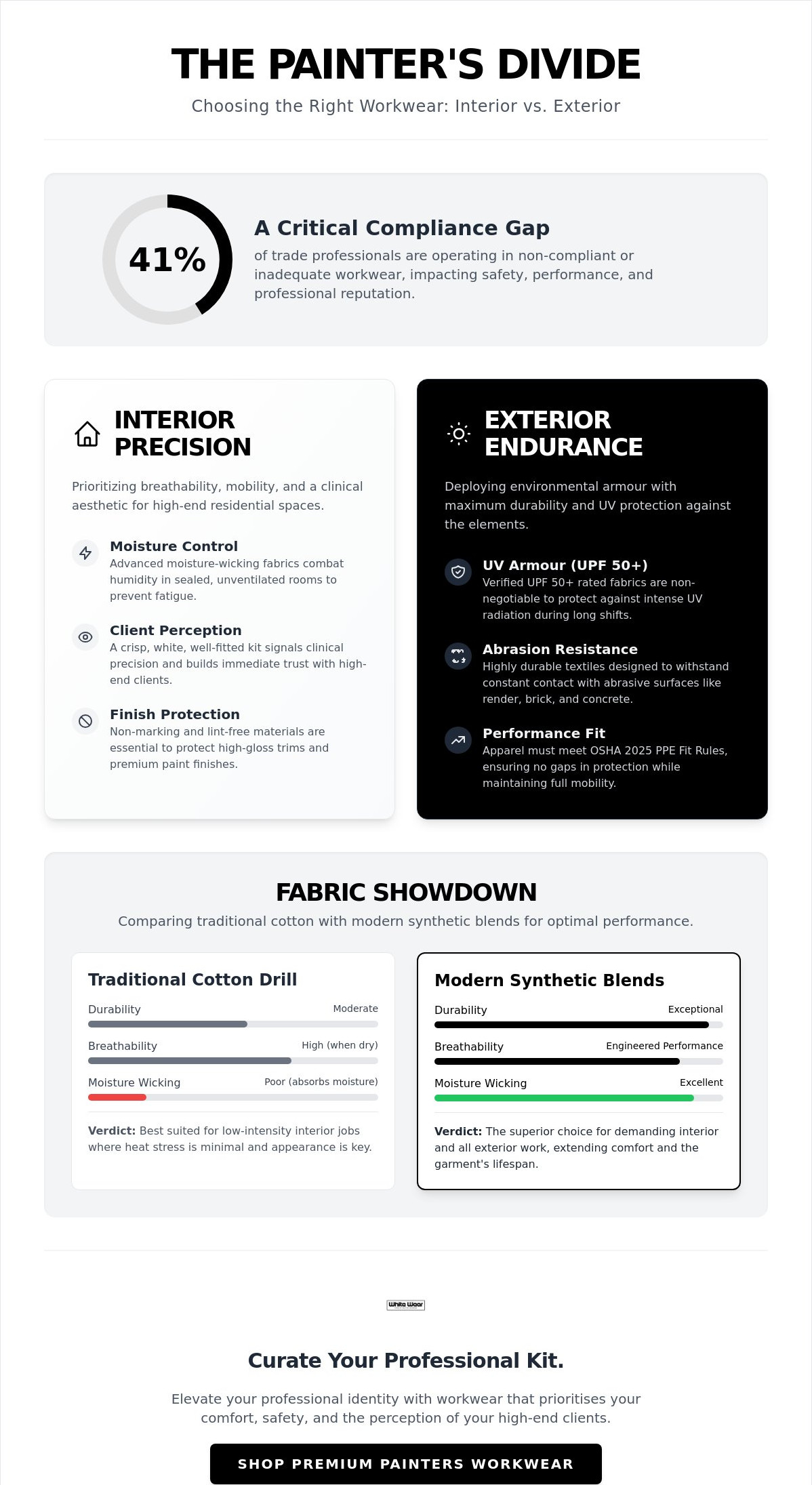
Did you know that 41% of trade professionals are currently operating in non-compliant or inadequate workwear? This staggering statistic reveals a silent drain on both your safety and your professional reputation. Whether you're battling a mid-summer exterior shift or executing a high-end residential interior, your attire is more than just a uniform. It's your environmental armour. Understanding the strategic nuances of painters clothing for interior vs exterior work is the difference between struggling through your shift and performing with effortless precision.
We understand that the physical demands of your workday require more than a generic solution. It's frustrating to face heat exhaustion on a scaffold or feel underdressed in a clinical, luxury setting. This guide will help you master the technical specifications of professional apparel to optimise your comfort, safety, and client perception. We'll explore the latest OSHA 2025 PPE fit rules, the cooling benefits of specific fabric weights, and how the right gear extends the lifespan of your professional investment. By the end of this article, you'll know exactly how to transition your kit to meet the demands of any environment.
Key Takeaways
- Learn how to maintain a clinical, high-end aesthetic in residential spaces while ensuring maximum breathability through advanced moisture-wicking properties.
- Discover the essential technical requirements for exterior workwear, including UPF ratings and durability standards needed to withstand the Australian sun and abrasive surfaces.
- Understand the strategic differences between painters clothing for interior vs exterior work to prevent premature fatigue and extend the lifespan of your professional investment.
- Compare the functional benefits of traditional cotton drill against modern synthetic blends to select the optimal textile for your specific job site conditions.
- Elevate your professional identity by curating a refined workwear kit that prioritises both your physical comfort and the perception of your high-end clients.
The Environmental Divide: Why Context Matters for Professional Apparel
The clock hits 7:00 AM. For the next ten hours, your body is your primary tool. But every tool requires the right casing. A climate-controlled luxury penthouse demands a different tactical approach than a sun-drenched coastal facade. Many professionals fall into the trap of using the same gear for every project, yet the strategic differences in painters clothing for interior vs exterior work are profound. Your workwear is a specialized form of Personal Protective Equipment (PPE). Treating it as a generic uniform is a recipe for premature fatigue and reduced productivity.
"One-size-fits-all" is a myth that actively hurts your bottom line. If your trousers are too heavy for an indoor project, you're battling unnecessary heat stress. If they're too thin for the outdoors, they'll shred against abrasive brickwork within weeks. This isn't just about comfort; it's about performance. A painter who isn't fighting their clothes is a painter who maintains precision until the final hour. Under the OSHA 2025 PPE Fit Rule, proper fit is now a compliance requirement, moving beyond mere preference to a professional standard. It's about ensuring there are no gaps in your protection while you move through the physical demands of the day.
Defining the Interior Workday
Interior sites often lack natural airflow, turning rooms into heat traps. Here, mobility in tight spaces is paramount. Your apparel must act as a silent partner. We're talking about non-marking fabrics and lint-free finishes that won't compromise a high-gloss trim. There's a vital psychological element at play. In high-end residential work, you must project clinical authority. You're a specialist entering a private sanctuary. A crisp, white, well-fitted kit tells the client you respect their space. It transforms your presence from a standard laborer into a trusted craftsman.
Defining the Exterior Challenge
The Australian sun is a painter's primary adversary. On exterior sites, your clothing acts as environmental armour. You're facing a trio of threats: intense UV radiation, abrasive render, and variable weather. Standard apparel is obsolete for the modern exterior pro. You need high-performance fabrics with verified UPF 50+ ratings to manage the temporal reality of a full day in the sun. Durability is essential when your gear constantly meets rough-sawn timber or concrete. You need gear that breathes to prevent heat exhaustion while remaining resilient enough to survive the grit of a raw construction site.
Interior Precision: Prioritising Breathability and Client Perception
Interior environments present a unique set of physiological challenges. While exterior work is often defined by the elements, interior projects are defined by their absence. Specifically, the absence of airflow. In a sealed residential room, humidity levels rise quickly as you work. This makes moisture-wicking properties a functional necessity rather than a luxury. When selecting painters clothing for interior vs exterior work, you must account for this lack of ventilation. High-performance fabrics ensure you don't end your shift feeling damp and weighed down by your own exertion. It's about maintaining your stamina from the first drop sheet to the final touch-up.
Client perception is equally critical. You aren't just a technician; you're a professional guest in someone's home. In high-end residential settings, your appearance is the first thing a homeowner evaluates. A crisp, white uniform signals a clinical level of precision. It suggests that if you're this meticulous about your own presentation, you'll be equally careful with their skirting boards and silk-finish walls. This "White Wear" effect creates immediate trust. It establishes a baseline of respect for the sanctuary you've been hired to refine. It transforms you from a standard contractor into an elite artisan.
For women in the trade, this professional stature is often undermined by generic, ill-fitting gear. Apparel that is simply a downsized version of men's wear fails to provide the necessary comfort or the polished aesthetic required for high-stakes interior work. Correct tailoring ensures that mobility isn't compromised during frequent kneeling or reaching in confined spaces. It provides the dignity and confidence needed to lead a site with authority.
The Psychology of Clean Whites
A spotless uniform is a silent communicator. It tells the homeowner that you possess the discipline to work cleanly in a finished space. Even after hours of cutting in, maintaining a polished appearance separates the master from the amateur. This is particularly vital in the luxury market where every detail is scrutinised. For a deeper look at how professional standards are evolving, explore The Professional Woman’s Guide to Elevated Workwear in 2026.
Mobility and Fabric Flexibility
Agility is the hallmark of a productive interior painter. You're constantly transitioning between low-level skirting work and high-reach cornices. Modern painters workwear now incorporates mechanical stretch. This technology provides flexibility through the weave itself, avoiding the degradation often seen with elasticated fibres. Lighter fabric weights, typically around 300 GSM, are preferred indoors to manage temperature without sacrificing protection. These garments must also comply with OSHA regulations for painters regarding safety in confined spaces. Strategic pocket placement is the final touch. It allows you to carry essential tools like scrapers and mobile devices without creating bulk that could snag on furniture or delicate fixtures.
Exterior Endurance: Environmental Armour and UV Protection
The Australian sun is a painter’s primary adversary. While interior projects demand aesthetic precision, exterior work is an exercise in environmental survival. Choosing the right painters clothing for interior vs exterior work requires a fundamental shift in mindset. You're no longer just a craftsman; you're a professional operating in a high-risk climate. On an exterior site, your apparel acts as a technical barrier against solar radiation and abrasive surfaces. It's about maintaining peak performance while the mercury climbs and the UV index hits extreme levels.
Professional standards have evolved beyond the casual "old clothes" approach. Under the DGUV 2026 Heat Stress Guidelines, UV protection is now a mandatory component of a professional risk assessment. This shift mirrors the rigorous OSHA painting safety standards that dictate specific protective requirements for different work zones. For exterior pros, this means full-length protection is non-negotiable. While it's tempting to reach for shorts in the peak of summer, doing so exposes you to cumulative skin damage and site hazards. Modern technical fabrics prove that you don't have to sacrifice cooling for coverage.
Site safety also dictates your aesthetic. Many commercial exterior projects now require compliance with AS 4602.1 and the updated AS/NZS 1906.4:2023 for high-visibility. Your clothing must ensure you're seen by plant operators and vehicle drivers without compromising the breathable, professional look that defines your brand. It's a balance of high-performance utility and the dignity of a well-curated professional kit.
UV Protection and Heat Management
Modern exterior workwear utilizes specialised weaves that block 98% of harmful UV rays. These UPF 50+ rated garments aren't just thick fabrics; they're engineered textiles that facilitate maximum airflow. Ventilation zones are strategically placed in high-heat areas, such as the underarms and back, to create a chimney effect. This keeps your core temperature stable during grueling shifts. To complete your sun-safe kit, consider the insights in Beyond the Basics: The Professional Guide to Essential Painters Accessories in 2026.
Toughness Without the Weight
Exterior surfaces like brick, render, and rough-sawn timber act like sandpaper on standard fabrics. You need environmental armour that can withstand constant abrasion. Reinforced knees and hems are essential, providing a defensive layer where you need it most. The evolution of ripstop fabrics means you can now enjoy heavy-duty protection without the restrictive weight of traditional canvas. These materials allow for brisk, purposeful movement, ensuring you remain agile on scaffolding and ladders throughout a ten-hour day.
The Technical Fabric Debate: Cotton Drill vs. Synthetic Blends in 2026
The choice of fabric is the most critical decision in your professional kit. It's the foundation of your daily comfort and the primary factor in your garment's lifespan. In 2026, the debate between traditional cotton and modern synthetics has moved beyond simple preference. It's now a matter of technical suitability for specific environments. When you're selecting painters clothing for interior vs exterior work, you're choosing between two distinct engineering philosophies. One prioritises natural climate control; the other focuses on environmental resilience.
Fabric weight is a key metric for the modern pro. For the Australian market, a weight of 300 to 320 GSM provides the ideal balance. It's heavy enough to prevent paint bleed-through but light enough to allow for essential breathability. Modern textiles have also moved toward mechanical stretch. By achieving flexibility through the weave rather than degradable elastanes, these garments maintain their shape through hundreds of industrial wash cycles. This transition reflects a wider industry shift toward high-performance apparel that acts as a long-term business asset rather than a disposable expense.
When to Choose 100% Cotton
Cotton drill remains the gold standard for interior residential projects. Its natural fibres offer a level of breathability that synthetic counterparts struggle to match in stagnant indoor air. There's also the tactile advantage. Cotton provides a soft, "broken-in" feel that supports the high-paced, repetitive movements of cutting in and rolling. It absorbs moisture effectively, keeping you cool during those long afternoon shifts in unventilated rooms. For a deeper dive into selecting the right fit for your needs, consult The Professional Guide to Choosing the Best Painters Pants in 2026.
The Rise of Performance Synthetics
Exterior painting requires a different level of textile endurance. Polyester blends have become the high-performance solution for professionals facing the Australian elements. These tech-blends offer superior moisture management, wicking sweat away from the body and allowing it to evaporate rapidly. This quick-dry property is invaluable during humid shifts or sudden weather changes. Unlike natural fibres, performance synthetics are highly resistant to UV fading, ensuring your professional aesthetic remains sharp even after months of exposure to the sun. If you're ready to upgrade your exterior kit, explore our range of painters clothing designed for the modern pro.
Sustainability in 2026 is defined by longevity. While the industry is currently navigating the transition away from PFAS-based treatments, modern fabric coatings are more effective than ever at releasing both oil and water-based splatters. Choosing a high-quality blend isn't just about the immediate workday; it's an investment in a garment that will maintain its clinical appearance and protective properties for years. This durability reduces the environmental footprint of your professional wardrobe while ensuring you always present a polished, authoritative image to your clients.
Curating Your Professional Kit: The White Wear Solution
Your professional wardrobe is more than a utility. It's a calculated investment in your business branding. Moving beyond the status quo means rejecting generic, ill-fitting garments in favour of refined essentials that provide dignity during grueling hours of labour. The White Wear philosophy is built on the belief that a painter’s attire should mirror the quality of their craftsmanship. By strategically selecting painters clothing for interior vs exterior work, you create a modular system that respects the temporal reality of your workday and the specific demands of your environment.
The ROI of professional apparel is measurable. A painter who presents a clinical, organized appearance often finds they can command higher rates and attract more discerning clientele. It’s about that first impression when you step onto a job site. When you look like an elite specialist, you're treated like one. This peer-led approach to design ensures that every pocket, seam, and fabric choice serves a purpose, allowing you to transition seamlessly between a high-end residential living room and a rugged commercial facade without losing your professional edge.
This level of dedication to professional standards is what defines industry leaders. For over 30 years, Performance Painting has exemplified this approach, proving that a consistent, high-quality image is essential for building a lasting reputation in competitive markets.
The Essential Interior Kit
For indoor projects, the goal is a balance of mobility and immaculate presentation. We recommend lightweight trousers paired with breathable, moisture-wicking shirts. This combination maintains a clinical authority while ensuring you stay cool in stagnant indoor air. These garments are designed with non-marking finishes to protect the sanctuaries you work in. To refine your indoor kit further, consult The Professional Painter’s Guide to Elevated Workwear in 2026 for the latest in ergonomic design.
The Heavy-Duty Exterior Kit
Exterior work requires environmental armour. Your kit should centre on high-GSM trousers that can withstand contact with abrasive surfaces like brick and render. Pair these with UV-rated tops that provide UPF 50+ protection against the Australian sun. It’s possible to integrate high-vis elements while maintaining a sense of modern lifestyle elegance. This ensures you remain compliant on commercial sites without sacrificing the sophisticated aesthetic of your brand. It’s time to stop settling for the status quo and invest in gear that works as hard as you do. Upgrade your professional presence today by selecting painters workwear that defines the modern standard of excellence.
Master Your Professional Environment
Mastering the technical nuances of your apparel is a strategic move that pays dividends throughout every ten-hour shift. You've seen how the divide between clinical interior precision and rugged exterior endurance requires a specific textile approach. By selecting the right painters clothing for interior vs exterior work, you aren't just choosing a uniform; you're investing in your own physical longevity and your brand's market position. Whether it's the moisture-wicking comfort required for a residential project or the UPF-rated armour needed for a coastal facade, your gear should reflect the high standard of your craft. High-performance fabrics aren't a luxury; they're a necessity for the modern artisan.
It's time to treat your workwear with the same respect you give your finest brushes. Elevate your professional wardrobe with White Wear’s 2026 collection. Every piece in our range is born from peer-led development by professional painters who understand the physical demands of the trade. We offer specialised Australian national shipping to ensure you're always equipped with refined essentials designed for the grueling reality of your workday. Lead your next project with the confidence and dignity you deserve.
Frequently Asked Questions
Is it okay to wear the same painters whites for both interior and exterior work?
While you can use the same gear, it's strategically better to differentiate your kit based on the environment. Interior projects favour lighter, more breathable fabrics that maintain a clinical appearance in close quarters. Exterior sites require tougher, UV-protected materials that can withstand abrasive surfaces like brick. Mixing the two often results in either heat exhaustion outdoors or looking unnecessarily rugged in a refined indoor setting.
What is the best fabric for painting in the Australian summer?
A high-performance polyester blend or a lightweight 300 GSM cotton drill with mechanical stretch is the superior choice for summer. These textiles facilitate moisture-wicking and airflow, which is essential for managing the temporal reality of a 10-hour shift in high humidity. Modern tech-blends provide the cooling you need without sacrificing the professional silhouette required for elite job sites.
Do exterior painters really need high-visibility clothing?
High-visibility integration is often a mandatory safety requirement on commercial or roadside projects under AS 4602.1 standards. Even in residential settings, having high-vis elements ensures you are easily spotted by plant operators or delivery vehicles. It’s a practical safety measure that, when executed with modern design, doesn't have to compromise your brand’s sophisticated lifestyle elegance.
How does professional workwear help in winning high-end residential jobs?
Professional apparel acts as a silent communicator of your clinical authority and meticulous attention to detail. When you arrive in a crisp, well-fitted uniform, it builds immediate trust with high-end clients who view their home as a sanctuary. It transforms your presence from a standard contractor into an elite artisan, justifying the premium rates you command for your craft. To see how this artisan approach translates into high-quality finishes, you can learn more about Deluxe FX Painting & Decorating and their approach to premium residential and commercial projects.
What is the difference between UPF 50+ and standard cotton clothing?
UPF 50+ textiles are specifically engineered to block 98% of harmful UV radiation, whereas standard cotton provides significantly less protection depending on the weave. When comparing painters clothing for interior vs exterior work, this rating is the most critical safety specification for any outdoor project. It provides a technical barrier that protects your skin during grueling shifts under the Australian sun.
How often should a professional painter replace their workwear for maximum impact?
Most elite professionals refresh their primary kit every 6 to 12 months to ensure they always project an image of success. While high-quality garments are designed for extreme durability, replacing items before they show heavy staining or fraying is vital for client perception. Maintaining a pristine aesthetic is a small investment that reinforces your reputation as a top-tier professional.
Can I get exterior oil-based paint out of my professional workwear?
Immediate treatment with a specialised solvent or a heavy-duty laundry pre-wash is essential, though complete removal is challenging once the paint has cured. Modern fabric treatments in 2026 are designed to release splatters more effectively during the wash cycle. However, many professionals find that maintaining separate sets of gear for heavy exterior work is the most practical way to preserve their interior whites.
Are shorts professional enough for exterior residential painting jobs?
Shorts are generally discouraged for professional exterior work as they fail to provide the necessary environmental armour against UV damage and abrasive surfaces. Trousers protect your legs from solar radiation and the grit of raw construction sites while maintaining a more authoritative professional presence. Choosing full-length protection signals to your client that you take both site safety and your professional image seriously.


