


A ripped seam mid-shift isn't just a safety hazard; it's a direct hit to your professional dignity. You've spent years perfecting your craft and building a reputation for excellence, yet the industry often expects you to perform in gear that feels like a disposable afterthought. We understand the frustration of non-breathable fabrics that turn a standard Australian workday into a grueling test of physical endurance. Selecting the right painters protective coveralls should never be a compromise between clinical-grade safety and the polished, sophisticated appearance your high-end clients demand.
It's time to expect more from your professional workwear. With OSHA's 2025 Proper-Fit Rule now strictly requiring PPE to fit each employee correctly, the right gear is essential for both comfort and avoiding penalties that can exceed $16,000 per violation. This guide helps you discover high-performance solutions that balance technical barrier protection with the breathability required for long hours on-site. We'll examine the latest innovations in microporous fabrics and ergonomic designs that ensure you stay cool, protected, and impeccably presented. You deserve a workspace where your attire reflects the precision of your work.
Key Takeaways
- Identify the technical distinctions between Type 5 and Type 6 certifications to ensure your barrier protection meets the clinical-grade requirements of the modern job site.
- Discover how premium painters protective coveralls act as a narrative anchor for your reputation, projecting a polished image of dignity to your most discerning clients.
- Evaluate the long-term economic and environmental benefits of transitioning from high-frequency disposables to refined, reusable trade essentials designed for the Australian climate.
- Master the anatomy of high-performance design, from ergonomic gussets that allow for unrestricted movement to reinforced stress points that endure the physical demands of the workday.
- Learn how peer-led innovation is redefining professional apparel by blending rigorous technical standards with a modern, sophisticated aesthetic.
Why Painters Protective Coveralls are Essential for the Modern Professional
Your attire is the first thing a client notices before a single drop of paint touches the wall. It's a visual handshake. High-performance painters protective coveralls are far more than a simple shield against spills; they are a specialized PPE barrier engineered for rigorous chemical and particulate resistance. In the modern Australian market, we're seeing a decisive shift away from seeing work clothes as disposable commodities. Instead, elite tradespeople are embracing refined essentials that act as a narrative anchor for their professional reputation. This gear tells a story of a craftsman who respects their health, their precision, and the high-end environments they transform.
The Australian workday is grueling. It demands gear that can withstand intense heat while providing an uncompromising barrier against industrial materials. Choosing the right apparel isn't just about utility; it's about maintaining your dignity during ten-hour shifts in demanding conditions. When your clothing is designed with the same level of detail as your finish work, you move with a different kind of confidence. You aren't just a worker in a suit; you're a professional in a uniform that reflects the quality of your trade.
The Dual Role of Protection and Presentation
Investing in premium painters workwear is a strategic move that directly influences client trust and project wins. When you arrive at a luxury residential site in gear that fits perfectly and looks immaculate, you instantly validate the premium rates you charge. It signals to the homeowner that you don't cut corners. Beyond the external perception, there is a significant psychological impact to wearing gear that provides genuine comfort. You feel like the expert you are. Looking the part is just as critical as the technical finish of the job because your appearance manages the client's expectations of your professionalism long before the final coat dries.
Health Risks of Inadequate Protective Barriers
The science of safety is non-negotiable. Modern paints and solvents are often VOC-heavy, posing significant risks through skin absorption and the inhalation of fine particulates during surface preparation. Standard cotton or low-grade synthetics are often too porous to offer real security. By utilizing garments that meet established Chemical Protective Clothing (CPC) standards, you ensure that hazardous substances stay on the outside of your garment. Painters protective coveralls provide the necessary defensive layer against cumulative chemical exposure that can lead to chronic respiratory issues and systemic health complications over a long career. Protecting your skin today is an investment in your ability to practice your craft for decades to come.
The Science of Safety: Understanding Fabric and Protection Standards
Precision requires protection. When you're operating in a spray booth or a high-pressure residential site, the interaction between your garment and the environment is a matter of technical physics. High-performance painters protective coveralls aren't merely cloth; they're engineered systems designed to manage specific industrial risks. Adhering to OSHA painting regulations isn't just about compliance; it's about respecting the physical boundaries of your body against cumulative chemical exposure. Understanding these standards allows you to choose gear that matches the intensity of your task.
Type 5 and Type 6 Protection Explained
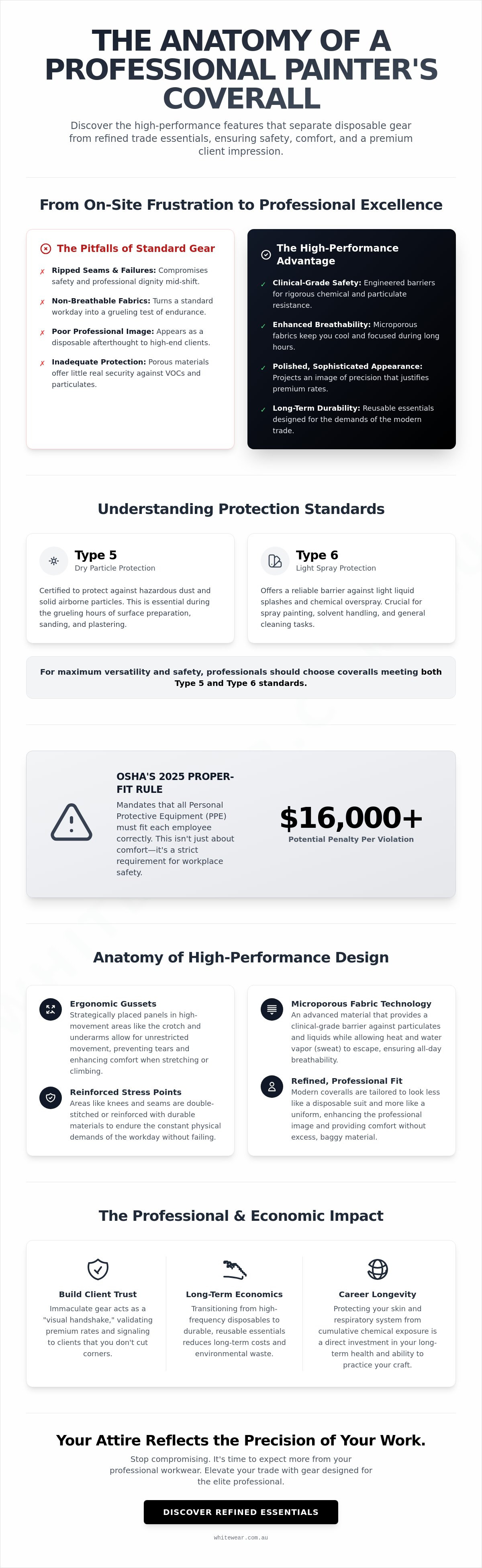
The technical hierarchy of PPE is defined by the nature of the threat. Type 5 certification signifies a garment's ability to protect against hazardous dust and solid dry particles, which is essential during the grueling hours of surface preparation and sanding. Type 6 protection is more specialized, offering a barrier against light liquid splashes and chemical overspray. For the modern professional, a garment that meets both standards provides the most versatile defense. You should opt for higher-tier protection when working with high-pressure spray equipment or solvent-based coatings where the risk of "strike-through" is greatest. Choosing painters clothing that prioritizes these technical benchmarks ensures you remain at the peak of your professional game.
Fabric Innovations: Polypropylene vs. Microporous Laminates
The evolution of workwear has moved beyond basic polypropylene. While standard non-wovens offer basic breathability, they often fail when faced with wet paint or fine mists. Advanced synthetic blends now utilize laminated structures that provide an impenetrable shield without sacrificing comfort. These materials are often treated with anti-static finishes, which is a critical safety feature in volatile spray-painting environments where a single spark can be catastrophic. The molecular barrier of a microporous film consists of a complex web of microscopic channels that are small enough to block pressurized liquid droplets while allowing individual water vapor molecules to pass through freely.
In the Australian climate, breathability isn't a luxury; it's a safety requirement. We measure this through the Moisture Vapor Transmission Rate (MVTR). A high MVTR ensures that as your body heat rises during labor, the moisture is wicked away from your skin and released through the fabric. This thermal regulation prevents heat exhaustion and keeps you focused on the precision of your finish. By balancing this clinical-grade barrier with high-airflow technology, you maintain an equilibrium of safety and stamina throughout the longest shifts.
Reusable vs. Disposable Coveralls: The Professional Comparison
The decision between disposable and reusable gear is more than a line item on a budget; it's a choice between temporary utility and long-term professional identity. For years, the industry has leaned on the convenience of single-use suits, but this approach often overlooks the cumulative costs and the physical toll of wearing low-grade materials. High-performance painters protective coveralls should provide a consistent barrier that doesn't falter when the pressure is on. While disposables have their place, the shift toward refined, reusable apparel reflects a growing commitment to both craftsmanship and sustainability within the Australian construction sector.
Trade waste is a significant concern. Every disposable suit discarded adds to the environmental footprint of a project, creating a cycle of consumption that many modern tradespeople are eager to break. Beyond the ecological impact, there's the matter of tactile experience. Woven fabrics offer a drape and breathability that non-woven plastic simply cannot replicate. They move with the body rather than against it. To ensure these garments maintain their protective integrity, a disciplined maintenance routine is essential. Following OSHA protective clothing standards ensures that your gear remains a reliable shield against volatile substances, shift after shift.
Evaluating the Long-Term Investment
A cost-per-wear analysis often reveals that premium gear is the more economical choice for established crews. While the initial outlay for styles found in our painters overalls guide is higher, their durability eliminates the frequent expense of mid-job failures. A rip in a cheap suit doesn't just expose you to chemicals; it halts production and compromises your safety. By investing in reinforced, woven apparel, you reduce downtime and project a sense of permanence to your clients. It's about choosing gear that's as resilient as your reputation.
When to Choose Disposable PPE
There are, of course, scenarios where the clinical convenience of disposable PPE is undeniable. Tasks involving asbestos removal or high-toxicity chemical stripping require a strict "one-and-done" approach to prevent cross-contamination. Disposables also serve as a practical solution for short-term apprentices or casual labor who may not yet require a permanent kit. Even in these cases, professionals shouldn't settle for subpar construction. Look for disposable painters protective coveralls that still adhere to Type 5 and 6 standards, ensuring that even temporary help is afforded the dignity of high-performance protection.
The Anatomy of High-Performance Coveralls: Fit, Function, and Form
High-performance gear is about more than just coverage. It's about how the garment responds to the kinetic energy of the painter. Every seam and panel in premium painters protective coveralls serves a specific purpose, moving beyond the "one size fits all" mentality of the past. We've embraced a sophisticated design that mirrors modern lifestyle elegance because your workwear shouldn't feel like a costume. It's about respecting the human form while providing a clinical-grade barrier that remains unyielding against industrial hazards.
Integration is the final piece of the technical puzzle. Your coveralls must interface seamlessly with other PPE, such as respirators and gloves, to create a continuous protective envelope. A well-designed hood should seal around a mask without gaps, and cuffs should overlap with gloves to prevent chemical entry. This level of technical synergy is what separates refined essentials from basic utility items. You deserve gear that works as hard as you do while maintaining a polished, authoritative appearance on every site.
Ergonomics for the Demanding Workplace
A tailored fit isn't just about aesthetics; it's a critical safety feature. Excess fabric is a liability that can snag on ladders or scaffolding, leading to dangerous falls or spills. Ergonomic gussets are essential. These diamond-shaped fabric inserts allow for unrestricted movement while reaching for high cornices or bending into low corners. Elasticated waists and cuffs play a dual role by maintaining a secure seal against overspray and providing a refined silhouette. We've also addressed the specific fit requirements for women in workwear, ensuring that every professional has access to gear that empowers their movement rather than restricting it.
Functional Features for the Job Site
The details define the professional experience. Reinforced knees and stress points are non-negotiable for apparel that must endure the friction and pressure of a modern construction site. Seamless shoulder construction improves comfort during overhead painting by eliminating pressure points where straps or harnesses typically sit. We've integrated two-way zippers to allow for ease of access and temperature regulation during those humid Australian afternoons. Strategic pocket placement ensures your essential tools and digital devices are always within reach without compromising the garment's protective integrity. Explore our latest collection of painters clothing to experience the difference that ergonomic design makes on your next project.
Elevating Your Trade with White Wear Refined Essentials
Your workday is a series of decisive moments. From the first drop of primer to the final inspection, your performance is a reflection of your standards. We believe your attire should mirror that same commitment to excellence. White Wear isn't just another supplier; we're a stylish peer and a trusted expert within the Australian painting community. We've moved beyond the sterile, purely functional language of generic competitors to create a brand that understands the science of the task and the human desire for dignity. Selecting the right painters protective coveralls is an act of self-respect that signals your status as a modern craftsman.
Our development process is rooted in reality. It's peer-led, meaning every pocket, seam, and fabric choice has been vetted by professionals who understand the physical toll of grueling hours under the Australian sun. We don't just sell utility items. We provide refined essentials designed to offer comfort when you're ten hours into a high-pressure project. By blending clinical authority with modern lifestyle elegance, we help you maintain a polished appearance that commands respect from colleagues and clients alike. You deserve gear that feels like a high-end luxury label but performs like a precision tool.
Why Australian Painters Choose White Wear
The choice to partner with an Australian company goes beyond local support; it's about technical relevance. We understand the specific challenges of the national trade landscape, from the humidity of the north to the grit of urban construction sites. Our commitment to high-quality construction ensures that every garment provides a reliable barrier without sacrificing the breathability required for our climate. We transition seamlessly from technical specification to emotional storytelling because we know that your work is your passion. White Wear provides the security of clinical-grade protection while honoring the pride you take in your professional identity.
Completing Your Professional Wardrobe
A truly professional appearance requires a cohesive kit. While coveralls provide the ultimate barrier, integrating them with specialised painters pants allows for versatility across different stages of a project. This holistic approach to your wardrobe is a powerful tool for winning high-end residential contracts. Clients notice when a team arrives in branded, sophisticated uniforms; it builds immediate rapport and justifies a premium service. It's time to stop settling for the status quo of ill-fitting, disposable gear. Explore the full White Wear collection for 2026 and discover how our painters protective coveralls can elevate your trade to new heights of professionalism and comfort.
Redefining Your Professional Standard
Your craft deserves a standard of protection that matches the precision of your finish. We've explored how the right balance of Type 5 and 6 certifications provides a clinical-grade barrier, while ergonomic features like diamond gussets ensure you move with absolute freedom. High-performance painters protective coveralls are no longer just a functional necessity; they're a refined essential that preserves your health and your professional dignity through every grueling shift. You've spent years building your reputation; don't let subpar gear undermine it.
White Wear is committed to this mission. Our gear is the result of peer-led development, grounded in the physical reality of the Australian trade landscape. We offer national shipping across Australia to ensure every professional has access to workwear designed for the endurance of real labor. It's time to move beyond the limitations of generic apparel and embrace a wardrobe that reflects your expertise. Upgrade your protection with White Wear high-performance coveralls and step onto your next site with the confidence of a true industry leader. You've earned the right to work in comfort and style.
Frequently Asked Questions
What is the difference between Type 5 and Type 6 protective coveralls?
Type 5 certification signifies a garment's ability to protect against hazardous dry particles, while Type 6 provides a barrier against limited liquid splashes and fine sprays. Choosing the right painters protective coveralls depends on whether your task involves heavy sanding or active spraying. For most professional sites, a dual-certified suit offers the versatility needed to transition between surface preparation and the final finish without compromising safety.
Can I wash and reuse painters coveralls?
Reusability depends entirely on the fabric construction and the level of chemical contamination. While standard disposable suits are designed for single-shift use to prevent cross-contamination, premium woven painters protective coveralls can be laundered if the barrier properties remain intact. You must inspect the garment for thinning or tears after every wash to ensure it still meets the rigorous safety standards your trade demands.
How do I choose the right size coveralls to ensure movement?
You should prioritize a fit that allows for a full range of motion without excess fabric snagging on ladders or equipment. Check size charts carefully and consider the layers you'll wear underneath during colder shifts. High-performance gear often features ergonomic gussets in the crotch and underarms, which prevent the garment from pulling or tearing when you're reaching for high cornices or bending into tight spaces.
Are white coveralls better than blue for professional painters?
White is the industry standard because it reflects heat and provides a clean, clinical aesthetic that clients associate with high-end craftsmanship. It also makes it easier to spot wet paint before you accidentally transfer it to a finished surface. While blue or grey options exist, white remains the narrative anchor for a professional who treats their trade with the utmost respect and precision.
What material provides the best breathability in Australian summers?
Advanced microporous laminates offer the best balance of liquid protection and thermal regulation for the Australian climate. These fabrics allow moisture vapor to escape while blocking liquid entry, preventing the uncomfortable sauna effect common in cheap plastic suits. It's about maintaining your physical stamina during grueling afternoon shifts where heat exhaustion is a genuine professional risk that can't be ignored.
Do I need a hood on my coveralls for interior painting?
A hood is essential for any overhead painting or spray applications to protect your hair and neck from cumulative chemical exposure. If you're strictly performing low-level trim work in a well-ventilated space, a hoodless design might offer better peripheral vision and comfort. However, keeping a hooded option in your kit ensures you're prepared for every technical challenge the job site presents.
How do I properly dispose of contaminated painting coveralls?
Contaminated gear must be handled according to your local Australian environmental regulations for hazardous waste. If your coveralls are soaked in solvent-based paints or toxic strippers, they shouldn't be placed in standard residential bins. Proper disposal prevents chemicals from leaching into the soil and ensures your business remains compliant with trade waste standards, protecting both your reputation and the environment.
Can women find tailored fit protective coveralls?
Modern professional apparel has evolved to include sophisticated, tailored fits specifically engineered for women. We've moved past the outdated approach of simply downsizing men's gear. Today's professional designs account for different hip and shoulder proportions, ensuring that every member of the crew has access to gear that provides both dignity and unrestricted movement during long hours of labor.


