


A uniform policy works when its requirements are clear and easy to find. A sample uniform policy for Australian painting contractors should set out grooming, branding, clothing and footwear expectations in the company policy manual and, where relevant, employment contracts. For contractors, appearance rules should apply only where the contract allows them.
A uniform policy is more than a list of shirts, trousers and shoes. Clear documentation helps workers understand what to wear, how standards apply on site and how exceptions are handled. This guide explains how to set practical presentation and branding standards, document uniform rules, and specify clothing and footwear. It also covers communicating changes and making reasonable adjustments, so expectations remain clear and workable.
Key Takeaways
- Set practical grooming and branding standards, with room for reasonable adjustments. The Federal Register of Legislation identifies section 268 of the Administrative Review Tribunal Act 2024 as the basis for requesting a written statement about a refusal decision.
- Put uniform requirements in employment contracts and your policy manual, covering issue, care, returns, hygiene, exceptions and how you’ll respond to non-compliance.
- List required clothing and footwear clearly, distinguishing everyday uniform items from protective gear needed for particular work conditions.
- Before deciding who pays for uniforms or laundry, consider the applicable award or enterprise agreement; a policy alone doesn’t make a pay deduction lawful.
Grooming, presentation, and branding
- Set requirements by task and setting. A client-facing estimate, an occupied home and an active worksite may call for different presentation details. Specify clean, neat clothing, suitable ways to secure hair and practical grooming expectations. Link each requirement to safety, hygiene or a professional image. For contractors, appearance rules should apply only where the contract allows them.
- Make grooming rules specific and fair. For example, explain how workers should secure long hair if it could interfere with a task. Apply expectations consistently across genders, while recognising that garments may differ. Consider whether a requirement unreasonably restricts cultural or religious dress or fails to accommodate disability or medical needs. Include a clear process for requesting adjustments.
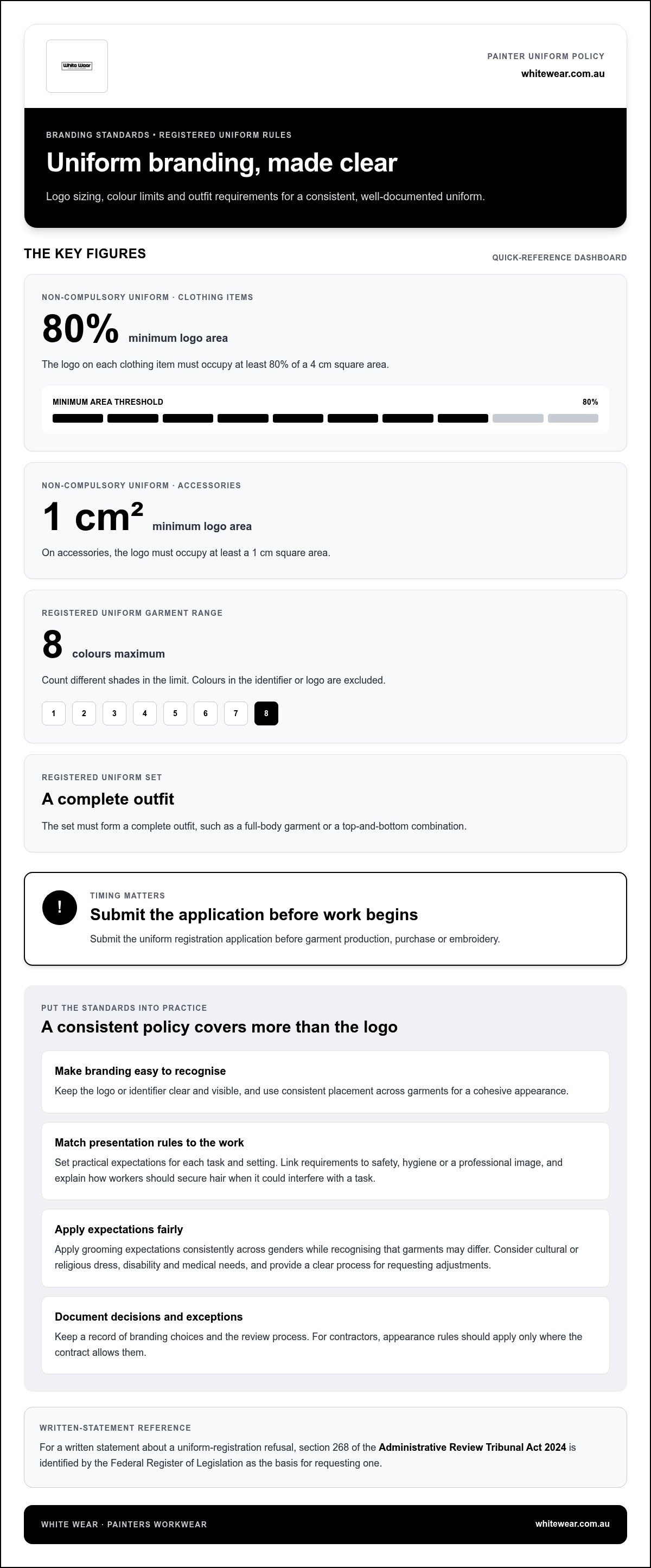
- Choose branding that remains legible and consistent. Keep any logo or identifier clear and visible on the uniform. For a non-compulsory uniform, the logo on each clothing item must occupy at least 80% of a 4cm square area. On accessories, it must occupy at least a 1cm square area. Use consistent placement across garments to create a cohesive appearance.
- Plan colour and outfit combinations before ordering garments. A registered uniform garment range can have a maximum of 8 colours, including different shades but excluding colours in the identifier or logo. A registered uniform set must form a complete outfit, such as a full-body garment or a top-and-bottom combination. Submit the registration application before garment production, purchase or embroidery.
- Keep a record of the policy’s branding decisions and review process. If a uniform registration refusal requires a written statement, section 268 of the Administrative Review Tribunal Act 2024 is identified by the Federal Register of Legislation as the basis for requesting one. Build a sample uniform policy for Australian painting contractors around clear standards, consistent logo use and a documented route for exceptions.
Including uniform requirements in employment documents
Set out uniform rules in the employment contract and policy manual. Define who the rules cover, costs, site expectations and responsibilities.
-
Set Out Uniform Terms in Employment Documents
Record required garments, wearing rules and care expectations in both documents. State who the policy covers, when it applies, how items are issued and what happens when employment ends. Include hygiene, grooming, identification and approved exceptions. Describe acceptable painters workwear by garment type rather than relying on a vague instruction to dress professionally. Keep the contract and manual consistent.
-
Assign Uniform and Safety Gear Costs
Set out who supplies uniforms, pays for replacements and handles laundry, then compare those terms with the applicable award or enterprise agreement. Australian employers must pay a uniform allowance when staff are required to buy their own uniform. A washing-cost allowance may also apply in some cases. Deductions from pay for uniforms must be permitted by legislation or an industrial instrument, properly authorised and reasonable. A policy alone does not make a deduction lawful.
-
Define Rules for Sites and Travel
Specify when workers must wear the uniform at client premises, construction sites and while travelling between jobs. Distinguish presentation rules from site-specific safety requirements, and explain how workers should manage changes between locations. For contractors, appearance requirements should apply only where the contract allows them. Practical examples, such as arriving in clean work clothing and following site PPE instructions, make expectations easier to apply consistently.
-
Address State and Territory WHS Differences
Create a location-based schedule for required PPE and site rules, identifying which work locations each instruction covers. State and territory WHS arrangements may affect how requirements apply, so one uniform clause should not be treated as a complete safety specification for every site. Record relevant site controls, required gear, maintenance expectations and replacement procedures. For contractors implementing broader fit-for-work safety policies on active job sites, detection kits available through druglab118.com can help support thorough compliance. Train workers to use and maintain safety gear, and replace damaged PPE promptly.
Mandatory uniform items and footwear
- Identify the work hazards before listing compulsory garments. Australian requirements depend on the task and site controls, so distinguish standard workwear from protective clothing and PPE. Diamantina Shire Council’s uniform policy lists the Work Health and Safety Act 2011 as supporting legislation. Use the applicable site requirements to shape each crew’s uniform schedule.
- Specify the relevant Australian Standard for each item of protective equipment. Diamantina Shire Council requires outdoor workers’ footwear purchased under its policy to meet the relevant Australian Standard for Personal Protective Equipment. Do not name a standard number unless it applies to the exact item and requirement. Record the footwear type and the site conditions that make it necessary.
- Set separate requirements for interior and exterior work. For interior painting, specify clothing and footwear suitable for the site, then list task-specific PPE identified by the work assessment. For outdoor work, Diamantina Shire Council’s policy calls for long-sleeved high-visibility shirts, long pants and broad-brimmed hats to minimise sun exposure. Treat this as an example, not a universal uniform for every job.
- Make headwear instructions precise for outdoor work. Under Diamantina Shire Council’s policy, broad-brimmed hats must have a brim of at least 7.5 cm. Outdoor workers must wear one when leaving a vehicle or machine to work outside, while drivers and operators may wear caps inside. State when each option applies, so workers can follow the rule through changing work locations.
- Describe footwear in clear, enforceable terms. Charles Sturt Campus Services requires closed-in shoes, while Diamantina Shire Council sets a separate standard for outdoor workers’ safety footwear. Use “closed-in shoes” only when that meets the site requirement, and specify protective footwear where applicable risk controls require it. Include inspection, use and replacement expectations, and train workers to use and maintain required safety gear.
Are Australian employers required to provide uniforms or reimburse uniform costs?
- Start with the applicable industry award or enterprise agreement. Australian awards and enterprise agreements can set requirements for uniform supply, wearing, replacement and laundry. These terms determine whether the employer supplies clothing or provides an allowance. Read the relevant instrument alongside the proposed policy, rather than treating the policy as the source of payment obligations.
- State who pays when employees are required to purchase their own uniform. Address uniform costs and any allowance under the applicable employment terms. A washing-cost allowance may also be required in some cases. Set out the applicable arrangement in writing, including how employees receive the allowance and which uniform items it covers.
- Separate uniform costs from required safety gear. Record who supplies, maintains and replaces each item, and align those responsibilities with applicable workplace requirements. Do not assume the uniform allowance covers every cost, particularly when an award or enterprise agreement addresses safety equipment or laundry separately. Train workers to use and maintain required safety gear, and replace damaged PPE promptly.
- Review proposed deductions before including them in the policy. Australian uniform-related pay deductions generally need to be permitted by legislation or an industrial instrument, properly authorised and reasonable in the circumstances. A written policy alone does not make a deduction lawful. Compare the proposed deduction with the applicable employment terms and consult your legal team before implementation.
- Turn the final decision into clear, usable policy language. Name the responsible party for purchasing, laundering, replacement and returns, then explain any allowance process in plain terms. For example, distinguish ordinary painters clothing from safety gear with separate cost and care rules. Once the payment framework is settled, explore painters workwear that fits your documented uniform requirements.
White Wear: Painters workwear
White Wear offers painters workwear and clothing for contractors putting a clear uniform policy into practice. Once you have defined required garments, presentation standards and everyday workwear needs, purpose-designed clothing provides a practical starting point for a consistent on-site appearance. Choose items that fit the written policy and the demands of painting work, then document how they meet your uniform requirements.
Turn to White Wear when you’re selecting painters clothing to support those standards across the working day. A clear policy sets expectations; suitable workwear helps workers follow them comfortably and consistently. Visit White Wear to explore painters workwear.
Make Your Uniform Policy Work on the Job
A written policy is useful when it guides everyday decisions, from preparing for a new site to replacing worn clothing. Treat your sample uniform policy for Australian painting contractors as a working document: review it when job conditions, team needs or business arrangements change, and communicate updates clearly to everyone affected.
Choose workwear that meets your standards and supports the demands of a painter’s working day. White Wear offers painters workwear and clothing to help put your uniform requirements into practice. The right garments can help your team feel prepared and presentable, with practical clothing suited to the work ahead.
Contact White Wear about workwear and take the next step towards a considered uniform policy and a confident crew.
Frequently Asked Questions
What Is A Workplace Uniform Policy (And Why Does It Matter)?
A workplace uniform policy explains what workers wear and how they present themselves at work. It gives employees and supervisors a shared reference when preparing for a client visit, moving between jobs or replacing an item. Clear wording also distinguishes everyday presentation expectations from site-specific protective equipment requirements, reducing uncertainty about what to wear for each task.
Can shoes, short socks, stockings and underwear form part of a uniform?
A policy can set practical expectations for visible items such as footwear and socks. For example, it might require enclosed shoes when the work or site calls for them, and specify sock colours only when they are visible. Avoid intrusive rules about underwear. Allow for fit, medical, cultural or religious needs, and explain how workers can request an adjustment without sharing unnecessary personal details.
If an identifier / logo is required on all uniform items, where should it be placed on skirts, pants and shorts?
Choose a consistent, visible position that suits each garment’s cut and does not restrict movement or access to pockets. For example, a logo could sit on a skirt’s lower side panel or above a pocket on pants and shorts. Treat these as design options, not universal placement rules. Before ordering, check the garment while worn and seated, and make sure the identifier remains visible during ordinary work.
What should a uniform policy for Australian painting contractors include?
A sample uniform policy for Australian painting contractors can begin with its purpose, who it covers and when it applies. Add a garment schedule, ordering and issue process, care expectations, replacement and return steps, and a record of approved adjustments. Include a version date and identify who maintains the document. A short site-specific schedule can capture differences between client locations without rewriting the core policy.
How should a painting contractor uniform policy address branding, personal presentation and acceptable clothing?
Use observable, work-related wording rather than subjective terms such as “smart” without explanation. For example, specify an approved logo position, clean work clothing and how long hair should be secured when it could interfere with a task. State which garments suit client-facing duties and which are appropriate for active work. Apply expectations consistently while allowing reasonable adjustments for individual needs.
Where can I find a sample Australian painting contractor uniform policy template?
Use this structure as a starting point, then adapt it to your workforce, contracts and work locations. Create sections for scope, clothing, footwear, presentation, costs, care, exceptions and non-compliance. Add a simple garment schedule listing each item, when it is required and who issues it. Before adopting the document, align its employment terms with the applicable award or enterprise agreement.


