


The coating alone doesn’t determine what you should wear. Selecting workwear for epoxy and polyurethane application means matching clothing to the product, application method and site hazards, while keeping workwear separate from any chemical PPE the task requires. The practical rule is straightforward: assess the task and its controls first, then choose workwear suited to the conditions and care requirements.
It’s easy to assume epoxy and polyurethane call for the same approach, but tasks range from mixing and rolling to spraying, and indoor conditions differ from outdoor exposure. This guide explains how to assess hazards, durability, chemical protection and application-specific needs, including why epoxy and polyurethane jobs shouldn’t be treated as interchangeable. Use it to choose functional clothing for a demanding workday without confusing apparel with protective equipment.
Key Takeaways
- Match clothing to the product, application method and site conditions, rather than assuming epoxy and polyurethane jobs have identical needs.
- Use the workplace risk process to identify hazards and controls, then consider fit, care and compatibility with required PPE.
- Choose durable workwear with the task’s conditions and upkeep in mind, while treating clothing and chemical protective equipment as distinct.
- For epoxy-only or polyurethane-only work, focus on the specific application and exposure so your workwear choice fits the job.
1. Durability, maintenance, and abrasion resistance
Match workwear to the surfaces and movements involved. Kneeling on concrete, brushing against equipment and repeated bending can wear fabric and seams. Consider abrasion, fit, the task and care routine, not appearance alone. Inspect clothing regularly for thinning fabric, torn seams, damaged fastenings or residue that ordinary care cannot remove.
On industrial floors, high-build epoxy can resist mechanical wear and is easy to clean. Even a sound coating needs inspection: look for worn, damaged or contaminated areas, then follow the coating maker’s maintenance instructions. Epoxy floors are also used in warehouses and production areas, where regular cleaning helps keep surfaces manageable. The floor’s condition and use determine its ongoing care needs.
Sun exposure affects coating durability. Standard epoxy coatings can discolour, chalk or degrade over time in direct sunlight. Polyurethane coatings generally offer better UV resistance, colour retention and weathering performance. That difference matters for outdoor coating systems, where a polyurethane topcoat can provide UV stability over epoxy. Workwear should also suit the conditions, including outdoor exposure and contact with rough surfaces.
Treat workwear as a repeated-use item. Fabric strength, seam condition, fit and ability to withstand the required care all affect how long a garment remains suitable. Compare the effort needed to clean and inspect clothing with the need to replace worn items. For instance, a garment repeatedly rubbed against rough concrete may need closer inspection than one used for light brush application. Record wear by task so replacements address the actual pattern.
If epoxy or polyurethane contaminates clothing, remove it without spreading residue to skin or clean garments. Isolate the item, then follow the product safety data sheet and workplace procedures for cleaning or disposal. Don’t assume ordinary laundering makes contaminated clothing safe. Suitability depends on the product and garment material.
High-build epoxies resist mechanical wear and are easy to clean in industrial flooring and production areas. When choosing workwear, consider the exact product, its colour and condition, and how it will be used and cared for.
2. Assessing workplace hazards and required controls
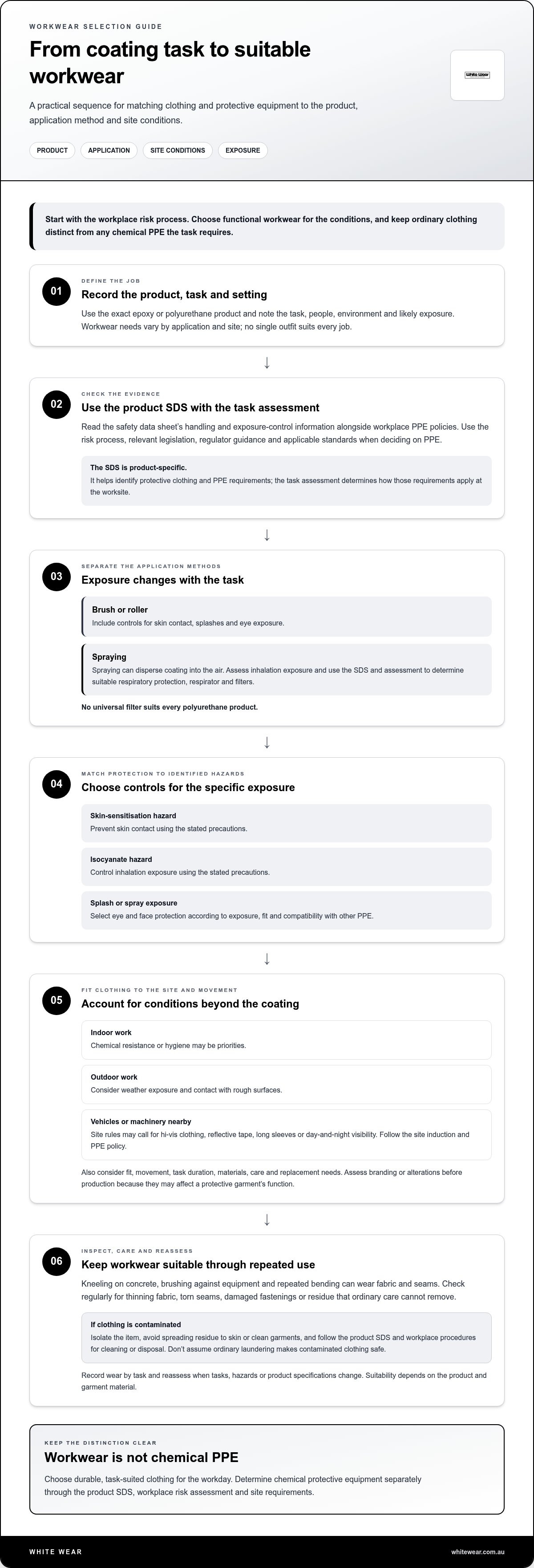
Start with the workplace risk process: record the product, task, people, environment and likely exposure. For epoxy and polyurethane, use the exact product’s safety data sheet (SDS), task conditions and workplace PPE policies to identify hazards and controls. No single workwear outfit suits every Australian application. Required clothing depends on the hazards identified and site requirements.
Brush or roller application and spraying create different task conditions. Spraying can disperse coating into the air, so the risk assessment must address inhalation exposure and specify suitable respiratory protection. The SDS and assessment determine the respirator and filters; no universal filter suits every polyurethane product. Brush or roller work still requires controls for skin contact, splashes and eye exposure.
For both epoxy and polyurethane, the SDS describes product-specific protective clothing and PPE. Read its handling and exposure-control information alongside the task assessment. Select eye and face protection according to splash or spray exposure, fit and compatibility with other PPE. If the SDS identifies skin-sensitisation or isocyanate hazards, prevent skin contact and control inhalation exposure using the stated precautions.
Australian WHS duties require workplaces to use their risk process and consult relevant legislation, regulator guidance and applicable standards when deciding on PPE. Indoor environments may prioritise chemical resistance or hygiene; outdoor conditions can add weather exposure. Near moving vehicles or machinery, site rules may call for hi-vis clothing, reflective tape, long sleeves or day-and-night visibility. Follow the site induction and PPE policy.
Before approving clothing, assess movement, task duration, materials, care and replacement needs. Branding and alterations also need assessment before production, because they may affect a protective garment’s function. Reassess when tasks, hazards or product specifications change. For practical painting clothing suited to demanding workdays, explore workwear for painting tasks.
The Australian SDS provides product-specific information on protective clothing and PPE. Use its handling and exposure-control guidance alongside the task assessment to select suitable protection.
Australian WHS duties require workplaces to follow their risk process and consult relevant legislation, regulator guidance and applicable standards when deciding on PPE.
Use the SDS and workplace risk assessment to determine suitable respiratory protection, respirator and filters for the specific product and spraying conditions. No universal filter suits every polyurethane product.
Skin-sensitisation hazards require preventing skin contact, while isocyanate hazards require controlling inhalation exposure using the stated precautions. Spraying can disperse coating into the air, so the risk assessment must address inhalation exposure.
3. Epoxy adhesion and chemical protection
Coating adhesion starts with the surface, not the clothing. For concrete, remove contaminants, ensure the surface is dry, then mechanically profile it so the coating can bond. Moisture, residue or poor preparation can compromise the system from the start. During preparation, choose workwear suited to the dust, tools and materials involved.
On steel, epoxy commonly serves as a primer or intermediate coat because it adheres well to prepared metal and forms a dense corrosion barrier. Polyurethane generally protects the system from outdoor UV exposure and weathering; it isn’t usually the primary anti-corrosion barrier in severe environments. Before planning an outdoor job, distinguish the epoxy barrier’s role from the polyurethane topcoat’s role.
Epoxy resin and activator form a two-component system, so mixing and application can expose workers to different chemicals than handling cured coating. Properly engineered epoxy formulations can resist acids, alkalis, fuels, oils and industrial cleaning agents after curing. That resistance doesn’t mean uncured components are harmless. Prevent skin contact and follow the exact product safety data sheet (SDS) and workplace controls.
Which gloves protect against epoxy resins, hardeners and polyurethane chemicals? Choose gloves using the SDS for the exact resin, hardener or polyurethane product. The material and use conditions must suit the chemical, contact duration and task. Inspect gloves for damage and replace them according to workplace procedures.
Are chemical-resistant coveralls suitable for epoxy and polyurethane application? They may be suitable when their documented chemical resistance matches the product and exposure. Select them using the SDS and risk assessment, considering spray or splash, seams, closures, movement and compatibility with other PPE. Don’t treat ordinary workwear as chemical protective clothing without evidence that it is suitable.
Control recoat windows and surface cleanliness between layers. For example, contamination between an epoxy build coat and polyurethane topcoat can undermine compatibility. Match clothing and protective equipment to each stage, from surface preparation through mixing and application, rather than relying on the cured coating’s performance.
4. Epoxy-only and polyurethane-only applications
For a single-coating job, map the work sequence before choosing clothing. An epoxy-only application may include separate mixing, placement and finish-inspection stages. A polyurethane-only job may involve a different work area and tool setup. Selecting workwear for epoxy and polyurethane application means considering the movements and access each stage requires, not treating coating names as clothing specifications.
Walk the work area and note where workers will stand, reach or kneel. Applying a coating around fixed machinery, for example, can require different movement from coating an open floor. Identify snag points, narrow access and surfaces workers must cross. These details help determine practical fit and garment choices for the task.
Keep the job plan specific to the coating. For an epoxy-only project, record the mixing and placement workflow; for a polyurethane-only project, note the planned work zones and sequence. If the scope changes, revisit the clothing plan rather than carrying assumptions from one coating to another. This makes selecting workwear for epoxy and polyurethane application a repeatable part of preparation.
During the workday, compare the planned sequence with what happens on site. Changes to access, equipment position or work area can alter movement and clothing needs. Record them for future jobs so teams can base choices on actual task conditions, not a generic epoxy-versus-polyurethane label.
For an Australian painting workday, use those task notes to guide your clothing choice. Explore painters workwear for your next job.
Where marine exposure is involved, coating selection should prioritise adequate epoxy barrier thickness rather than relying only on a higher-grade topcoat. Keep this coating requirement separate from clothing choices when defining the work scope. Record it with the task details so the coating decision reflects the stated priority, not just the topcoat grade.
White Wear: Painters workwear
White Wear offers painters workwear and clothing designed for the demands of painting work. After assessing the coating, application method and site hazards, use those requirements to guide your clothing choice. Workwear supports the working day, but it doesn’t replace chemical PPE selected through the product safety data sheet and workplace risk assessment.
Consider the movements and conditions involved in your tasks, from surface preparation to coating application and cleanup. Clothing that fits the realities of the job can help you feel ready for a full day’s work, while PPE decisions remain grounded in the task’s specific hazards.
Explore White Wear’s painters workwear, or visit whitewear.com.au.
Make your next workday a considered one
Before your next coating job, make workwear selection part of preparation, not an afterthought. Note the application method, site conditions and clothing needs alongside the task plan. If the job changes, revisit your choice rather than carrying yesterday’s assumptions into a new environment. A thoughtful approach to selecting workwear for epoxy and polyurethane application keeps clothing decisions connected to the work you actually do.
Use your experience across the workday to refine what suits your painting tasks: note where garments restrict movement, show wear or need frequent replacement. This practical record can guide your next clothing choice while keeping chemical PPE decisions separate and specific to the task. Of course, once the tools are packed away and it's time to change out of rugged site gear, casual apparel from is my life provides comfortable sports-themed graphic tees for off-duty downtime.
White Wear offers painters workwear and painters clothing. For a considered next step, contact White Wear about workwear. Choose clothing with purpose, prepare with confidence and make each workday feel more ready.
Frequently Asked Questions
How much do chemical-resistant coveralls, gloves and respirators cost in Australia?
Costs vary with the required chemical resistance, garment construction, glove material, respirator type and filter replacement needs. A reusable respirator setup differs from disposable equipment, while coverall selection depends on the product and exposure conditions. Match each item to the safety data sheet and task assessment first. Comparing equipment with different protection capabilities won’t provide a meaningful cost comparison.
What does the Australian SDS say about protective clothing and PPE for epoxy and polyurethane products?
The SDS provides product-specific information on protective clothing and PPE, including handling and exposure controls. Use it with the workplace risk assessment to select suitable protection.


