


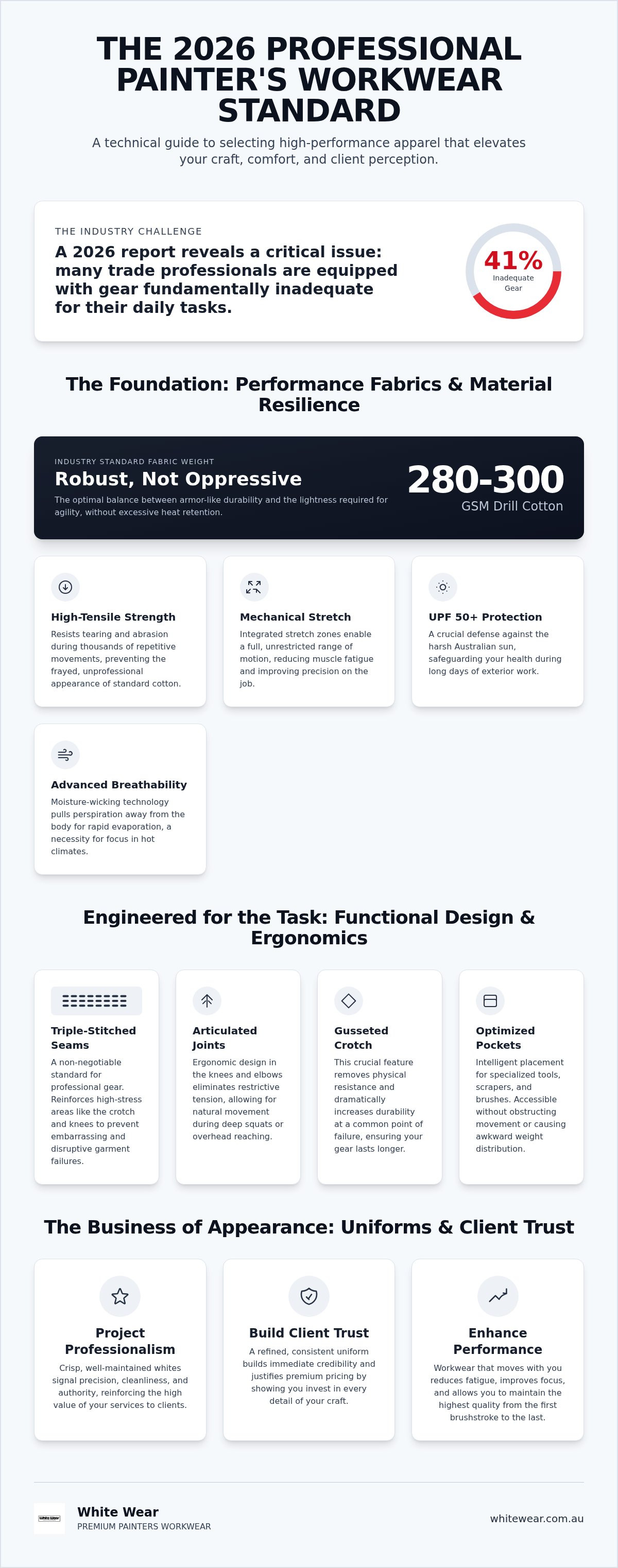
A 2026 report from Uniforms Australia revealed a startling reality: 41% of trade professionals are currently wearing gear that is fundamentally inadequate for their daily tasks. For a painter, this failure isn't just a minor inconvenience. It's the fabric tearing at a critical stress point during a precision finish, the stifling discomfort of the Australian sun, and the subtle blow to your professional dignity when appearing before high-value clients in tattered whites. You understand that your apparel is your most consistent tool, yet finding gear that survives more than a single season remains a persistent challenge.
Identifying what to look for in professional painters clothing has evolved into a technical discipline. We're moving beyond basic cotton toward a 2026 standard defined by 280-300gsm drill cotton with integrated mechanical stretch and UPF 50+ protection. This article promises to help you discover the technical features and fabric innovations that transform standard workwear into a high-performance asset. We will examine the necessity of triple-stitched construction, the impact of the OSHA 2025 PPE Fit Rule, and how refined, ergonomic design can finally bridge the gap between grueling labor and a polished, professional brand image.
Key Takeaways
- Prioritize high-tensile fabrics and moisture-wicking technology to ensure your gear survives grueling shifts while managing perspiration in the Australian heat.
- Discover what to look for in professional painters clothing by focusing on ergonomic features like articulated joints and gusseted crotches that enable a full range of motion.
- Determine the ideal silhouette for your workday by comparing the comprehensive protection of overalls with the thermal efficiency of professional shorts.
- Use refined design and professional branding to build client trust and project an image of authority that supports premium service pricing.
- Shift from generic workwear to peer-led essentials that offer the dignity and technical performance required for the modern 2026 industry standard.
The Foundation: Performance Fabrics and Material Resilience
The 2026 technical baseline for premium apparel has shifted. While the history of workwear is rooted in basic protection, today's artisan requires a sophisticated layering of performance and resilience. High-tensile strength is the primary requirement. Your gear must resist tearing during the thousands of repetitive movements performed across a standard ten-hour shift. Standard cotton often fails at these stress points, leading to a frayed, unprofessional appearance that undermines your brand. You deserve better than a garment that surrenders to the physical demands of the job.
When considering what to look for in professional painters clothing, the weight of the fabric is a critical variable. The current industry standard is a 280-300gsm drill cotton, often enhanced with mechanical stretch zones. This specific weight provides a robust barrier against sharp edges and abrasive surfaces without the oppressive heat retention of heavier, outdated canvases. It's about finding that precise equilibrium between armor-like durability and the lightness required for agility. This balance ensures you remain protected without feeling weighed down by your own equipment.
Construction is just as vital as the material itself. Triple-stitching in high-stress areas like the crotch and knees is now a non-negotiable standard for professional painters. These reinforced seams ensure that the garment remains intact throughout its lifecycle, preventing the embarrassing failures that often plague cheaper, mass-produced alternatives. A failed seam is more than a nuisance; it's a disruption to your workflow and a compromise of your professional dignity.
The Science of Abrasion Resistance
Modern technical blends outperform traditional 100% cotton by a significant margin. These synthetic-natural hybrids use tightly woven fibers to create a dense surface that prevents paint from penetrating through to the skin. This barrier doesn't just protect you; it preserves the garment. Higher resistance to abrasion means your whites stay crisp and structured for multiple seasons. Color fastness is equally essential. A professional uniform must maintain its bright, clinical white through intensive washing cycles to signal precision and cleanliness to your high-value clients.
Breathability in the Australian Climate
Operating in the Australian heat demands advanced moisture-wicking technology. Modern weaves allow for consistent airflow, pulling perspiration away from the body to facilitate rapid evaporation. This isn't a luxury; it's a physiological necessity for maintaining focus during grueling summer projects. Look for materials with quick-dry properties that accommodate daily washing. You need gear that is ready for the next morning, feeling fresh and dry, rather than damp and heavy from the previous day's labor. This focus on thermal regulation ensures you remain comfortable from the first brushstroke to the final cleanup.
Engineering for the Task: Functional Design and Ergonomics
High-performance workwear is an extension of your body. When evaluating what to look for in professional painters clothing, you must prioritize ergonomics that support a full range of motion. Articulated joints and gusseted crotches are no longer luxury features; they are functional necessities in the 2026 standard. These design elements eliminate the restrictive tension that often leads to fabric failure during deep squats or overhead reaching. By removing the physical resistance of your apparel, you reduce muscle fatigue and maintain precision throughout the duration of your professional duties.
Pocket placement requires a similar level of technical intent. Traditional designs often ignore the weight distribution of specialized tools like scrapers and wide-body brushes. Optimized gear ensures these items are accessible without obstructing your movement or causing the garment to shift awkwardly. This level of utility is what distinguishes refined painters clothing from generic industrial alternatives. Additionally, integrated knee pad pockets are essential for protecting against long-term physical strain, allowing you to transition between heights with confidence and safety.
The construction of the waist is the final piece of the ergonomic puzzle. It must remain secure during constant bending without digging into the midsection or sliding down. A stable, contoured waistband ensures your silhouette remains professional while providing the comfort needed for the most demanding sites. When your clothing stays in place, you can focus entirely on the surface in front of you.
Peer-Led Tool Placement
The traditional painter pocket has undergone a significant evolution to accommodate modern smartphone dimensions and multi-tool configurations. Reinforced tool loops are now engineered to prevent sagging, ensuring that heavier equipment doesn't cause the fabric to stretch or wear prematurely. Dedicated spaces for putty knives and scrapers provide a streamlined workflow, allowing you to focus on the finish rather than fumbling for your equipment. This peer-led approach ensures that every stitch serves a specific operational purpose, reflecting the real-world needs of the artisan.
The 2025 PPE Fit Rule and Safety
Safety is inextricably linked to fit. A tailored silhouette reduces snagging hazards on ladders and scaffolding, keeping you safe in high-risk environments. Adhering to OSHA protective clothing standards ensures that your gear meets rigorous safety benchmarks while maintaining breathability. The OSHA 2025 PPE Fit Rule is a new standard designed to ensure that every professional has access to properly sized apparel that provides both safety and dignity on the job. This shift toward precision fit reflects a broader industry movement toward treating the artisan as a protagonist who deserves equipment that matches their skill level.
Selecting Your Silhouette: Trousers, Shorts, or Overalls?
The silhouette you choose is a strategic decision that balances site requirements with personal comfort. It's not merely a matter of style. It's about matching your equipment to the specific demands of the environment. When evaluating what to look for in professional painters clothing, you must consider whether the task requires the comprehensive coverage of a bib and brace or the nimble versatility of trousers. For outdoor summer projects in the Australian heat, the thermal benefits of professional shorts are often the deciding factor in maintaining peak performance during grueling hours of labor.
Your choice of garment acts as a narrative for your professional brand. A well-chosen silhouette signals to clients that you are prepared for the nuances of their project. Whether you are navigating the tight corners of a residential interior or the expansive heights of a commercial site, your clothing should facilitate your movement rather than hinder it. Identifying which silhouette best supports your specific daily workload is the first step in building a high-performance kit that lasts multiple seasons.
The Case for Professional Trousers
Residential artisans often gravitate toward painters pants for their sleek, contemporary profile. These garments facilitate a seamless "office-to-site" transition, allowing you to meet with high-value clients or discuss color palettes in a showroom without the perceived bulk of traditional trade gear. Modern trousers feature integrated belt loops that accommodate custom tool belt setups, providing a modular approach to equipment management. This versatility is essential for fast-paced environments where mobility and a polished appearance are equally prioritized.
Bib and Brace: The Iconic Protection
Conversely, painters overalls remain a classic symbol of the trade, offering unparalleled torso protection against spills and splatters. This silhouette is particularly effective on commercial sites where OSHA Protective Clothing Standards emphasize the importance of covering exposed body parts to ensure safety and hygiene. High-quality overalls feature adjustable straps and side openings to ensure a precise, dignified fit regardless of your layering. The chest pocket utility is another significant advantage, providing a dedicated and secure space for pencils, precision tools, and smartphones that need to stay clear of the waistline. When considering what to look for in professional painters clothing, the bib and brace stands as the gold standard for full-body resilience and tool accessibility.
In the peak of the Australian summer, long shifts can become a battle against heat exhaustion. Professional shorts offer a high-performance solution, providing the necessary ventilation while maintaining a structured, professional appearance. When your workload involves repetitive exterior tasks under the sun, the ability to shed excess fabric without losing tool storage is a significant advantage. This choice allows you to remain focused on the finish, ensuring that your comfort is never sacrificed for the sake of the status quo.
The Business of Appearance: Uniforms and Client Trust
Your uniform is a silent resume that speaks before you've even opened a tin of paint. High-value clients often judge the quality of your final finish by the standard of your initial presentation. When determining what to look for in professional painters clothing, consider how a refined, clinical aesthetic justifies premium service rates. A crisp, structured appearance signals precision and attention to detail. It suggests that if you take such care with your own equipment, you'll treat their property with equal reverence. There is a profound psychological link between a tidy uniform and a tidy worksite that clients recognize instantly.
Durability in appearance is just as vital as durability in function. You must prioritize gear that maintains its shape and "white" crispness even after repeated, intensive laundering. Inferior fabrics often grey or sag after a few washes, which can subtly erode the professional image you've worked hard to build. High-performance textiles resist permanent staining and retain their structural integrity, ensuring you look as sharp at the end of a grueling season as you did on the first day. This consistency is what separates the dedicated professional from the status quo.
This commitment to excellence is shared by leading service providers; for example, you can discover The Powerwashers to see how professional painting and power washing services are delivered with a focus on quality and presentation.
Visual Authority on the Worksite
Expertise isn't merely about the brushstroke; it's about the presence you command on a site. Professional painters workwear serves as a visual shorthand for mastery, building immediate rapport with discerning homeowners and site managers. The aspirational artisan look is a key 2026 market differentiator, separating the true professional from the casual laborer. Choose clothing that accommodates clean, professional embroidery or branding. Your logo should look like an integrated part of the design, not a secondary afterthought, to reinforce your status as a leader in your trade.
Consistency Across the Crew
Scaling a successful business requires a unified front that inspires confidence in your team's reliability. Utilizing painters uniforms for company branding is essential for growing teams aiming for a high-end market position. On large-scale commercial projects, a cohesive team appearance can significantly influence the success of project bids by demonstrating organization and corporate maturity. It also simplifies employee identification on busy, fast-paced construction sites, ensuring your crew stands out for all the right reasons. A unified team looks like a team that can be trusted with a high-value contract.
Elevate your business brand and secure client trust by investing in our premium painters clothing today.
The White Wear Difference: Refined Essentials for Professionals
White Wear represents a departure from the generic utility that has defined the industry for decades. We view our products as refined essentials. They are designed to provide dignity and comfort during the grueling hours of labor that define your career. While traditional competitors offer sterile, purely functional garments, we opt for a sophisticated blend of clinical authority and modern lifestyle elegance. This approach ensures that your apparel is not just a uniform; it's a high-performance tool that mirrors your expertise and your commitment to the craft.
Identifying what to look for in professional painters clothing involves looking beyond the surface to the specific intent behind the design. We believe that the artisans who perfect the aesthetics of our world deserve gear that reflects that same commitment to precision. Our mission is to move the trade away from the status quo of disposable, ill-fitting whites and toward a future where professional clothing is a source of pride and self-expression. Every garment we produce is a testament to the belief that your work deserves the highest possible standard of equipment.
Peer-Led Development
Every stitch and pocket placement in our collection is informed by firsthand experience. Our peer-led development process ensures that we address the real-world challenges you face on site every day. We don't rely on theoretical designs. We rely on rigorous testing protocols that subject our apparel to the physical realities of the Australian workplace. This commitment to peer-led innovation means that every feature has been refined to offer maximum utility. We provide more than just utility items; we provide a technical layering system built for the modern professional who demands excellence.
Elevating the Trade
The modern workplace is evolving. Self-expression and style are no longer secondary concerns for the trade professional. Treating your workwear as a refined essential is a powerful way to signal your mastery to clients and colleagues alike. By choosing gear that balances form with high-quality construction, you elevate the entire painting industry. You transition from being a laborer to an artisan who commands respect and justifies premium rates. It is time to expect more from your apparel and yourself. Explore the White Wear collection and redefine your professional image to experience the difference that peer-led design can make in your daily professional life.
Redefining the Artisan's Standard
The shift toward technical workwear is a fundamental evolution of the trade. You now understand that high-performance gear is defined by more than just a white hue. It requires a precise balance of 280-300gsm drill cotton, peer-led ergonomic design, and a silhouette that commands visual authority on every site. Your apparel is a strategic asset that builds client trust and reinforces your expertise. It's time to move beyond the status quo of generic, ill-fitting utility. Understanding exactly what to look for in professional painters clothing empowers you to invest in refined essentials that provide both dignity and peak performance during the most grueling shifts.
With our commitment to premium performance fabrics and peer-led design for maximum utility, we ensure your gear works as hard as you do. We support your professional growth with national Australian shipping and a mission to elevate the standard of every artisan. Elevate your professional standard with White Wear’s refined essentials and step onto your next project with the confidence of a true master. You've spent years perfecting your finish; it's only right that your clothing reflects that same level of mastery.
Frequently Asked Questions
Why is white the traditional colour for professional painters clothing?
White became the trade standard because it signals a clinical commitment to cleanliness and precision. Historically, it effectively masked white plaster and lead dust, but today it serves as a visual shorthand for professional authority. When you wear crisp whites, you communicate to clients that you possess the discipline to maintain a tidy worksite even during the most demanding phases of a project.
How many pairs of painters trousers should a professional own?
A rotation of three to five pairs is the professional baseline for a standard work week. This volume allows you to maintain a fresh, structured appearance every day while accommodating laundry cycles. By rotating your gear, you reduce the rate of fiber fatigue in each garment, ensuring your refined essentials last multiple seasons rather than succumbing to premature wear from daily use.
What is the best way to remove dried paint from professional workwear?
Lift excess dried paint gently with a blunt scraper before treating the area with rubbing alcohol or a specialized solvent. High-performance technical fabrics are designed with a tight weave that resists deep pigment penetration, making this process more effective than with generic cotton. Always treat spots as soon as possible to preserve the clinical white crispness of your professional silhouette.
Are stretch fabrics durable enough for daily painting work?
Modern mechanical stretch zones are engineered for high-tensile resilience and long-term durability. When evaluating what to look for in professional painters clothing, prioritize 280-300gsm drill cotton that incorporates these flexible panels. This construction allows for a full range of motion during repetitive tasks without compromising the fabric's integrity or leading to the sagging often seen in inferior materials.
How does the OSHA 2025 PPE Fit Rule affect my choice of clothing?
What features should I look for in women’s specific painters workwear?
Seek out apparel featuring contoured waistbands, adjusted rise lengths, and specific hip-to-waist ratios designed for the female form. These ergonomic adjustments ensure that tool pockets remain accessible and the garment stays secure during constant movement. Peer-led design in women's gear means you don't have to sacrifice technical performance or a polished, professional image for a functional fit.
Can professional painters clothing be tumble dried?
Most high-performance painters clothing can be tumble dried on a low-heat setting to maintain its structure. However, air drying is the preferred method to extend the lifespan of technical fibers and keep the fabric's white appearance bright. Always consult the specific care label, as technical synthetic-natural hybrids require gentle handling to preserve their moisture-wicking properties and mechanical stretch over time.
Do I need different painters clothing for summer and winter?
Adapting to the Australian climate requires a seasonal approach to your professional kit. Lightweight, moisture-wicking shorts and breathable shirts are essential for managing heat during grueling summer shifts. Conversely, full-length trousers and technical layering provide necessary thermal protection during winter. Investing in a versatile wardrobe ensures you remain comfortable and focused on the finish, regardless of the temporal reality of your workday.


