


Your clothing is either working for you or working against you. On a professional job site, painters clothing requirements aren't a bureaucratic checklist; they're the difference between a tradesperson who commands premium rates and one who blends into the background. Every seam, every pocket, every fabric choice sends a signal before you've said a word.
You already know the frustration. Shirts that fail at the shoulder after three weeks of overhead work. Pants with pockets designed for a different era, leaving your modern tools with nowhere to live. And the slow, grinding heat of a fabric that traps every degree of an Australian summer against your skin across a twelve-hour shift. These aren't minor inconveniences; they're daily taxes on your performance and your professional image.
This guide cuts through the noise. From Australian safety expectations to the functional architecture your workwear actually needs in 2026, you'll walk away with a clear, authoritative understanding of what professional painting apparel demands today, and how meeting that standard becomes one of your sharpest competitive advantages.
Key Takeaways
- Meeting professional painters clothing requirements in 2026 goes far beyond compliance — the right apparel actively signals your competence and commands premium rates before a single brushstroke is made.
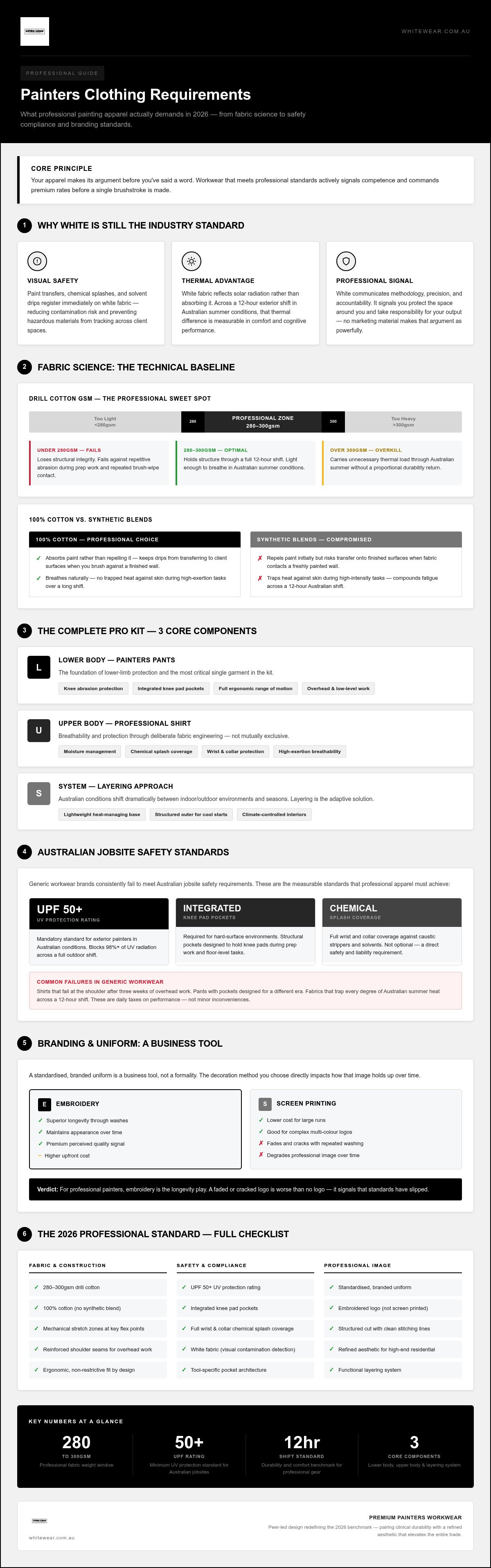
- Fabric specification is non-negotiable: 280-300gsm drill cotton with mechanical stretch zones is the technical baseline that separates workwear that lasts a season from gear built for twelve-hour shift durability.
- Australian jobsite safety demands specific, measurable standards — including UPF 50+ UV protection and integrated knee pad pockets — that generic workwear brands consistently fail to meet.
- A standardized, branded uniform is a business tool, not a formality; understanding the difference between embroidery and screen printing for longevity directly impacts your professional image over time.
- Peer-led design, like the approach White Wear brings to the Australian market, is redefining what the 2026 benchmark looks like — pairing clinical durability with a refined aesthetic that elevates the entire trade.
Fundamental Requirements for Professional Painting Apparel
Before a client opens their front door, before you've introduced yourself, your apparel has already made its argument. Professional painters clothing requirements aren't arbitrary tradition; they're a functional system refined over decades of real jobsite conditions. Understanding why each requirement exists transforms compliance from a chore into a competitive edge.
Why White is Still the Industry Standard
White endures for three distinct, non-negotiable reasons. First, it's a visual safety mechanism. A wet paint transfer, a chemical splash from a caustic stripper, or a solvent drip registers immediately on white fabric. On darker clothing, that same contamination can go unnoticed, increasing exposure risk and the chance of tracking hazardous materials across a client's home. Second, in the context of Australian summers, white fabric reflects solar radiation rather than absorbing it. Across a twelve-hour exterior shift, that thermal difference is measurable in both comfort and cognitive performance. Third, white communicates methodology. It signals that you work with precision, that you protect the space around you, and that you take accountability for your output. No marketing material makes that argument as quietly or as powerfully.
That said, the 2026 professional standard isn't about clinical sterility. High-end residential clients increasingly expect a refined aesthetic alongside technical competence. Modern painters clothing requirements have evolved to accommodate this, with structured cuts, clean stitching lines, and subtle design details that elevate the traditional uniform without compromising its functional logic.
The Core Components of a Pro Kit
A complete professional kit addresses the body systematically, from the ground up.
- Lower body: Specialized painters pants are the foundation of lower-limb protection. They need to shield against knee abrasion during prep work, accommodate integrated knee pad pockets for hard-surface environments, and move with you through the full ergonomic range that overhead and low-level work demands.
- Upper body: Breathability and protection aren't mutually exclusive, but they require deliberate fabric engineering. A professional shirt needs to manage moisture during high-exertion tasks while providing enough coverage to guard against chemical splash at the wrist and collar.
- Layering system: Australian conditions shift dramatically between indoor and outdoor environments, and between seasons. A functional layering approach means a lightweight base that handles heat, with a structured outer option for cooler morning starts or climate-controlled interiors.
Non-restrictive fit underpins all three components. Apparel that binds at the shoulder during overhead roller work or pulls at the thigh during a low crouch isn't just uncomfortable; it's a direct tax on your efficiency across every hour of the day. The fit standard for 2026 is ergonomic by design, not by accident.
Technical Performance and Functional Design Standards
Fabric choice isn't aesthetic preference. It's an engineering decision that compounds across every hour of a twelve-hour shift, determining whether your gear performs or quietly degrades your output. Meeting professional painters clothing requirements in 2026 means understanding the material science behind the apparel, not just the label on the collar.
The Science of Modern Workwear Fabrics
The 280-300gsm drill cotton specification exists for precise reasons. Below 280gsm, fabric loses the structural integrity needed to resist repetitive abrasion during prep work and repeated brush-wipe contact. Above 300gsm, you're carrying unnecessary thermal load through an Australian summer without a proportional durability return. That 20gsm window is the professional sweet spot: enough body to hold structure through a full day, light enough to breathe.
100% cotton remains the technical baseline for two reasons that synthetic blends can't replicate. First, cotton absorbs paint rather than repelling it, which keeps errant drips from transferring onto client surfaces when you brush against a finished wall. Second, it breathes. Synthetic fabrics trap heat against the skin during high-intensity commercial projects, accelerating fatigue in ways that are difficult to attribute but easy to feel by hour eight.
The meaningful evolution in 2026 workwear isn't moving away from cotton; it's augmenting it. Targeted mechanical stretch zones, typically woven into the seat, inner thigh, and shoulder panels, address the specific stress points where mid-shift blowouts historically occur. These aren't cosmetic additions. They're structural reinforcements that allow the fabric to move with the body through the full ergonomic range of overhead and low-level work without compromising the drill weave's durability elsewhere.
Pocket Architecture as a Tool of the Trade
A pocket placed without ergonomic logic is a liability, not a feature. Professional pocket architecture for painters requires deliberate placement decisions:
- Dedicated tool loops: Positioned at the upper thigh rather than the hip, allowing a scraper or brush handle to sit vertically without digging into the work surface when kneeling.
- Secure smartphone storage: A deep, structured pocket with a reinforced opening prevents a device from shifting during overhead work. Digital measuring tools and quoting apps are now standard on professional job sites, and losing a phone to a shallow pocket is an avoidable operational cost.
- Internal vs. external pocket design: External pockets with open profiles risk paint transfer onto client surfaces. Internal or flap-secured pockets keep tools accessible while protecting the environment around you.
Reinforcement standards complete the picture. Triple-stitching and bartacking at every major stress point, including pocket corners, crotch seams, and waistband junctions, are non-negotiable for gear built to outlast a single season. These construction details separate workwear engineered for the trade from garments that merely look the part.
If you're evaluating whether your current kit meets this technical baseline, explore White Wear's range of painters workwear built specifically around these 2026 performance standards.
Safety Standards and PPE Compliance for Australian Jobsites
Australia doesn't forgive complacency on sun exposure. The UV index here regularly exceeds levels that cause skin damage within minutes of unprotected outdoor work, and painters clothing requirements in this country carry a specific, measurable obligation that generic workwear brands consistently sidestep. Compliance isn't a checkbox; it's a daily shield against cumulative harm.
Sun Safety and UPF Requirements
The governing standard is AS/NZS 4399:2017, which classifies sun protective clothing on a verified UPF scale. For professional outdoor painting work, UPF 50+ is the functional minimum. At that rating, the fabric blocks more than 98% of UV radiation from reaching the skin. Anything below UPF 30 provides inadequate protection for extended exterior shifts, regardless of how the garment is marketed.
Fabric density is the primary driver of UV blocking performance. This is where the 280-300gsm drill cotton specification carries a safety dimension beyond durability: the tight weave structure that gives the fabric its structural integrity also reduces UV transmission. A lightweight summer shirt, even in white, simply can't replicate that protection. Long-sleeved designs are increasingly becoming the professional norm for outdoor residential work precisely because they extend that UPF-rated barrier across the forearm, where brush-handle sun exposure accumulates across years of unprotected shifts.
Ergonomics and Injury Prevention
Knee injuries are among the most common long-term occupational health costs in the painting trade. Prep work, skirting board detail, and floor-level cutting-in place sustained pressure on joints that weren't designed for hard-surface contact. The functional solution isn't external knee pads strapped over your pants; it's integrated knee pad pockets built into the garment itself.
Purpose-built painters overalls with internal pad pockets position the protective insert precisely where anatomical contact occurs, without the bulk or shifting that external pads introduce. That positional accuracy matters across a full day of kneeling and standing cycles.
Garment weight distribution matters too. A poorly balanced workwear system, heavy tool load on one side, restrictive fabric across the shoulders, creates asymmetric strain that compounds over weeks. Balanced pocket architecture and ergonomic seam placement reduce that cumulative load.
Fit is also a safety issue on ladders and scaffolding. Excess fabric at the calf or a loose waistband creates genuine snagging risk on rungs and bracing. A structured, fitted cut isn't just aesthetic; it removes a hazard that loose-fitting trade gear introduces every time you climb.
One additional compliance consideration: some commercial and civil construction sites require Hi-Vis over traditional whites. Knowing your site requirements before arrival, and carrying a compliant Hi-Vis layer as part of your standard kit, prevents the kind of access delays that cost both time and professional credibility.
The Professional Image: Branding and Uniform Requirements
Before a quote is accepted or a handshake exchanged, a client has already made a judgment call. Your uniform is the first piece of evidence they evaluate. Not your portfolio. Not your references. The way your team presents at the front door shapes every pricing conversation that follows, and that reality belongs squarely within any serious discussion of painters clothing requirements for 2026.
Building Trust Through Visual Authority
Painters workwear functions as a silent resume. A standardized, clean uniform signals organizational discipline. It tells a client that you run a structured operation, that your crew follows consistent standards, and that the care you bring to your own presentation will extend to their property. That inference happens in seconds, and it's remarkably difficult to reverse once formed.
The cleanliness requirement is practical, not cosmetic. A single set of whites won't hold that standard across a multi-day residential job. Professional painters maintain a rotation of sets specifically so that client-facing moments, whether a morning introduction or an afternoon walkthrough, are always met with fresh, uncompromised apparel. That rotation is a business investment, not an overhead cost.
In a competitive market where pricing pressure is constant, premium apparel is one of the few differentiators that operates before any conversation begins. It shifts the framing from "how cheap can you go?" to "what does working with a business like this cost?"
Branding and Durability
Company branding on workwear is only an asset if it holds. The choice between embroidery and screen printing isn't aesthetic preference; it's a durability decision with direct consequences for your professional image over time.
Embroidery outperforms screen printing across repeated industrial laundering cycles. Paint-contaminated whites require hot washes and strong detergents that degrade screen-printed graphics within months, leaving a cracked, faded logo that undermines the very credibility it was meant to build. Embroidery maintains its structure through that process, making it the appropriate specification for any garment that will see regular trade-level cleaning.
Logo placement matters operationally, not just aesthetically. A chest-height left-breast placement remains visible during active work, whether you're on a ladder, crouching at skirting board level, or speaking with a client across a room. Placement on the upper back serves crew identification across a job site. Both positions require the surrounding fabric to maintain its shape after laundering, which circles back to the 280-300gsm drill cotton standard discussed earlier.
Crew consistency deserves its own standard. A lead painter in pristine branded whites alongside a crew member in off-brand, mismatched gear doesn't project a unified business; it projects a business that hasn't decided what it wants to be. Uniform standards across every team member on site are a non-negotiable component of the professional image that commands premium residential rates.
Pride follows quality. When your crew wears gear that's genuinely well-made, the standard of presentation maintains itself. Explore White Wear's painters workwear built to hold its professional standard through every shift, every wash, and every client introduction.
The White Wear Standard: Meeting 2026 Requirements
Generic workwear brands make a calculated bet: that most painters won't know the difference between apparel that's designed for the trade and apparel that's merely adjacent to it. White Wear exists to close that gap. Built specifically for the Australian painting industry, the range addresses painters clothing requirements not as a compliance exercise but as a design brief, one written by the people who actually spend twelve hours in the gear.
Designed by Peers for Professionals
The distinction that separates White Wear from broad-catalogue competitors is the development process itself. When feedback comes directly from active job sites, the specifications that emerge aren't theoretical. They're calibrated against real conditions: the shoulder stress of a full day on rollers, the pocket placement that actually works when you're cutting in at skirting level, the fabric weight that holds its structure through an Australian summer without becoming a thermal trap by midday.
That peer-led loop produces apparel that earns a different category entirely. Not workwear. A refined essential. Something a professional reaches for because it performs at the level their work demands, and because it presents at the level their business deserves.
The result is a range that doesn't ask you to choose between durability and aesthetics. Clean stitching lines, structured cuts, and considered design details sit alongside the 280-300gsm drill cotton construction and reinforced stress points that serious trade work requires. Both dimensions are non-negotiable. Both are delivered.
Future-Proofing Your Trade Wardrobe
White Wear also addresses a segment of the trade that generic workwear has consistently underserved: women working in the painting industry. Women's workwear in the trade has historically meant ill-fitting adaptations of men's cuts, with the same pocket placements and proportions applied without adjustment. That's a functional failure, not just an aesthetic one. A pocket positioned for a different body geometry doesn't serve its purpose. White Wear's approach to women's apparel applies the same peer-led design rigour to fits and specifications that actually work for female painters across a full professional shift.
Investing in gear that outlasts generic alternatives isn't a luxury decision. It's an operational one. Apparel that holds its structure, its branding, and its professional standard through repeated industrial washing cycles costs less over time than gear that degrades within a season. White Wear is built on that premise: performance that respects the professional's time, their budget, and their reputation.
Every component of the range, from the fabric specification to the pocket architecture to the branding durability, is designed to meet the 2026 benchmark without compromise. Elevate your professional standard with White Wear's specialized range today.
Your Next Shift Starts With the Right Standard
Painters clothing requirements in 2026 aren't a passive checklist. They're an active business decision. The fabric weight that protects your joints, the pocket architecture that keeps your tools where you need them, the branded uniform that reframes every pricing conversation before you've opened your mouth: each element compounds into a professional identity that generic workwear simply can't build.
The clearest path forward is gear designed by people who've actually spent twelve hours in it. Peer-led development, built for Australian conditions, with specialized functional tool architecture that performs where off-the-shelf options consistently fall short. That's the standard White Wear is built around, and it ships Australia-wide.
You've already invested in your skills. Your apparel should be working just as hard. Shop the professional standard in Australian painters workwear and step onto your next job site with every advantage already in place.
Frequently Asked Questions About Painters Clothing Requirements
What are the legal requirements for painters' clothing in Australia?
Australian painters' clothing requirements are primarily governed by Work Health and Safety (WHS) legislation, which obliges both employers and self-employed tradespeople to provide and wear appropriate PPE for identified hazards. This includes protection against UV exposure, chemical splash, and physical injury risks like knee abrasion. Specific obligations vary by state and territory, so checking with your relevant SafeWork authority is the most reliable way to confirm current site-specific requirements.
Beyond WHS obligations, commercial and civil construction sites often impose additional clothing standards through their own site safety management plans. These can include Hi-Vis requirements, specific footwear standards, and fabric specifications. Arriving without compliant gear creates access delays and damages your professional credibility before a single task begins.
Why is white the traditional and required colour for professional painters?
White remains the professional standard for three practical reasons that have nothing to do with tradition for its own sake. It makes chemical splashes and wet paint transfers immediately visible, reducing contamination risk. It reflects solar radiation rather than absorbing it, which matters considerably across long exterior shifts in Australian conditions. It also communicates precision and accountability to clients before any work begins, which directly influences how your pricing is received.
Do apprentices have different clothing requirements than qualified painters?
Apprentices are subject to the same WHS obligations as qualified painters on Australian job sites. There's no legislated clothing exemption based on trade status. Practically speaking, apprentices working under a qualified painter's supervision are typically expected to meet the same presentation standard as the rest of the crew, particularly on residential jobs where client-facing presentation reflects on the entire business.
Some employers provide apprentices with branded workwear as part of their onboarding, which serves both safety compliance and crew consistency goals. Starting with gear that meets the professional standard from day one also builds the habits and expectations that carry through an entire career.
What fabric weight (gsm) is required for durable painters' trousers?
The professional benchmark for painters' trousers sits in the 280-300gsm drill cotton range. Below 280gsm, fabric doesn't have the structural integrity to resist the repetitive abrasion that prep work and brush-wipe contact create across a full shift. Above 300gsm, you're carrying unnecessary thermal load without a meaningful durability return, which becomes a real performance issue during Australian summers.
That specific weight range isn't arbitrary. The tight drill weave that delivers durability at this gsm also contributes to UV blocking performance, so the fabric is doing double duty. Trousers outside this range, whether too light or unnecessarily heavy, represent a compromise somewhere in that equation.
How many sets of workwear should a professional painter own?
A practical minimum is three complete sets. Paint-contaminated whites require thorough washing after each shift, and drying time means a single set can't reliably turn around overnight. With three sets in rotation, you always have a fresh option available for client-facing moments, whether that's a morning introduction, an afternoon walkthrough, or an unexpected site visit from a property manager.
For painters running a crew or working consecutive multi-day residential jobs, four to five sets per person is a more realistic operational standard. The investment in that rotation pays back through the consistent professional image it maintains, which directly supports premium rate positioning.
Are there specific UV protection requirements for outdoor painting jobs?
Australia's UV index regularly reaches levels that cause skin damage within minutes of unprotected exposure, and painters' clothing requirements for outdoor work reflect that reality. The relevant standard is AS/NZS 4399:2017, which provides a verified UPF classification system for sun protective clothing. UPF 50+ is the functional minimum for extended exterior shifts, providing more than 98% UV radiation blockage.
Long-sleeved designs are increasingly the professional norm for outdoor residential work because they extend that UPF-rated coverage across the forearm, where cumulative exposure from brush-handle work adds up over years. A lightweight shirt, even in white, doesn't replicate the UV protection delivered by a properly rated, heavier-weave fabric.
What are the requirements for knee protection in the painting trade?
There's no single national standard mandating a specific knee protection method for painters, but WHS legislation requires that known injury risks, including knee abrasion and joint stress from sustained hard-surface contact, are adequately controlled. Purpose-built painters' trousers with integrated knee pad pockets are the most effective solution because they position the protective insert precisely at the anatomical contact point without the bulk or shifting that external straps introduce.
The distinction between integrated and external knee protection matters across a full workday. External pads strap over the garment and shift position during repeated kneeling and standing cycles. Internal pockets built into the garment hold the pad in place regardless of movement, which is the difference between protection that works and protection that's technically present.
Can I wear generic cargo pants for professional painting work?
Generic cargo pants don't meet professional painters clothing requirements on several measurable dimensions. Fabric weight is rarely specified to the 280-300gsm drill cotton standard, pocket placement isn't designed around painting ergonomics, and there's no integrated knee pad provision. On a residential job site, they also signal to clients that you haven't invested in trade-specific gear, which undermines the professional image that justifies premium pricing.
The practical costs compound quickly. Generic pants that fail at the seams after a few weeks of overhead work, or that lack secure tool storage for a smartphone and scraper, create operational friction every single shift. Gear engineered specifically for the trade pays back that investment in durability, functionality, and the professional credibility that generic alternatives simply can't replicate.


