


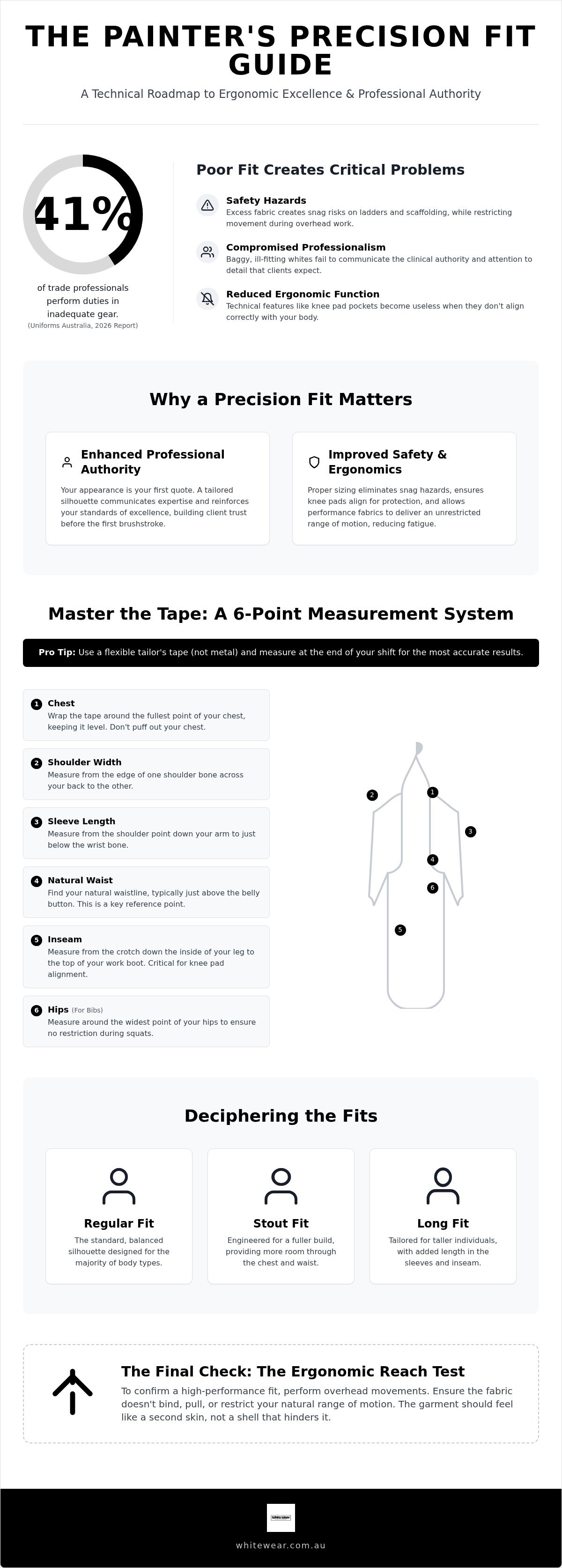
A 2026 report from Uniforms Australia revealed that 41% of trade professionals are currently performing their duties in gear that is fundamentally inadequate for the task. For a master painter, an ill-fitting garment is more than a minor annoyance. It is a hazard that restricts movement on a ladder and compromises the professional dignity you've worked years to establish. This comprehensive painters clothing size guide serves as your technical roadmap to a refined fit. It moves beyond the baggy, generic whites of the past to embrace a new standard of ergonomic excellence.
You understand that your workwear is a functional tool, not just a uniform. When your knee pads shift during use or your trousers sag during a long shift, your focus is pulled away from the precision of the finish. We will help you master the art of professional sizing to ensure your apparel provides clinical precision and a sophisticated silhouette. This guide covers essential measurement techniques, the impact of the OSHA 2025 PPE Fit Rule, and how to select high-performance fabrics that offer an unrestricted range of motion for overhead work.
Key Takeaways
- Understand the link between a precise fit and professional authority, moving beyond generic, baggy whites that compromise your safety and brand.
- This painters clothing size guide provides the technical methodology for using a flexible tape to capture accurate torso and waist measurements.
- Decipher the Australian coding system to choose between Regular, Stout, and Long fits, ensuring your trousers sit exactly where they should.
- Learn to perform the "Reach Test" to verify that your four-way stretch gear maintains its silhouette during repetitive overhead movements.
- Elevate your daily experience by selecting peer-led designs that prioritize ergonomic comfort during the most grueling hours of a long shift.
The Science of Fit: Why Precision Sizing Matters for Professional Painters
Precision defines the master painter. A sagging hem or a bunching sleeve isn't just a minor annoyance; it's a distraction that pulls your focus from the canvas. This painters clothing size guide serves as a technical manual for the professional who treats their attire as a precision instrument. Traditional workwear has long relied on a "one-size-fits-most" philosophy, but a high-performance environment demands anatomical accuracy. Transitioning from generic utility to refined, high-performance apparel is the first step in reclaiming your professional dignity on the job site.
The Connection Between Fit and Professional Authority
Your appearance is your first quote. Clients who invest in premium finishes expect to see that same level of detail reflected in your presence. A tailored, professional silhouette communicates a sense of clinical authority that baggy, generic whites simply cannot match. It's a move away from the disposable mindset of the past. Wearing gear designed specifically for your craft provides a psychological edge, fostering a sense of mission and pride during a demanding workday. When you look like an expert, you carry yourself with the confidence of one. This refined aesthetic doesn't just build client trust; it reinforces your own standards of excellence.
Safety and Ergonomics: More Than Just Aesthetics
Ill-fitting gear is a physical liability. Excess fabric in high-activity zones creates snag hazards when you're navigating scaffolding or climbing ladders. If your trousers are too loose, the mechanical stretch of the fabric cannot work effectively, leading to fabric tension that restricts your range of motion during overhead work. Precision sizing ensures your movement remains fluid and unrestricted.
Proper sizing also ensures that technical features function as intended. For example, knee pad pockets must align perfectly with your patella to provide actual protection. If they sit too low or shift during use, they become useless weight that contributes to joint strain. By prioritizing a refined fit, you reduce the physical strain on your body and minimize the daily fatigue associated with the long shift. This anatomical alignment isn't about vanity; it's about career longevity and operational safety. High-performance painters clothing should feel like a second skin that empowers your movement rather than a shell that hinders it.
Master the Tape: How to Measure for a Professional Silhouette
A refined fit begins with precise data. To achieve a professional silhouette, you must move beyond the guesswork of standard high-street sizing. A flexible tailor’s tape is your most essential tool here. Rigid metal tapes are designed for measuring substrate, not the human form. For the most accurate results, measure yourself at the end of a shift. This accounts for the natural physical expansion that occurs during hours of labor, ensuring your gear remains comfortable through the final brushstroke. This painters clothing size guide prioritizes anatomical accuracy to support your daily performance.
Upper Body: Measuring for Reach and Rotation
Start with the chest. Wrap the tape around the fullest point while maintaining a natural stance. Don't puff your chest; you need a measurement that reflects your resting state. Shoulder width is equally pivotal. Measure from the edge of one shoulder bone across the back to the other. This ensures that when you reach overhead, the fabric doesn't bind or pull. For sleeves, measure from the shoulder point to just below the wrist bone. This provides optimal protection while allowing clearance for a watch or gloves. A precise sleeve length prevents the common annoyance of fabric dragging through wet paint during detailed trim work.
Lower Body: The Foundation of Movement
Lower body measurements form the foundation of your mobility. Find your natural waistline, usually just above the belly button. This may differ from where you prefer to wear your belt, but it's a vital reference point for technical trousers. For the inseam, measure from the crotch down to the top of your work boot. Precision here is mandatory. An incorrect inseam causes knee pads to sit too low, leaving your joints vulnerable when kneeling on hard surfaces. This alignment is a core component of our "Long Shift" design philosophy.
If you're opting for bib and brace styles, include a hip measurement at the widest point. This ensures the garment doesn't restrict your stride or bunch during deep squats. Once you've secured these figures, choosing the right painters clothing becomes a calculated decision rather than a gamble. This data-driven approach to your wardrobe ensures that every piece of gear you own supports your craft with clinical precision. Using a consistent painters clothing size guide allows you to build a professional kit that feels custom-made for the demands of the trade.
Deciphering the Chart: Regular, Stout, and Long Fits Explained
Australian workwear utilizes a specific alphanumeric system that provides more nuance than standard S/M/L retail sizing. When you see a label like 82R or 92S, you're looking at a technical specification for your body. The number represents the waist measurement in centimetres, while the letter denotes the leg length and overall proportion. Mastering this painters clothing size guide requires understanding that your waist measurement is only half the equation. To maintain a sophisticated silhouette, you must align your height and build with the correct fit category.
Regular (R) vs Stout (S) vs Long (L)
The "Regular" (R) fit serves as the industry baseline, typically engineered for professionals between 175cm and 185cm. However, the trade demands diverse physiques. The "Stout" (S) fit is designed for the broader professional. It accommodates a larger waist and more developed leg muscles without adding unnecessary length that would bunch at the ankle. Conversely, the "Long" (L) fit is essential for taller frames. It prevents the unprofessional "high-water" effect, ensuring your trousers maintain a clean line from hip to boot. Choosing the correct category ensures your gear looks tailored, not borrowed.
Knee Pad Alignment and Inseam Length
Safety features are only effective when they're positioned correctly. This is where the distinction between fits becomes critical. The "Knee Drop" refers to the distance from the waistband to the centre of the knee pad pocket. If a professional with a shorter inseam wears a Regular fit, the knee pads will sit too low, leaving the joints exposed during kneeling tasks. This misalignment is a primary cause of daily fatigue and long-term joint strain.
Your choice of professional footwear also influences this selection. A heavy-duty boot with a thick sole may require a slightly different inseam than a lighter work shoe to ensure the hem sits perfectly without dragging. When your clothing is anatomically aligned, safety features like knee pads become an invisible extension of your body. This level of precision is what separates high-performance painters clothing from generic hardware store options. It ensures that during the most grueling hours of a long shift, your protection remains exactly where it belongs.
The Ergonomics of Motion: Sizing for the Long Shift
Static data provides the blueprint, but the real test of a painters clothing size guide is how the fabric behaves under stress. Painting is a high-motion discipline. Constant reaching, squatting, and climbing are the daily reality for the master tradesperson. Your workwear must function like a second skin, maintaining its sophisticated silhouette while facilitating a total range of movement. This is the heart of the "Long Shift" design philosophy. It ensures your gear feels as precise and comfortable at the end of the day as it did at the first brushstroke. A modern fit strategy must account for this constant physical exertion.
The Role of Advanced Fabric Technology
Modern professionals don't wear the stiff, boxy canvases of previous generations. Advanced four-way stretch technology has changed the definition of a "fitted" garment in the trade. Unlike old-school gear that relied on a baggy cut to allow for movement, high-performance stretch allows for a more sophisticated, tailored shape. There is a clear difference between a garment that's tight and one that's fitted. A fitted piece follows your anatomical lines, offering support without any restriction. Fabric recovery is just as vital. High-quality materials snap back into place instantly. This prevents the unprofessional "baggy knees" or sagged seat that often happens after hours of crouching in generic utility wear.
Mimicking the Workday During Fitting
When your new gear arrives, don't just stand still in front of a mirror. You need to stress-test the fit by mimicking your actual work postures. Try the "Reach Test" first. Extend your arms fully overhead as if you're cutting in a ceiling. If the shirt untucks or the sleeves pull back too far, you might need to adjust your size choice. Next, perform a deep "Squat Test" to check the rise tension. You shouldn't feel any restrictive pulling across the thighs or see a gap at the back of the waistband. The rise should provide full coverage during movement without bunching up when you're on a ladder or seated.
Factor in your seasonal needs too. If you're working through winter, make sure your measurements allow for thin, high-performance base layers. You want to stay warm without losing that sharp silhouette. Maintenance is another key factor in long-term fit. Premium professional apparel is built for stability. Generic cotton whites often shrink in hot water, but high-performance painters clothing is engineered to keep its shape wash after wash. Choosing gear that respects your ergonomics is a long-term investment in your daily comfort and professional dignity.
Elevating Your Professional Presence with White Wear
A complete professional system adapts to the environment. For internal residential work where mobility and a sharp appearance are paramount, choosing the right painters pants ensures you maintain a clinical aesthetic while moving freely. When the heat of the Australian summer demands it, specialized shorts offer the same ergonomic benefits without the weight. For high-volume commercial projects or restoration work, painters overalls provide an elevated level of protection and style, acting as a full-body shield against overspray. If you're still uncertain about your specific measurements, our online support team provides bespoke sizing advice to ensure your first purchase is your best purchase.
Care for Longevity
Maintaining that precision requires a commitment to care. This painters clothing size guide has helped you find the perfect fit; keeping it depends on your clinical protocol. High-performance fabrics with four-way stretch technology are durable, but they demand respect. Avoid high-heat drying cycles that can degrade the elastic fibres over time. Instead, opt for a cool or warm wash and air drying to preserve the garment's shape and recovery. This approach ensures that your whites remain bright and your fit remains precise for the duration of your career. Investing in quality over quantity is a commitment to your long-term comfort and professional dignity during grueling hours of labour.
Step into a new standard. Your workwear should be a source of pride, providing the comfort you need for every demanding task. With a refined fit and a curated selection of White Wear, you aren't just dressed for work. You're prepared for excellence.
Master Your Professional Silhouette
Mastering your professional image starts with the data you've gathered from this painters clothing size guide. You now have the technical framework to move beyond generic, ill-fitting gear and embrace a silhouette that reflects your expertise. By prioritizing anatomical alignment and understanding the nuances of Regular, Stout, and Long fits, you ensure your safety features remain effective through every hour of the long shift. Precision is not just about aesthetics; it's about the dignity of the trade.
Our peer-led designs utilize advanced four-way stretch technology to provide a fit that is both sophisticated and high-performing. This gear is built by painters for painters who refuse to settle for the status quo. With Australia-wide shipping on all professional gear, upgrading your wardrobe is as efficient as your most streamlined project. Your craft deserves the clinical precision and refined style of gear designed for the modern professional.
Ready to step into a new standard of comfort? Find Your Perfect Fit in the White Wear Collection today. Take pride in your presence and perform with the confidence that only a tailored fit can provide.
Frequently Asked Questions
What does "92R" mean in Australian workwear sizing?
A 92R label indicates a 92-centimetre waist with a Regular length leg. This alphanumeric system is the technical standard for Australian workwear, where the number identifies the literal circumference of your natural waistline. The "R" signifies a proportion designed for an average height between 175cm and 185cm. Referencing a technical painters clothing size guide ensures you don't confuse this with vanity sizing found in retail stores.
How should painters trousers fit around the waist and hips?
Your trousers should sit securely at your natural waistline without requiring a belt to remain in place. The hips must have enough volume to facilitate a deep squat without the fabric pulling tight across the seat. A sophisticated fit avoids excess bunching while maintaining a clean, professional silhouette. If you feel restricted during a basic lunge, the rise or hip measurement is likely too small for your build.
Should I size up if I am between two measurements?
When you're between sizes, the decision depends on the fabric technology. For garments featuring advanced four-way stretch, it's often better to choose the smaller size to maintain a refined appearance. The fabric's elasticity will accommodate your movement while preventing the baggy look associated with oversized gear. If the garment is a traditional rigid drill, opting for the larger size provides the necessary mechanical room. This painters clothing size guide prioritizes a tailored finish.
How do I know if my knee pads are in the correct position?
Perform a squat to verify that the knee pad pocket centres directly over your patella. When standing, the knee pads will naturally sit slightly lower; this is a deliberate design feature. The true test occurs when you're actually kneeling on a hard surface. If the pad shifts to the side or sits too high, you may need to reconsider your inseam length or switch between Regular and Stout fit categories.
Do painters overalls follow the same sizing as standard trousers?
Painters overalls generally follow the same waist measurements as trousers, but they require additional attention to your torso length. Because they're a single-piece garment, a torso that's too short will cause the crotch to hang low, restricting your stride. Conversely, a torso that's too long will cause uncomfortable pulling at the shoulders. Always check the total garment length against your height to ensure the ergonomic features align with your body.
What is the best way to measure my inseam without help?
The most effective way to measure your inseam solo is by using a pair of your best-fitting trousers. Lay them flat on a hard surface and measure from the crotch seam down to the bottom of the hem. Alternatively, stand against a wall and place a book between your legs as high as is comfortable. Mark where the top of the book hits the wall and measure from that point down to the floor in centimetres.
Will stretch painters pants lose their shape over time?
High-performance stretch gear is engineered with superior fabric recovery to prevent permanent deformation. While generic stretch fabrics might suffer from "baggy knees" after a few shifts, professional-grade apparel retains its original dimensions. This durability is a hallmark of peer-led development. Following a clinical care protocol, such as avoiding high-heat drying, further protects the integrity of the elastic fibres, ensuring your refined fit lasts for the life of the garment.
How does sizing differ for women’s painters workwear?
Women’s painters clothing is specifically patterned to accommodate a different waist-to-hip ratio and a shorter rise. While many professionals have historically relied on smaller men's sizes, these often result in a poor fit at the waist or restricted movement at the hips. A dedicated women's sizing approach accounts for these anatomical nuances. This ensures the garment provides the same level of professional dignity and unrestricted motion without the need for constant adjustment.


