


The 2026 professional landscape has moved beyond the "one-size-fits-most" approach to workwear, recognizing that ergonomic alignment is a fundamental requirement for the modern tradesperson. Whether you are working on a high-end residential project or a large-scale commercial site in Australia, your gear must function as a precision tool. Understanding how to properly fit painters overalls is the first step in ensuring your physical longevity and maintaining a clinical edge on the tools. It's no longer enough to simply provide protection; your clothing must empower your movement and reflect the high standards of your craft.
We understand the frustration of fabric chafing during repetitive motions or gear that "rides up" during critical ladder work. You deserve a tailored but functional silhouette that eliminates these distractions while projecting an image of technical authority to your clients. This guide explores the technical nuances of fitting your workwear to ensure maximum mobility and comfort during even the most demanding shifts. We'll walk you through precise measurement techniques, movement-based stress tests, and the refined adjustments needed to keep your knee pads and hems exactly where they belong. Prepare to transform your daily uniform into a high-performance essential.
Key Takeaways
- Understand how a balanced silhouette reduces muscular fatigue by eliminating unnecessary garment tension during long shifts.
- Master the "Torso Arc" measurement technique to ensure your bib and brace provides a refined fit over your standard base layers.
- Perform the "Overhead Reach" stress test to determine how to properly fit painters overalls for zero-restriction mobility on the ladder.
- Learn to align knee pads with clinical precision to protect your joints while maintaining a clean, professional aesthetic at every height.
- Discover how peer-led design and premium poly-cotton blends create a functional workwear silhouette that offers both flexibility and durability.
The Science of the Silhouette: Why Proper Fit Defines Professionalism
Your silhouette is your first handshake. In a high-stakes environment where precision is the product, a balanced and purposeful appearance establishes immediate clinical authority. A professional silhouette is characterized by clean lines and an intentional fit that mirrors the high-quality finish of your work. When you project this level of refinement, you build a psychological bridge of trust with your clients. This isn't just about vanity; it's about the tangible link between your appearance and your project rates. Clients are more likely to invest in a professional who treats their own presentation—and their business organization—with the same care they apply to a pristine wall finish; you can learn more about tools for maintaining professional client files and contact information.
Historically, the Boilersuit or coveralls was a purely functional shield against grime. However, the modern tradesperson recognizes that garment tension is a primary driver of muscular fatigue. When fabric is too tight across the back or thighs, your body works against the clothing with every movement. This constant resistance leads to exhaustion long before the shift ends. Conversely, the common myth that "baggy" equals "breathable" is a dangerous misconception in high-performance painting. Excess fabric creates unnecessary drag, traps heat in stagnant folds, and compromises your mobility. Learning how to properly fit painters overalls ensures that your gear supports your body's natural mechanics rather than hindering them.
Mobility vs. Aesthetics: Striking the Balance
Traditional painters clothing often forces a compromise between looking like a professional and moving like an athlete. We believe you deserve both. The "sweet spot" in a professional fit involves enough volume for a full range of motion without the sloppy appearance of oversized gear. Modern, premium fabrics now incorporate "fabric memory," allowing the garment to flex during deep squats or overhead reaches and then return to a polished, structured shape. This prevents the "sagging" effect that often plagues lower-quality alternatives after a few hours of labor. Achieving this balance requires an understanding of how to properly fit painters overalls to your specific frame, ensuring the garment remains a refined essential throughout the day.
The Consequences of an Improper Fit
Ill-fitting gear is a physical liability. When straps are too short or poorly positioned, they place direct pressure on the trapezius muscles, leading to chronic neck and shoulder strain. This is particularly problematic during the repetitive motions of cutting-in or rolling. Furthermore, excess fabric around the legs and torso poses a significant safety risk on ladders and scaffolding, where a single snag can lead to a fall. Beyond safety, friction in an ill-fitting crotch or underarm area causes premature wear and tear, destroying your investment in record time. Proper alignment prevents this friction, ensuring your gear lasts as long as your reputation for excellence.
Measuring for the Long Shift: The Critical Dimensions of Painting Apparel
Precision in craftsmanship begins long before the first drop of paint hits the surface. It starts with the tape measure. The golden rule of professional measurement is simple yet frequently overlooked: always measure over the specific layers you intend to wear during a shift. A fit that feels tailored over a summer singlet will quickly become restrictive when paired with a heavy winter hoodie. Understanding the nuances of painters overalls design requires accounting for this seasonal variance to ensure your mobility remains uncompromised year-round. You aren't just fitting for a mirror; you're fitting for the physical reality of a ten-hour day.
Most generic sizing charts rely solely on waist and inseam. This approach is fundamentally flawed for a one-piece garment. While your trouser length matters, it's only half the story for full coveralls. The most critical metric for ergonomic performance is the "Torso Arc." This measurement dictates whether the garment will "ride up" during overhead reaching or "drop" during ladder work. Mastering how to properly fit painters overalls means prioritizing this vertical dimension over horizontal width to prevent the garment from becoming a physical anchor during demanding tasks.
Calculating Your Torso Arc
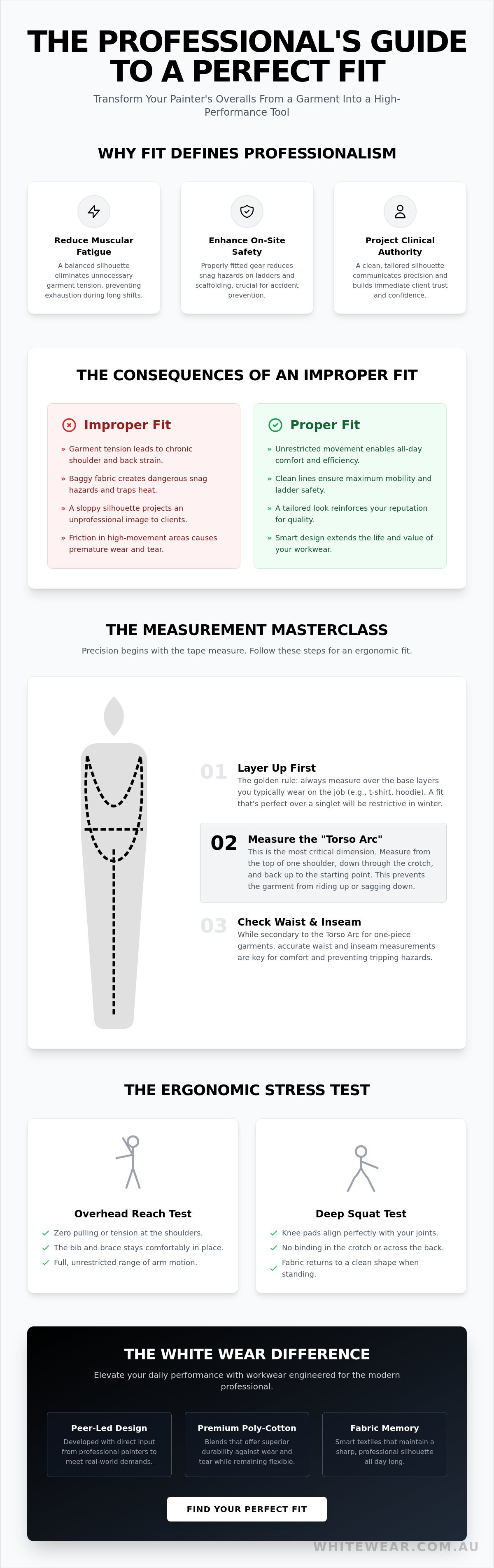
To find your arc, place the tape measure at the highest point of your shoulder. Run it down the front of your body, through the crotch, and back up the spine to the starting point. This total circumference determines the "rise" of the garment. If you have a long torso, you may need to size up even if your waist measurement suggests otherwise. Ignoring this step is the primary reason professionals experience shoulder digging or crotch strain. This specific measurement ensures that the garment's pivot points align with your own, allowing for fluid movement on the job site.
Waist and Hip Alignment
Comfort at the waist should never require a belt to keep the garment in place. We recommend the "Two-Finger Rule": you should be able to slide two fingers comfortably between the waistband and your layering. This provides the necessary room for the torso to expand and contract during deep squats without stressing the seams. Pay close attention to hip room as well. Modern painters clothing often features sophisticated pocket architecture. When these pockets are loaded with scrapers, brushes, or phones, they shouldn't pull the fabric tight against your thighs. A truly professional fit accommodates your tools while maintaining a clean, streamlined profile that projects clinical authority.
The Ergonomic Stress Test: Assessing Mobility Before the First Coat
A mirror tells you how you look, but it won't tell you how you'll feel at hour eight of a double-coat day. Static checks are deceptive. To truly understand how to properly fit painters overalls, you must put the garment through a series of dynamic movements that mimic the grueling reality of the job site. This is the ergonomic stress test. It's a clinical assessment of the garment's ability to remain a refined essential during high-intensity labor. If your gear restricts you in the fitting room, it will fail you on the scaffold.
Start with the Overhead Reach. Extend both arms toward the ceiling as if you're cutting-in a cornice. If the shoulder straps dig into your neck or the ankle hems lift more than two inches, the torso length is insufficient for your frame. Next, perform a Deep Squat. You're looking for excessive tension across the seat and thighs. If the fabric pulls tight enough to restrict blood flow or strain the seams, you've sacrificed longevity for a slim look. Finally, execute the Ladder Step. Lift one knee toward your chest to simulate climbing. If the crotch area catches or restricts your stride, the garment fails to provide the mobility you deserve.
Checking the "Rise" and Seat
"Crotch drop" is more than a style error; it's a mobility anchor. If the crotch sits too low, it creates a physical barrier to wide strides and climbing, forcing you to adjust your gear constantly. The ergonomic rise is the vertical distance that dictates your range of motion. When you drop to one knee, the seat should expand slightly to accommodate your posture without becoming a "skin-tight" failure point. A tailored but functional seat ensures the fabric moves with your muscles rather than fighting against them.
Shoulder Strap Calibration
Straps are the suspension system of your workwear. They must support the bib's weight without pulling the crotch upward into an uncomfortable position. Premium painters workwear often utilizes elasticated inserts at the back or shoulder points to provide dynamic tension. These inserts allow the garment to grow with your movements, preventing the "strap-dig" that causes chronic upper-back fatigue during long shifts. If you find yourself constantly loosening the hardware to find relief, the garment is likely too short for your height, regardless of what the waist size suggests.
Technical Adjustments: Refining Straps, Cuffs, and Knee Pad Alignment
Achieving a professional fit is a process of refinement that extends beyond the initial measurement. Once you've mastered the basics of how to properly fit painters overalls, the focus shifts to technical adjustments that ensure your gear performs under pressure. These fine-tuned details transform a standard garment into a high-performance tool. Every adjustment should be purposeful. Your goal is to eliminate physical distractions so you can focus entirely on the precision of your craft. Small changes in how you secure your straps or manage your hems can significantly reduce fatigue during a ten-hour shift.
The "Knee Pad Sweet Spot" is perhaps the most elusive aspect of ergonomic alignment. Many professionals find their protection "floats" too low, leaving the joint vulnerable during sudden kneeling. This is often a result of improper strap calibration. By tightening the shoulder straps slightly, you raise the entire front panel, including the knee pad pockets, ensuring the protective inserts align perfectly with your anatomy. Conversely, if you've opted for specialized painters pants or hybrid bibs, ensure the internal inserts are seated correctly within the pocket architecture. To verify the alignment, perform ten consecutive kneeling repetitions. The pad should meet the floor precisely where your knee makes contact every single time.
Knee Pad Pocket Precision
Knee pads that shift during movement aren't just annoying; they're a safety hazard. If your pads consistently slip to the side, it's a sign the leg width is too generous for your frame. You can often correct this by utilizing internal drawstrings or side-button adjustments to pull the fabric closer to the leg. This creates a more stable "sleeve" for the knee pad. Testing pad alignment through repetitive movement is the only way to guarantee protection during the high-intensity kneeling required for baseboard work or floor coatings. Proper alignment ensures you maintain your clinical authority even when working at ground level.
Cuff and Hem Management
Managing the interaction between your hem and footwear is critical for both safety and clinical presentation. A hem that's too long creates a "heel-tread" hazard, leading to potential trips on ladders or scaffolding. We recommend a slight taper in the leg to provide a modern, streamlined silhouette that won't snag on equipment. The fabric should achieve a clean "break," resting lightly on the top of your work boots without pooling. If the leg length is excessive, professional hemming is always superior to bulky cuffs, which can trap debris and paint splatter. Refining these details ensures you maintain an image of upward mobility and technical expertise throughout the workday. Experience the difference of peer-led design by exploring our range of professional painters workwear today.
The White Wear Difference: Elevating Your Daily Performance Through Design
The dignity of the trade is often found in the smallest details. At White Wear, we believe your workwear should be a refined essential that provides both physical comfort and professional pride. Understanding how to properly fit painters overalls is only the first step; the second is choosing a garment designed to maintain that fit through the rigors of the trade. Our peer-led development process ensures every piece of painters clothing we produce offers a superior out-of-the-box fit. We aren't just manufacturers; we are insiders who understand that a single millimetre of restriction can lead to a day of frustration. This isn't just about fabric; it's about the psychological shift that occurs when you step onto a site looking and feeling like the protagonist of your own career.
Our use of premium poly-cotton blends is a deliberate choice for the modern professional. These fabrics provide a structured silhouette that projects clinical authority while remaining flexible enough for the most demanding overhead reaches. Unlike generic alternatives that lose their shape or sag under the weight of tools, our pocket architecture is engineered to remain accessible regardless of your size. We've positioned every holster and utility loop to ensure your scrapers and brushes are always within reach without dragging the garment out of alignment. This thoughtful design allows you to move with a sense of upward mobility, knowing your gear supports your expertise rather than hindering it.
Engineered for the Australian Professional
The Australian environment demands a unique balance of breathability and durability. Our signature white fabrics are designed to keep you cool during intense summer shifts while providing a robust shield against the elements. We've reinforced every stress point, from the crotch to the shoulder joins, to ensure garment integrity during heavy movement. This commitment to quality means your uniform retains its professional shape and crisp appearance even after 50+ washes. It’s an investment in your career longevity and your daily comfort. You deserve a uniform that works as hard as you do while maintaining a polished, high-end aesthetic.
Your Next Step Toward a Better Workday
A better workday begins with a perfect fit. We invite you to consult our comprehensive sizing guide to find the silhouette that best matches your specific body type. For those seeking a more tailored approach, we highly recommend reviewing our professional woman’s guide for gender-specific fitting insights. Choosing the right gear is an act of self-respect that signals your expertise to every client you meet. Elevate your professional presence today and Explore the White Wear Collection to find your next refined essential.
Refine Your Performance with a Clinical Edge
Your workwear is a refined essential that defines your daily experience on the tools. By prioritizing the Torso Arc measurement and validating your mobility through dynamic stress tests, you ensure your gear supports your body's natural mechanics. Mastering how to properly fit painters overalls is a commitment to your long-term physical health and professional identity. It's about securing your longevity in a demanding trade while maintaining a polished, clinical aesthetic that commands immediate respect from every client you meet on-site.
You deserve gear that reflects the precision of your craft. Our peer-led development process ensures that every piece of White Wear clothing provides the sophisticated silhouette and ergonomic performance required for the modern workday. With nationwide Australian shipping, your upgrade to a higher standard of workwear is immediate and effortless. Elevate your professional silhouette with White Wear’s premium overalls and experience the difference that intentional design makes. Step into your next project with the confidence of a professional who refuses to compromise on dignity, comfort, or performance.
Frequently Asked Questions
Should I buy painters overalls one size larger than my regular pants?
You should typically size up by one to two inches compared to your standard trouser waist. This adjustment ensures the garment accommodates the additional layers you wear underneath and provides the necessary vertical volume for the torso. Buying your exact waist size often results in a restrictive fit that limits your range of motion during deep squats or repetitive overhead reaching.
How do I know if the "rise" of my overalls is too short?
You'll know the rise is insufficient if you experience "strap-dig" or crotch tension while performing a standard overhead reach. The rise dictates your vertical mobility. If the fabric pulls tight against your shoulders before your arms are fully extended, the garment is too short for your frame. This lack of vertical volume leads to chronic fatigue and physical irritation throughout the workday.
What is the best way to adjust the straps on a bib and brace?
The most effective method is to calibrate your straps while wearing your full kit, including work boots and seasonal layers. Aim for a tension point that supports the bib's weight without pulling the crotch upward into an uncomfortable position. Premium painters workwear often includes elasticated inserts that allow for dynamic adjustment; use these to find a balance between a secure hold and effortless flexibility.
Why do my knee pads always slip down to my shins?
This misalignment usually occurs because the shoulder straps are set too loose or the leg length is excessive for your height. When the front panel sits too low, the knee pad pockets "float" away from your joints. Tightening the straps slightly will often pull the pockets back into the correct position. Understanding how to properly fit painters overalls requires ensuring these protective elements align precisely with your anatomy during movement.
Can I hem my painters overalls if they are too long?
Yes, professional hemming is highly recommended over bulky cuffs for both safety and clinical presentation. Excessive fabric at the ankle creates a "heel-tread" hazard on ladders and can trap paint debris. A tailored hem that achieves a clean "break" over your boots ensures you maintain a streamlined, professional silhouette while eliminating tripping risks on the job site.
How much should I account for fabric shrinkage after the first wash?
You should account for approximately 1% to 3% shrinkage if you are using high-quality poly-cotton blends. While premium painters clothing is often pre-shrunk, a slight tightening is natural after the initial wash. If your gear feels borderline tight when new, it is wise to size up slightly to ensure long-term comfort and mobility after repeated laundering.
Are slim-fit painters overalls practical for ladder work?
Slim-fit designs are highly practical if they utilize high-performance fabrics with built-in memory and flexibility. A tapered silhouette reduces snag hazards on scaffolding and provides a modern, refined look. However, you must ensure the garment passes the "ladder step" test; if the fabric restricts your stride or pulls at the hip, a more relaxed cut is necessary for safety.
What should I wear underneath my overalls for the best fit?
Opt for moisture-wicking, low-profile base layers that don't add unnecessary bulk to your frame. Heavy denim or thick fleece can distort the intended silhouette and create uncomfortable friction points. Choosing breathable, technical fabrics ensures your overalls can glide over your body during movement, which is a key component of how to properly fit painters overalls for maximum ergonomic performance.


