


What if the strongest case for better painters’ uniforms starts with the work, not the wardrobe? If your clothes pull when you reach, feel uncomfortable through a long shift or make tools awkward to carry, you know what could work better. Your manager may be focused on the upfront cost. Convincing your boss to invest in better uniforms means showing how fit, movement, care and presentation relate to the team’s actual needs.
This guide will help you make a concise, evidence-led proposal without overstating what new clothing can achieve. You’ll learn how to document problems with the current uniform, compare alternatives against practical criteria and frame the decision around more than the purchase price. You’ll also find ways to suggest a manageable next step, such as gathering crew feedback or reviewing an option before making a wider change. White Wear’s specialised painters’ workwear is one relevant option to include in your comparison.
Key Takeaways
- Define “better” by how uniforms suit painting tasks, including movement, fit, care and presentation.
- Use garment condition, replacement records and crew feedback to make your case specific and credible.
- Make convincing your boss to invest in better uniforms easier by comparing current and proposed clothing against the same practical criteria.
- Keep the pitch collaborative: recognise budget priorities and suggest a clear way to review the options.
- Consider painter-focused clothing, including specialised workwear from Australian supplier White Wear.
Why better painters’ uniforms deserve a business conversation
Your crew may notice a uniform twisting during overhead work, rubbing at the shoulders or wearing through at the knees. Management may see a request to replace clothing that still looks usable. Both perspectives are reasonable. Convincing your boss to invest in better uniforms starts with translating day-to-day experience into observable work needs, not simply asking for a more polished look.
A workwear investment should be considered over the garment’s working life, not by its purchase price alone. That doesn’t guarantee savings. It points to a more useful question: how well does the current clothing serve the job, and how does a practical alternative compare? Workwear has long been shaped by the needs of particular tasks. The general history and purpose of workwear helps explain why relevance to the job matters alongside appearance.
Start with the realities of a painter’s workday
Base the discussion on what your team actually does and experiences. Ask painters to note recurring tasks, the movements involved and any conditions that affect their clothing. A day might include reaching overhead, crouching to prepare a surface, getting in and out of a vehicle or moving between indoor and outdoor work. Use these as prompts, not assumptions about every crew’s routine.
Record specific examples: a waistband that shifts while bending, restricted movement when reaching, a pocket that doesn’t suit the tools carried, or seams and knees showing wear. Note when and where each issue occurs, and whether one person or several have raised it. This keeps the discussion grounded without claiming that discomfort automatically reduces output or that a particular garment will prevent injury.
Translate clothing concerns into business priorities
Connect each observation to a decision the business can assess. Fit and comfort affect how clothing feels through a shift; movement and storage relate to the tasks and equipment the crew handles. Ask team members which issues matter most and whether preferences differ by role or fit. The goal is to identify useful criteria, not assume everyone needs the same garment.
Presentation is another valid consideration. Consistent, work-appropriate clothing may support the image the business wants clients to associate with its team, especially when painters work in occupied homes or commercial spaces. Frame this as a brand preference, not a guaranteed source of trust or new work.
Treat durability as something to assess. Compare garment condition, repair or replacement records where available, and how the team cares for its clothing. A proposed option may seem better suited to the work, but only use over time can show how it holds up in your conditions. Separate observed facts from expectations. That distinction makes the case more credible and gives management a clear basis for review.
Build a credible business case for upgrading painters’ uniforms
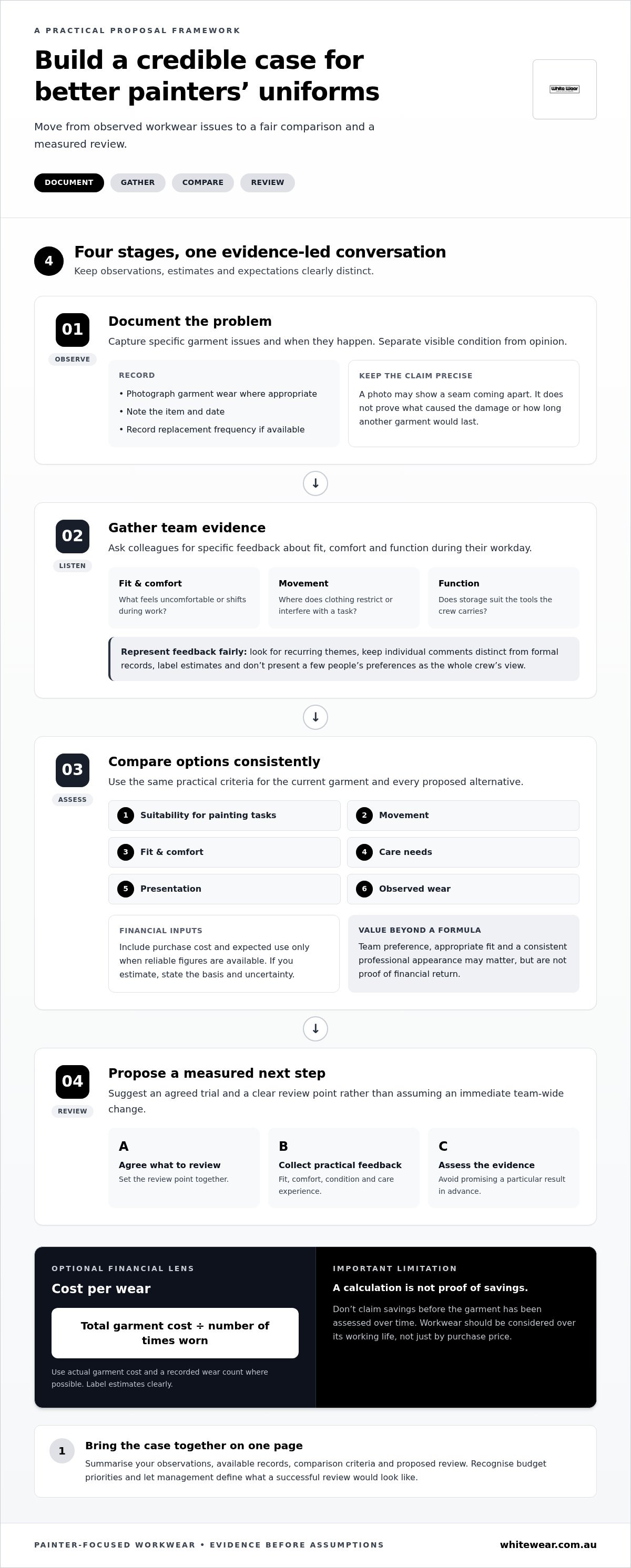
A clear proposal helps your boss assess the issue without relying on broad claims about productivity or savings. Keep the process simple: document what’s happening, gather evidence, compare options fairly, then suggest a review. This gives the conversation a practical shape and shows you’re seeking a considered decision, not an open-ended spend.
- Document the problem. Photograph garment wear where appropriate, note the item and date, and record how often replacements are needed if that information is available. Separate visible condition from opinion. A photo can show a seam coming apart, but it can’t prove what caused the damage or how long another garment would last.
- Gather team evidence. Ask colleagues for specific feedback on fit, comfort and function during their workday. Look for recurring themes, but keep individual comments distinct from formal business records. Label estimates as estimates, and don’t present a few people’s preferences as the view of the whole crew.
- Compare options consistently. Assess the current garment and any proposed alternative against the same criteria: suitability for painting tasks, movement, fit, comfort, care needs, presentation and observed wear. Include purchase cost and expected use only when your employer can provide reliable figures. If you estimate, state the basis and uncertainty.
- Propose a review. Instead of requesting an immediate team-wide change, suggest an agreed trial with a clear review point. Decide what feedback to collect, such as fit, comfort, condition and care experience. This creates a measured next step without promising a particular result.
Cost per wear can help frame the financial comparison if the inputs are sound. Cost per wear is the total garment cost divided by the number of times it’s worn. Use the actual garment cost and a recorded wear count where possible. If either figure is estimated, label it clearly. Don’t use the calculation to claim savings before the garment has been assessed over time.
A useful proposal also recognises value that isn’t captured by a formula. Team preference, appropriate fit and a consistent professional appearance may matter to the business, even when they can’t be reduced to a dollar figure. Present these alongside the evidence, not as proof of a financial return.
For a concise case, put your observations, records, comparison criteria and proposed review on one page. This makes convincing your boss to invest in better uniforms a collaborative discussion: your manager can weigh the evidence against budget priorities and define what a successful review would look like. Then compare relevant options, including specialised painters’ workwear from White Wear.
Compare uniform options against real painting work
A useful comparison tests the current uniform and a practical alternative against the same job demands. Don’t assume a newer garment is automatically better or that one style will suit every painter. The aim is to find which option best fits your team’s tasks and preferences, using observations and reliable product information rather than impressions alone.
Choose criteria that matter on a painting job
Consider the movements and demands of the actual work: bending to prepare surfaces, reaching overhead, kneeling and carrying tools between tasks. Assess whether each garment allows comfortable movement, how it fits different team members and whether its care requirements suit the way clothing is laundered. Check claims about material or construction against reliable product information. Include the team’s range of fit and sizing needs, not just one wearer’s experience.
| Criterion | Current uniform | Proposed option |
|---|---|---|
| Movement | Where does it restrict or shift during tasks? | Does it feel suitable during the same movements? |
| Wear | What condition is visible, and when was it noted? | What reliable information or trial evidence is available? |
| Comfort and fit | What do different wearers report? | Does it address those preferences across the team? |
| Care | How is it laundered and maintained? | Are care instructions workable for the crew? |
| Presentation | Does it align with the business’s preferred image? | Does it meet the same presentation standard? |
Compare the current setup with a practical alternative
Make each option answer a specific concern. If the current trousers feel restrictive when kneeling, assess the alternative during that movement. If the team reports inconsistent fit, compare feedback from more than one wearer. Record what was observed, what came from team feedback and what remains unknown. This like-for-like approach makes convincing your boss to invest in better uniforms a grounded decision. A branded appearance is not proof of garment performance or a guarantee of new work.
Keep workwear selection separate from personal protective equipment (PPE). Comparing uniforms isn’t a substitute for assessing hazards or checking the protective equipment required for a particular task. Follow your employer’s safety processes and current, authoritative Australian workplace guidance to determine task-specific requirements. Don’t assume ordinary painting clothing protects against chemicals, dust, falls or other hazards.
Once you’ve agreed on the criteria, assess painter-focused clothing using available garment information and, where practical, team feedback from actual wear. There may not be one universal winner. A clear comparison shows where an alternative appears to address a documented need, where evidence is incomplete and what a small trial could help the team evaluate next.
How to pitch better uniforms to your boss
A strong pitch is brief, specific and open to discussion. You’re not asking your manager to accept every preference or approve a full change on the spot. You’re asking them to consider a work-related concern and agree on a sensible way to assess it. This makes convincing your boss to invest in better uniforms less about winning an argument and more about reaching a clear decision together.
Prepare a short proposal your manager can assess
Keep your notes focused: describe the issue, share the strongest supporting examples and state which work-related criteria a different uniform should meet. Include your comparison, but be upfront about gaps, such as limited wear records or feedback from only part of the team. End with the decision you’re requesting, whether that’s a review conversation, team feedback or a trial.
Use a simple sequence for the conversation:
- Request a suitable time. Ask for a short conversation about the painting crew’s uniform, rather than raising it in passing during a busy moment.
- State the issue clearly. Name the specific concern and where it shows up in the workday.
- Show your evidence. Share relevant examples, team comments or records, distinguishing confirmed information from estimates.
- Propose a next step. Suggest comparing options, gathering wider feedback or agreeing on a limited trial and review.
A sample pitch could sound like this:
“Could we set aside time to review our painters’ uniforms? We’ve recorded [verified example or issue], and [team feedback or available record] suggests it’s worth assessing. I’ve compared the current option with an alternative against [agreed criteria]. I know we need to work within budget, so would you be open to discussing [a review, team feedback or a trial] and agreeing what we should measure?”
Respond constructively to common objections
If your manager raises budget, acknowledge the constraint and return to reliable records. Ask which budget or purchasing criteria they want used, then compare suitable options within those limits. Don’t promise savings based on assumptions. If they feel the current uniform is fine, share a specific example and invite them to hear feedback from the team before drawing a conclusion.
Different preferences are normal. One painter may prioritise ease of movement, while another may focus on fit or care requirements. Don’t present one person’s preference as the crew’s verdict. Instead, suggest collecting consistent feedback and comparing it against shared, job-related criteria. That lets management weigh individual needs alongside a consistent team approach.
Keep the tone respectful, even if the answer isn’t an immediate yes. Agree on what information would help, who should provide it and whether a follow-up review makes sense. To bring painter-specific options into the discussion, explore specialised painters’ workwear from White Wear.
Make the case tangible with painter-focused workwear
Once your team and manager agree on what matters, use those criteria to assess clothing made for painting work. That keeps the decision grounded: a garment isn’t automatically the right choice because it looks new or carries a brand. Assess it against the tasks, fit preferences and practical requirements your team has identified. This is where a general uniform conversation becomes a focused review of painters’ workwear.
Connect the proposal to specialised painters’ clothing
Map each documented need to a question you can evaluate. If movement is a concern, consider whether the garment suits the team’s routine tasks. If fit preferences vary, make sure feedback reflects more than one wearer. If expected wear matters, rely on product information and evidence from actual use rather than assuming a workwear label guarantees a particular lifespan.
White Wear is an Australian supplier of specialised painters’ workwear and clothing, with a focus on durable, functional apparel for the painting trade. Include its clothing in your comparison, then assess it against your agreed criteria. Painter-focused clothing is relevant to the discussion, but that doesn’t mean every item suits every team or task.
White Wear provides nationwide shipping across Australia. Factor that into your review alongside job suitability, available garment information and the crew’s needs.
Agree on a clear next step
Bring the recommendation back to the criteria instead of making a general request to upgrade. You might ask your manager to review painter-focused clothing alongside the current setup, then decide whether there’s enough evidence to trial a change. If a change is approved, agree how the team will share feedback and when you’ll review fit, comfort, care and garment condition. A review point makes the decision measurable without promising savings or a particular outcome.
This is a practical way to make your case: connect the team’s stated needs to an option that can be assessed, then use workplace evidence to guide the next decision. White Wear’s specialised painters’ clothing gives you a relevant place to begin that review.
Explore painters’ workwear and compare the options with the criteria your team has established.
Turn the conversation into a practical next step
A better uniform decision doesn’t need to begin with a sweeping change. Start with one agreed action: invite your manager to review the criteria, gather the team’s views or discuss a trial. Focus on what the clothing needs to do during a real painting workday, then use the review to learn what suits the crew. This measured approach makes convincing your boss to invest in better uniforms a constructive conversation, even if the first step is simply gathering more information.
When you’re ready to compare options, White Wear offers specialised clothing designed for professional painters, with nationwide shipping across Australia.
Explore White Wear’s painters’ workwear and take the next step with a clear proposal. Bring your team’s experience to the conversation and use practical criteria to guide the decision.
Frequently Asked Questions
How do I convince my boss to improve our work uniforms?
Start with a specific example from your painting team, such as clothing that shifts during overhead work or feels restrictive while kneeling. Ask teammates whether they’ve experienced the same issue, then compare possible alternatives against agreed needs. Convincing your boss to invest in better uniforms is easier with workplace evidence than with broad claims about productivity. Acknowledge budget limits and ask whether your manager would consider a review or another practical next step.
What should I include in a uniform proposal for work?
Keep the proposal brief enough to scan quickly. Describe the current issue, include relevant examples or records, and summarise what the painting team needs from its clothing. Add the criteria used to assess alternatives, the decision you’re requesting and how you could review any change. Mark estimates clearly and use figures only when they come from the employer’s records. Avoid promising savings or performance gains that haven’t been established.
How can I calculate whether a uniform is worth the investment?
Use cost per wear as one comparison tool: divide the garment’s actual purchase cost by the number of times it’s worn. Use the price and wear count available to your business, and label estimates rather than presenting them as facts. The calculation doesn’t prove guaranteed savings or establish how long a garment will last. If records exist, also note replacement frequency and care requirements to give your manager more context.
Should a small painting business have a uniform policy?
A consistent approach can help a small painting team agree on presentation and clothing expectations, but one policy won’t suit every business. Consider the work performed, customer-facing roles, staff preferences and practical care arrangements. If clothing is connected to a task’s safety requirements, refer to current Australian workplace guidance and the employer’s safety processes. Build expectations around the actual team and work rather than adopting rules simply because another business uses them.
How can a team trial new work uniforms before changing everything?
Before a trial begins, agree on what the team hopes to learn, who will take part, what feedback to collect and when to review it. Ask wearers to comment on fit, movement during specific painting tasks, comfort across the shift and garment care. Record the current setup where possible, so feedback has a useful point of comparison. Let the manager set the trial’s scale and conditions based on the crew’s needs.
Can better uniforms improve a painting company’s professional image?
Consistent, suitable workwear may help a painting team present a more cohesive appearance, particularly in customer-facing roles. It can’t guarantee customer trust or win work, and presentation isn’t the same as garment performance. Consider how clothing fits the company’s existing brand and what the team feels comfortable wearing. Assess appearance alongside practical criteria such as fit and suitability for the work, so the decision reflects the business’s priorities.


