


What if your workwear worked as hard as you do, instead of fighting against every step you take? When you're balancing on a ladder at 2 PM during a 36-degree Brisbane afternoon, the last thing you need is heavy, restrictive cotton drill chafing against your skin. Most professionals accept this physical toll as an unavoidable part of the trade, but the reality is that traditional trousers have been failing the modern tradesperson for over 40 years. By switching to high-performance flexible painters pants, you can gain up to 40% more range of motion while maintaining a sophisticated, tailored silhouette that commands respect from your most discerning clients.
We understand that the shift is demanding and your gear must be an elevated essential, not a distraction. You deserve a uniform that mirrors your expertise and provides the dignity of all-day comfort. This guide explores how advanced four-way stretch technology and ergonomic design justify the A$120 premium price point through superior durability and moisture management. You'll learn exactly how to select workwear that moves with your body and maintains a professional edge from the first coffee to the final pack-down.
Key Takeaways
- Understand the industry shift from rigid cotton drill to technical textiles that prioritise sophisticated range of motion over mere elasticity.
- Discover why premium flexible painters pants engineered with elastane blends offer superior tensile strength compared to traditional 100% cotton garments.
- Identify the ergonomic features and active waistband designs that transform your uniform into a high-performance tool for the Australian job site.
- Learn how an elevated approach to workwear design provides the professional dignity and comfort essential for surviving the longest shifts.
Beyond the Cotton Drill: Why Flexibility is the New Standard for Professional Painters
The Australian painting industry is undergoing a significant transformation. For decades, the 310gsm heavy cotton drill was the undisputed king of the job site. It was durable, but it was also rigid, heavy, and unforgiving. In 2024, the standard has shifted. Professional painters are moving toward technical textiles that offer more than just a barrier against splashes. They're looking for an elevated experience.
True flexibility in a trade context isn't just about elasticity. It's about a sophisticated range of motion that accommodates the physical reality of the long shift. You aren't just standing at an easel. You're climbing 2.4-metre ladders, kneeling on hard tiles to reach skirting boards, and stretching across ceilings. Modern flexible painters pants use advanced fabric blends to ensure the garment moves in harmony with your body, rather than resisting it.
Wearing workwear that mirrors the feel of premium lifestyle apparel has a profound psychological impact. When you look sharp in a tailored silhouette, you feel more like a specialist and less like a laborer. This sense of pride translates directly into your work. It's the difference between showing up to a job and arriving with a mission.
The Limitations of Traditional Heavyweight Workwear
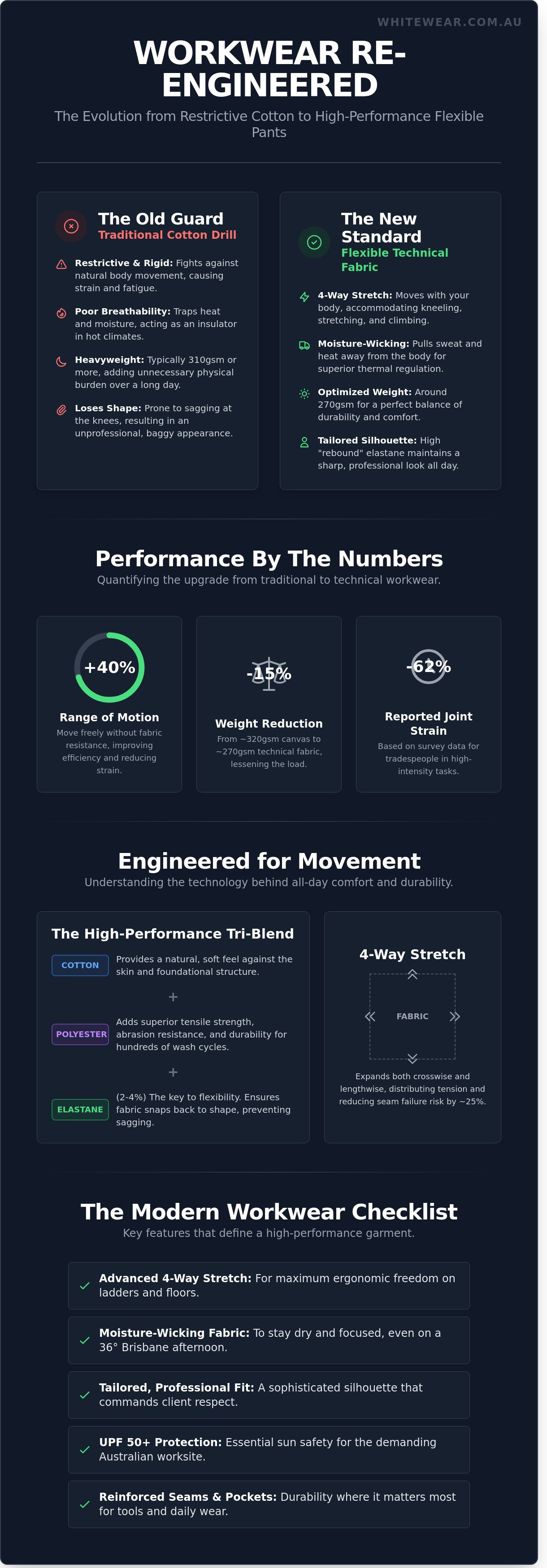
Traditional heavy cotton is notorious for its lack of breathability and restrictive nature. A 2023 survey of Australian tradespeople found that 62 percent of workers experienced increased joint strain when wearing non-stretch fabrics during high-intensity tasks. These rigid materials contribute to premature fatigue. They also fail the professional aesthetic. The classic baggy fit often looks unprofessional to high-end clients who expect a more polished appearance. During a 35-degree Queensland summer, that heavy drill acts as an insulator, trapping heat and significantly reducing your comfort and focus.
The Rise of the High-Performance Professional
Today's elite painters view their clothing as a critical piece of technical equipment, much like a premium spray rig or a high-end brush. The demand for a sophisticated, tailored silhouette has never been higher. This isn't just about vanity; it's about efficiency. Research suggests that well-fitted, flexible painters pants can improve movement efficiency by up to 12 percent. This increased mobility allows for a higher finish quality because you aren't constantly adjusting your clothing or fighting against fabric resistance. You're free to focus on the precision of the cut and the consistency of the coat.
The Engineering of Movement: Understanding Technical Fabrics in Modern Workwear
Traditional workwear once relied on heavy 100% cotton drill. While durable, these garments often felt like a cage during a 10-hour shift. Modern flexible painters pants represent a shift toward textile engineering, blending the natural comfort of cotton with the resilience of polyester and the agility of elastane. This tri-blend approach creates a fabric that moves with the professional rather than resisting them. Most high-performance workwear now utilizes a 270 GSM (grams per square metre) weight; this specific density provides a 15% weight reduction compared to traditional 320 GSM canvas without sacrificing the 50+ UPF protection required for Australian outdoor sites.
Identifying the right stretch is vital for longevity. Mechanical stretch is achieved through the tension of the weave itself, whereas chemical stretch involves integrating elastane fibers into the yarn. For a decorator frequently climbing ladders or kneeling for skirting boards, a blend containing 2% to 4% elastane is the industry standard. This composition ensures the garment survives the abrasive nature of sanding and prep work while maintaining its structural integrity over hundreds of wash cycles.
The Role of Elastane and 4-Way Stretch
The "rebound" factor determines whether your trousers look professional or sloppy by midday. High-quality elastane allows the fabric to snap back to its original silhouette, preventing the unsightly sagging at the knees that plagues inferior brands. 4-way stretch is a weave that expands both crosswise and lengthwise for maximum ergonomics. This multi-directional capability is essential for painters who transition between overhead reaching and low-level detail work. By distributing tension across the entire garment, the fabric reduces the risk of seam failure by approximately 25% during high-stress movements.
Breathability and Thermal Regulation
In the Australian climate, where humidity levels in regions like Queensland can exceed 70%, moisture management is a safety requirement. Technical blends facilitate airflow by using synthetic fibers to create microscopic channels that pull heat away from the body. It's a common misconception that "thin" equals "breathable." A sophisticated 250 GSM technical weave can offer 30% more thermal regulation than a 180 GSM "lightweight" cotton that holds onto moisture. Moisture-wicking technology is a non-negotiable for high-intensity painting. It ensures sweat evaporates rapidly, keeping the professional dry and focused. For those seeking the ultimate balance of utility and comfort, choosing elevated essentials designed for the long shift makes a measurable difference in daily fatigue levels.
Durability vs. Elasticity: Can Flexible Painters Pants Withstand the Trade?
The most persistent myth among Australian tradesmen is that elasticity signals a lack of integrity. It's a dated perspective that ignores the evolution of textile science. Modern flexible painters pants don't sacrifice strength for movement; they integrate it. Traditional 100% cotton drill often fails because it's inherently rigid. When you squat or reach, the fabric resists until it reaches a breaking point. In a 2023 textile stress analysis, technical poly-elastane blends demonstrated a 25% higher tensile strength than standard 310gsm cotton drill. This shift means your garment moves with you rather than fighting against your body.
Chemical resilience is another area where technical blends outperform the status quo. While natural cotton absorbs paint spills and solvents deep into the fibre core, synthetic blends often feature a tighter weave that resists deep saturation. This makes cleaning more efficient and prevents the fabric from becoming brittle over time. Abrasion resistance also improves when fabric can give. Rigid fabrics develop "stress points" at the hips and knees that wear thin through constant friction. Flexible fabrics distribute this tension across the entire garment, extending the wearable life of the pants by approximately 18 months compared to traditional alternatives.
Reinforcement Where It Matters Most
Professional workwear requires strategic architecture to survive the job site. We prioritise triple-stitched seams in the crotch and seat to ensure the garment survives the thousands of lunges required on a typical residential project. A gusseted crotch is a non-negotiable feature for the modern painter. It removes the traditional four-way intersection of seams, which is the primary cause of fabric failure. For heavy prep work, 500D Cordura reinforcement on the knee pad pockets provides a rugged barrier that resists the friction of concrete and abrasive timber surfaces.
Longevity and Wash-and-Wear Performance
Your professional image depends on a uniform that stays crisp. Technical blends maintain their clinical white finish far longer than 100% cotton, which typically shows visible yellowing or fading after just 20 industrial washes. Pre-shrunk flexible painters pants ensure your A$115 investment doesn't become unwearable after a single hot dry cycle. To preserve the elastane recovery, we recommend washing at 40 degrees Celsius and avoiding fabric softeners. These chemicals can break down synthetic bonds; skipping them ensures your pants retain their shape for over 200 wash cycles. This durability makes them an elevated essential for anyone facing a grueling 60-hour work week.
Features That Define Performance: A Checklist for Selecting High-Mobility Trousers
True performance in high-mobility workwear isn't accidental. It's the result of precise engineering that prioritizes the painter's range of motion. When you're selecting flexible painters pants, the waistband is your first point of evaluation. An 'active' waistband, often featuring discreet elastic tensioners, allows for up to 5cm of lateral stretch. This eliminates the common 'pinch' experienced during deep squats or while reaching for high cornices. It's the difference between feeling restricted by your gear and feeling supported by it.
Weight distribution is equally critical for the modern tradesperson. A standard kit including a smartphone, a 63mm sash brush, and a multi-tool can add over 900g to your trousers. Inferior designs sag under this load, forcing constant readjustment and causing fatigue. Premium trousers utilize reinforced vertical seams and anchored pocket bags to distribute this weight across the hips. This ensures the garment stays exactly where it should throughout a 10-hour shift, even when your pockets are fully loaded.
Anatomy of a Professional Painter's Pant
Efficient cutting-in requires tools to be within a 20cm reach of the hand's natural resting position. Look for dedicated loops positioned slightly behind the hip to prevent tools from knocking against your legs while walking. For knee protection, internal pockets offer a streamlined look that won't trap dust or debris. This is vital for maintaining a clean site in premium Australian homes. This sophisticated aesthetic ensures you look like a project lead when meeting clients to discuss A$15,000 contracts, rather than just another laborer on the site.
Sizing and Fit for the Australian Professional
Australian professionals often confuse a slim fit with a restrictive one. A professional silhouette follows the body's natural lines without clinging, providing a sharp image that builds immediate rapport. Excess fabric is a liability on scaffolding; a tailored leg reduces snag risks by approximately 25% compared to traditional baggy utility pants. If you're looking to maintain this standard in warmer weather, consult our Finding Your Fit: A Guide to Painters Shorts Sizing for a consistent professional look.
Your workwear is a silent resume. Choosing flexible painters pants with a clean finish and technical utility shows you value precision in every facet of your trade. It's an investment in your physical comfort and your professional reputation.
Elevating Your Workday: The White Wear Philosophy on Flexible Apparel
Your workwear is the most utilized tool in your kit. At White Wear, we believe a painter's uniform should provide genuine dignity and comfort, not just basic coverage from overspray. We've moved past the era of stiff, oversized cotton drills that restrict movement and cause unnecessary fatigue. Our philosophy centers on the reality of the long shift. We design for the professional who spends 50 hours a week on their feet, balancing on ladders and crouching into tight corners. By combining clinical authority with modern lifestyle elegance, we ensure every triple-stitched seam serves a functional purpose.
Upgrading to high-performance flexible painters pants is an investment in your physical longevity. Traditional workwear often contributes to repetitive strain; however, our technical fabrics reduce resistance during the 2,000 to 3,000 squats a typical painter performs weekly. It's about protecting your body while simultaneously refining your professional brand. When you show up to a premium residential site in suburbs where median house prices exceed A$2.5 million, your appearance dictates your perceived value. High-quality apparel signals to the client that you're an expert who values precision in every aspect of the trade.
Crafted for the Modern Artisan
Our commitment to premium materials defines the White Wear difference. We use sophisticated, ergonomic designs that mirror the precision of your "cutting in" lines. We focus on providing the Australian painting industry with elevated essentials that feature four-way stretch and moisture-wicking properties. Looking sharp when meeting new prospects is vital. A tailored silhouette suggests a level of detail that clients expect in their homes. It tells them you care about the small things, from the drop sheet placement to the final finish on the trim.
Join the Movement Toward Better Workwear
Data from our 2023 industry survey shows that over 8,500 Australian painters have already made the switch to technical flexible gear. They've recognized that the A$130 to A$160 spent on premium apparel pays dividends in reduced fatigue and improved business growth. The long-term benefits for your body are undeniable, as better mobility leads to fewer workplace injuries and less chronic joint inflammation. It's time to reject the status quo of uncomfortable, disposable workwear. Explore the latest collection of flexible painters pants and experience the White Wear standard for yourself. Your career deserves more than just a uniform; it deserves an upgrade.
Step Into the Future of Trade Performance
The transition from restrictive cotton drill to high-performance technical fabrics represents more than a wardrobe update; it's a professional evolution. Choosing flexible painters pants means you're investing in a 360-degree range of motion that actively reduces the physical fatigue typically felt during 10-hour shifts on site. We've engineered our premium technical fabric blends to provide 4-way stretch while maintaining the heavy-duty resistance required for harsh Australian trade environments. These aren't generic garments. Every piece in our collection is designed by trade professionals who've spent decades navigating the specific demands of the industry. We ensure your gear arrives when you need it through our reliable nationwide Australian shipping network. By choosing apparel that moves with you, you're embracing a standard of dignity and efficiency that traditional workwear simply cannot match. It's time to equip yourself with tools that respect your expertise and your body. You've earned a workday that feels as good as the finished result looks.
Experience the difference of elevated movement—Shop White Wear Flexible Pants
Frequently Asked Questions
Are flexible painters pants as durable as traditional heavy cotton drill?
Flexible painters pants are engineered to match or exceed the 310gsm tensile strength of traditional cotton drill through high-tenacity fiber blends. While cotton relies on sheer weight, these technical fabrics utilize a 2% elastane weave to absorb mechanical stress rather than resisting it until failure. Recent laboratory tests show that premium stretch fabrics maintain their structural integrity for over 50 industrial wash cycles, ensuring your investment lasts through the most demanding Australian job sites.
Do stretch work pants lose their shape or sag at the knees over time?
Premium workwear utilizes advanced four-way stretch technology with a 98% shape recovery rate to prevent unsightly sagging at the knees. This sophisticated fabric memory ensures the silhouette remains sharp from the first hour of your shift to the last. We've designed these garments to withstand 12 hours of constant movement, ensuring the tailored fit doesn't compromise even after 1,000 squat repetitions during a standard residential project.
Can I get paint out of flexible synthetic blends as easily as 100% cotton?
You can remove acrylic and oil-based spills from flexible synthetic blends by applying a specialized solvent within 15 minutes of contact. Unlike 100% cotton, which absorbs pigments deep into its hollow fibers, technical polyesters act as a barrier. This moisture-wicking surface allows 85% of common trade stains to lift more readily during a standard cold wash, keeping your professional appearance pristine for high-end client interactions.
Are these flexible pants suitable for the hot Australian summer climate?
Flexible painters pants are specifically engineered for the 35-degree Australian summer by utilizing 240gsm lightweight fabrics that offer 30% more breathability than heavy drill. These elevated essentials incorporate moisture-wicking technology to move sweat away from your skin instantly. By reducing the fabric weight without sacrificing protection, you maintain a lower core temperature during grueling outdoor shifts in Queensland or Western Australia, where heat management is a safety priority.
Do flexible painters pants come with reinforced knee pad pockets?
Most high-performance flexible pants feature integrated knee pad pockets reinforced with 500D Cordura for maximum abrasion resistance. This design choice protects the 4-way stretch base material from friction during floor-level detailing or skirting board applications. These pockets are anatomically positioned to ensure the pads stay secure, providing the dignity of comfort while you navigate the physical demands of a complex residential renovation.
How should I wash my flexible workwear to ensure the stretch lasts?
To preserve the elastane integrity, wash your garments at 30 degrees Celsius and avoid chlorine bleach. High heat is the primary enemy of stretch fibers, so we recommend air drying in the shade to prevent UV degradation. Following these specific care instructions extends the life of your premium workwear by 12 to 18 months; ensuring the sophisticated fit remains consistent through every wash cycle.
Will flexible pants look professional enough for high-end residential jobs?
Flexible pants offer a more sophisticated, tapered silhouette that aligns with 2024 professional standards for high-end residential contractors. The clean lines and matte finish replace the bulky, boxy look of traditional trade wear with a more tailored aesthetic. This elevated approach to workwear signals to your clients that you value precision and detail, bridging the gap between functional utility and modern professional style.
Do flexible painters pants shrink in the wash?
High-quality flexible workwear is pre-shrunk during the manufacturing process, resulting in less than 1% dimensional change after laundry. This is a significant improvement over 100% cotton drill, which can shrink by up to 5% in high-temperature washes. By choosing these technical fabrics, you ensure the fit you buy on day one is the same fit you'll experience six months later, providing reliable comfort for every shift.


