


What if the greatest threat to your professional longevity isn't a sudden accident, but the subtle, repetitive strain caused by the clothes you wear? For many Australian tradespeople, chronic knee pain and lower back fatigue are treated as inevitable side effects of the craft. You've likely spent years pushing through 10-hour shifts in heavy, restrictive fabrics that trap heat and fight against every reach and squat. It's a grueling reality that often leads to burnout or long-term musculoskeletal issues.
We believe your apparel should be a high-performance tool, not a source of physical stress. Understanding why quality painters workwear reduces workplace injury risk is the first step toward reclaiming your comfort and professional dignity. By prioritising engineered textiles and ergonomic fits, you can significantly lower the risk of tripping hazards and heat exhaustion while maintaining a polished appearance that reflects your high standards. This guide examines how specialised design protects your body from the unique demands of the job site; ensuring you finish the day feeling as capable as when you started.
Key Takeaways
- Understand how ergonomic engineering and flexible textiles mitigate the silent musculoskeletal risks inherent in the professional painting trade.
- Discover why quality painters workwear reduces workplace injury risk by minimising the physical drag that causes premature muscle fatigue and burnout.
- Learn how high-quality cotton drill and abrasion-resistant materials provide a superior barrier against chemical contact and site-specific hazards.
- Explore how streamlined silhouettes and strategic storage placement prevent tripping hazards and help you maintain balance while working at heights.
- Shift your perspective from viewing apparel as a utility to seeing it as a refined essential; this approach protects your physical longevity and professional dignity.
The Critical Link Between Workwear and Painter Safety
Safety is often discussed in terms of harnesses and hard hats, yet for the professional painter, the most persistent hazards are often invisible. Understanding why quality painters workwear reduces workplace injury risk requires looking beyond the immediate splash of a drop sheet. The true "silent risks" lie in the high-repetition biomechanics of the workday. Professional painters face a unique set of musculoskeletal challenges that differ from heavy-lifting trades; it's a game of endurance and precision. When you wear standard apparel that fights against your range of motion, your body compensates in ways that lead to chronic injury. High-end apparel transforms a passive garment into an active safety tool.
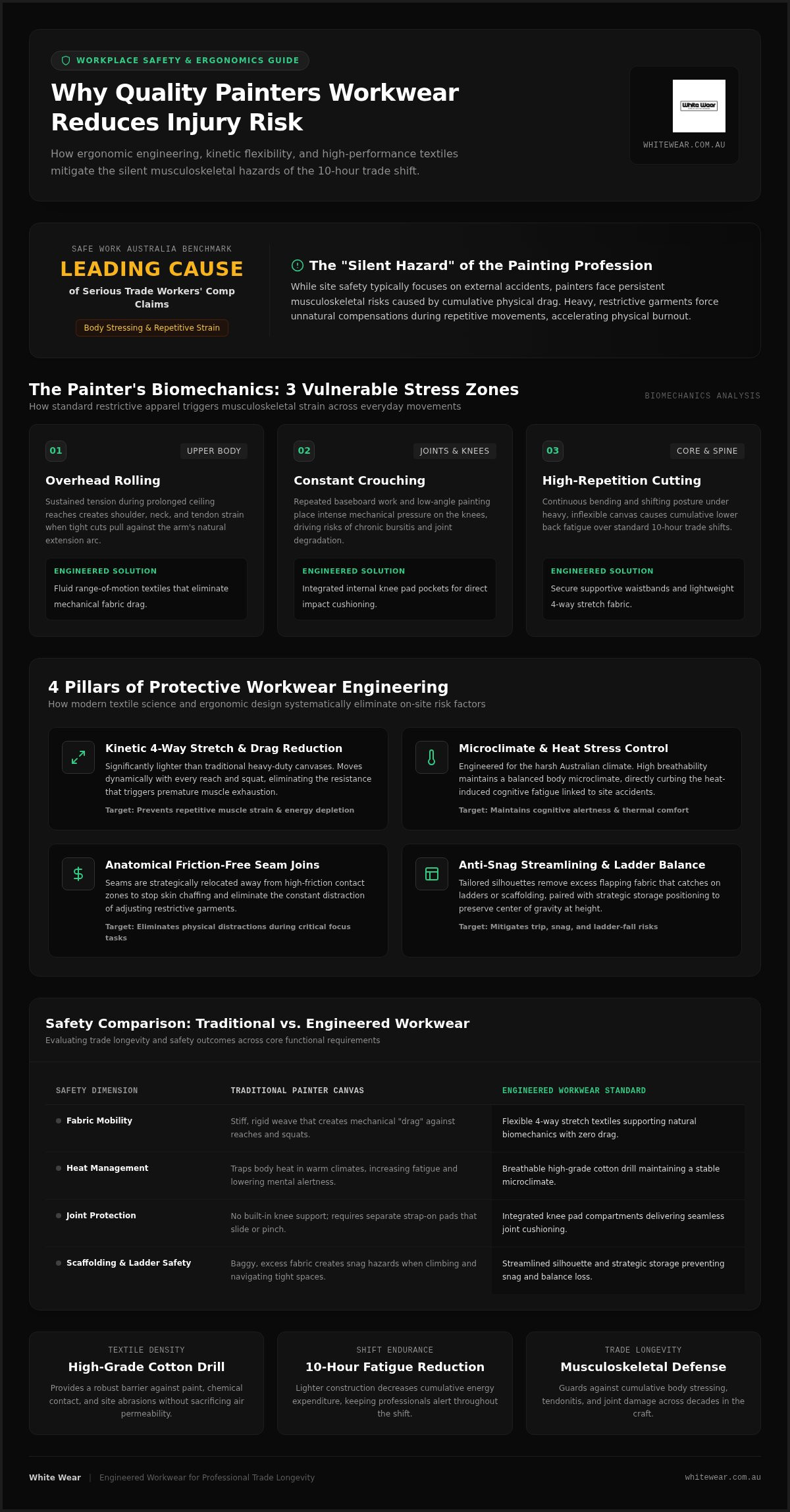
In Australia, data from Safe Work Australia indicates that body stressing remains the leading cause of serious workers' compensation claims across the construction and trade sectors. For a painter, this often manifests as over-extension during overhead rolling or knee strain from constant crouching. Engineered workwear is designed to mitigate these forces by reducing the mechanical "drag" of the fabric against the skin. By prioritising a sophisticated approach to design, we create an environment where the professional remains alert, agile, and protected from the cumulative toll of the trade.
Understanding the Painter's Biomechanics
Consider the repetitive arc of cutting-in or the sustained tension of overhead work. These movements require a garment that moves with the limb, not against it. Restrictive trousers or shirts force the musculoskeletal system into unnatural compensations, which eventually lead to tendonitis or lower back fatigue. Ergonomic workwear represents the precise intersection where advanced textile science meets the fluid requirements of human movement. By utilising fabrics that offer superior recovery and stretch, we ensure that the body's natural biomechanics are supported throughout a ten-hour shift.
Beyond Paint Splatters: The Role of PPE
Most industry competitors view personal protective equipment as a final barrier against external spills. We take a more sophisticated approach. High-performance quality painters workwear must also address internal stressors like heat regulation and skin health. In the harsh Australian climate, heat stress is a primary contributor to cognitive fatigue, which in turn increases the risk of site accidents. Durable, breathable fabrics maintain a stable microclimate around the body, keeping you alert and focused. This elevated approach to design ensures you aren't just protected from paint, but from the physical toll of the trade itself.
Ergonomic Engineering: How Fit Prevents Repetitive Strain
Ergonomic engineering is the silent partner of the professional painter. While many view fabric flexibility as a luxury, in a high-intensity trade, it's a fundamental safety requirement. Kinetic movement shouldn't be a struggle against your clothes. When fabric lacks a sophisticated four-way stretch, every reach and squat requires additional force, leading to a "drag" factor that accelerates muscle fatigue. This cumulative strain is a primary reason why quality painters workwear reduces workplace injury risk; it preserves your energy by working with your body's natural biomechanics rather than against them. High-performance materials are significantly lighter than traditional heavy-duty canvases, reducing the physical load on the wearer during a demanding 10-hour shift.
Precision in design extends to the very placement of joins. Anatomical seams are strategically positioned away from high-friction zones to eliminate skin irritation and the distraction of constant readjustment. A professional who isn't fiddling with a restrictive waistband or a pinching seam is a professional who remains focused on the task at hand. This mental clarity is essential when navigating complex site environments where split-second decisions prevent accidents. Investing in refined essentials ensures that your apparel supports your focus, allowing you to maintain the high standards your clients expect.
Preventing Musculoskeletal Disorders (MSDs)
Joint health is the foundation of a long career. The integration of internal pockets for knee pads in specialised painters pants provides essential cushioning that prevents long-term joint degradation and bursitis. Furthermore, tailored cuts eliminate excess fabric, ensuring you don't snag on scaffolding or ladders. A secure, supportive waistband reduces lower back strain during repetitive bending, providing the structural integrity needed for grueling labour.
Thermal Regulation and Cognitive Safety
Heat stress is a documented catalyst for workplace accidents. By following OSHA personal protective equipment guidelines regarding breathable apparel, professionals can maintain a stable core temperature even in the peak of the Australian summer. Moisture-wicking textiles prevent the "heavy garment" effect caused by perspiration, ensuring you remain agile. This thermal regulation is critical for preserving the mental clarity required to identify site hazards and work safely at heights.
Material Science: Protection Beyond the Surface
Material science serves as the invisible shield of the modern artisan. Beyond aesthetics, the technical composition of a garment dictates its ability to protect the wearer from caustic chemicals and physical abrasions. Dense weave structures are critical for reducing chemical permeability. This helps prevent occupational dermatitis, a common yet avoidable condition in the trade. This structural integrity is precisely why quality painters workwear reduces workplace injury risk; it acts as a primary barrier between the professional and the site's inherent hazards.
Frayed or damaged clothing isn't just a matter of poor presentation. It's a safety liability. Loose threads and compromised seams create snagging points that can lead to falls or equipment entanglement. By choosing the White Wear standard of high-quality cotton drill, you invest in a fabric that maintains its protective properties through hundreds of wash cycles. Unlike generic alternatives, this material offers the necessary thickness to resist scrapes without sacrificing the breathability required for the Australian climate. It is a refined essential that provides both dignity and defense.
The Superiority of Specialised Fabrics
Selecting the best fabrics for painters trousers involves balancing durability with physical health. Cheap synthetic blends often pose a fire risk and can cause severe skin irritation when combined with sweat and paint solvents. We utilise reinforced panelling in high-wear areas like the knees and pockets to ensure garment integrity. This focus on material placement aligns with broader research into ergonomics and musculoskeletal disorder prevention; reducing the weight and friction of the garment lessens the overall physical toll on the body.
Laundering for Longevity and Safety
Maintaining your workwear is as vital as the initial purchase. Paint-clogged fabric quickly loses its breathability, turning a protective garment into a heat trap. Additionally, dried paint can turn flexible cotton into a "stiff" shell, creating physical restrictions that fight against your movement. Regular, proper laundering preserves the textile's recovery properties. This ensures the protective barrier remains effective, allowing you to move with the precision and grace your craft demands throughout the entire workweek.
Functional Design: Reducing Trip Hazards and Ladder Risks
Precision in design isn't merely an aesthetic choice; it's a critical safety intervention. For a professional operating at heights, the distribution of weight can be the difference between a steady hand and a dangerous loss of balance. This is fundamentally why quality painters workwear reduces workplace injury risk. By applying the "Science of Storage," we ensure that tool pockets are positioned to maintain your centre of gravity. Traditional workwear often places heavy loads in swinging pockets that pull the wearer off-balance. Our approach uses streamlined, secure compartments that keep essentials close to the body, eliminating the "catch points" that lead to falls.
Cuff design and silhouette also play a pivotal role in site safety. Poorly fitted trousers with excess fabric at the ankle are a primary cause of trips during ladder transitions. A tapered, secure cuff ensures that your footing remains clear and your movement unobstructed. Additionally, the crisp white finish of premium apparel provides a high-contrast visual marker in low-light interior sites. This visibility ensures you're easily seen by other trades, reducing the risk of accidental collisions in busy, fast-paced workspaces.
Ladder Safety and Tool Accessibility
Working on a ladder requires three points of contact at all times. When your apparel is poorly designed, you're often forced to break this rule to reach for tools or readjust shifting fabric. High-performance painters overalls solve this by distributing tool weight evenly across the torso. This reduces the need for repetitive climbing, as your primary tools are safely secured within reach. Non-swinging pockets ensure that your gear doesn't snag on rungs or scaffolding as you ascend, preserving your focus for the task at hand.
Visibility and Professional Alertness
There's a deep psychological link between the quality of your apparel and your level of site alertness. Wearing a clean, refined uniform increases "safety consciousness," fostering a mindset of precision and care. When a team adopts consistent company branding, it creates a culture of mutual accountability. This professional appearance isn't just for the client; it's a daily reminder of the high standards you uphold for yourself and your peers. Explore our full range of refined painters workwear to elevate your site safety standards today.
Investing in Longevity: The White Wear Standard
The true cost of budget apparel is rarely found on the price tag. It's measured in the cumulative toll on the human body; the nagging back pain, the overheated afternoons, and the premature fatigue that leads to avoidable errors. This is fundamentally why quality painters workwear reduces workplace injury risk. When you choose refined essentials over generic utility items, you're investing in your professional longevity. Peer-led development ensures every pocket and seam has been tested in the heat of a 10-hour shift. We don't just sell clothing; we provide the dignity and comfort required for grueling hours of labour. Transitioning your crew to a sophisticated wardrobe isn't just a procurement choice. It's a commitment to a higher standard of care and professional identity.
The ROI of Premium Workwear
The financial return on high-end apparel extends far beyond simple replacement cycles. While cheap synthetics might fail within weeks, high-quality cotton drill maintains its structural integrity and protective barrier over time. More importantly, by providing superior ergonomic support, you directly reduce the risk of absenteeism caused by musculoskeletal strain. A crew that isn't fighting their clothing is a crew that remains focused, agile, and productive. Understanding why quality painters workwear reduces workplace injury risk is essential for any business owner looking to protect their most valuable asset: their people. For the modern Australian professional, these garments are refined essentials that safeguard both the person and the profit margin.
Choosing Your Next Safety Tier
Evaluating your current wardrobe is an exercise in professional self-respect. Take a moment to audit your current gear: does it support your movement, or does it demand constant readjustment? High-stakes trades require apparel that is both supportive and empowering, treating the tradesperson as a protagonist who deserves better than the status quo. By upgrading to peer-tested standards, you foster a site culture that values precision and safety above all else. This transition signals to your clients and your team that you prioritise excellence in every detail, from the finish on the wall to the safety of the person holding the brush. Elevate your safety standards with White Wear today.
Elevating Your Professional Standard
Choosing the right apparel is a decisive step toward a sustainable career. We've explored how ergonomic engineering and advanced material science transform standard clothing into active safety equipment. By reducing the physical drag on your body and eliminating site-specific trip hazards, you preserve your energy for the precision your craft demands. This is precisely why quality painters workwear reduces workplace injury risk; it treats your physical health as a priority, not an afterthought.
Our commitment to peer-led development ensures every garment offers premium Australian durability and sophisticated ergonomic construction. You deserve refined essentials that provide dignity and comfort during your most demanding shifts. Explore the White Wear range of engineered painters workwear and invest in a wardrobe designed by painters, for painters. Take pride in your appearance and your health. It's time to work with a standard that matches your own.
Frequently Asked Questions
How can the fit of my trousers actually prevent back pain?
Ergonomic waistbands and four-way stretch fabrics reduce the physical effort required for repetitive bending and squatting. When trousers are too tight or lack flexibility, your lower back muscles overcompensate to overcome the fabric's resistance. This cumulative strain leads to chronic fatigue. High-quality designs ensure that the garment moves in harmony with your spine and hips, preserving your structural integrity throughout a demanding 10-hour shift.
Why is cotton drill considered safer than synthetic blends for painters?
High-quality cotton drill is the superior choice because it offers natural breathability and high abrasion resistance without the fire risks associated with cheap synthetics. Synthetics can melt against the skin in high-heat environments or during accidental flash fires. Cotton drill also has a dense weave that acts as a robust barrier against chemical permeability, reducing the risk of occupational dermatitis while remaining comfortable in the harsh Australian climate.
Can high-quality workwear really reduce the risk of falling from a ladder?
Specialised design reduces ladder risks by eliminating excess fabric that causes snagging and by distributing tool weight evenly. Streamlined silhouettes ensure that trouser cuffs don't catch on ladder rungs during transitions. When tools are stored in secure, non-swinging pockets, your centre of gravity remains stable. This is a key reason why quality painters workwear reduces workplace injury risk; it ensures you maintain the required three points of contact without distraction.
How often should I replace my painters workwear to ensure it stays safe?
You should replace your workwear as soon as you notice fraying, thinning fabric, or paint-clogged fibres that restrict movement. Frayed edges are significant catch points that increase tripping risks. Once fabric becomes stiff with dried paint, it loses its ergonomic stretch and breathability. Regular audits of your wardrobe ensure that your protective barrier remains intact, providing the safety and professional dignity you need on a high-stakes job site.
Does the weight of the fabric affect my risk of injury on the job?
The weight of your fabric directly impacts muscle fatigue and heat exhaustion. Heavy, cumbersome materials increase the drag on your limbs, forcing your body to work harder with every movement. This leads to premature burnout and a higher likelihood of errors. Modern, high-performance textiles provide high-GSM protection without the excessive weight, keeping you agile and alert. Lightweight, durable materials are essential for managing physical stress during long Australian summer shifts.
What are the most important safety features to look for in painters overalls?
Look for internal knee pad pockets, reinforced panelling, and strategic tool storage that balances weight across the torso. Internal pockets ensure that cushioning remains in the correct anatomical position during crouching, preventing joint degradation. Reinforced high-wear areas prevent garment failure that could lead to skin scrapes. Every feature should focus on reducing physical strain, which is why quality painters workwear reduces workplace injury risk by acting as a functional tool.
Is there a difference in safety requirements for men's and women's workwear?
Safety requirements are identical, but the anatomical fit must be specific to each body type to prevent injury. Poorly fitted workwear on women often leads to excess fabric in the crotch or legs, creating significant tripping hazards. Proper fit ensures that safety features, like knee pads and tool pockets, align correctly with the wearer's biomechanics. Providing gender-specific cuts isn't about style; it's about ensuring every professional has apparel that supports their physical longevity.
How does heat stress management in clothing contribute to workplace safety?
Effective heat stress management keeps your core temperature stable, which is critical for maintaining cognitive alertness and preventing accidents. Dehydration and overheating lead to dizziness and slower reaction times, especially when working at heights. Breathable, moisture-wicking fabrics allow for efficient evaporative cooling in the Australian heat. By keeping you physically cool, your apparel ensures you remain mentally sharp enough to identify and avoid site hazards throughout the entire workday.


