


Why does a standard pair of whites surrender to a crotch blowout after just three weeks on the ladder, while professional-grade apparel remains pristine for an entire year? It is a question of precision engineering rather than just fabric thickness. Understanding what makes painters clothing durable requires looking past the surface to the technical innovations that define modern workwear. For the dedicated professional, clothing is not just a utility. It is a refined essential designed to provide dignity and comfort during grueling hours of labor.
You know the frustration of pockets ripping under the weight of heavy tools or fabric thinning after frequent washing to remove stubborn stains. It’s a cycle that undermines both your budget and your professional image. This guide will reveal the specific quality markers and material standards that separate high-performance gear from generic, disposable alternatives. We will explore the science of polyester-cotton hybrids, the necessity of bar-tacking stress points, and how the 2026 standards for apparel longevity are redefining what it means to be truly job-ready. Investing in the right gear isn't just about protection; it’s about reclaiming your focus on the craft.
Key Takeaways
- Master the science of high-performance textiles by identifying the optimal polycotton blends and high GSM ratings that provide a resilient fabric shield.
- Learn why triple-stitched seams and precision bar-tacking are the industry benchmarks for preventing blowouts during demanding on-site maneuvers.
- Understand what makes painters clothing durable by evaluating a garment’s ability to maintain its structural integrity under repetitive mechanical stress and abrasion.
- Discover how heavy-duty pocket linings and chemical-resistant finishes protect your essentials and ensure your workwear survives contact with harsh solvents.
- Elevate your professional presence with peer-led designs that bridge the gap between rugged utility and refined aesthetic standards for the modern workday.
What Defines Durability in Professional Painters Clothing?
Durability is not a vague marketing term; it is a measurable metric of performance. For the career painter, it represents the garment's capacity to maintain structural integrity while subjected to constant mechanical stress. Climbing ladders, stretching across ceilings, and kneeling on abrasive surfaces create high-tension moments that test the limits of standard textiles. When we discuss what makes painters clothing durable, we are analyzing a fabric's resistance to abrasion, tearing, and the aggressive degrading effects of chemical solvents. A garment that thins after a few weeks of friction is not just a nuisance; it is a failure of engineering.
A high-performance garment must do more than just survive the physical environment. It must breathe. During long Australian workdays, heat management is as critical as physical strength. A truly superior piece of workwear balances this ruggedness with sophisticated airflow, ensuring the wearer remains composed and comfortable throughout a twelve-hour shift. Beyond the physical, there is a standard of presentation. Just as a professional's kit should retain its fit and crisp appearance, property owners often look to exterior specialists like Warrens Power Washing to maintain the cleanliness of parking lots and garages, ensuring every aspect of the site reflects quality. If the fabric sags or stains permanently after a single month, it has failed the fundamental test of professional-grade apparel.
The Lifecycle of Professional Workwear
Opting for "disposable" whites is a false economy that many tradespeople eventually outgrow. While the initial cost is lower, the true price is paid in frequent replacements and compromised safety. Fabric fatigue is a silent productivity killer. As fibers weaken, the garment loses its ability to protect the skin or support the weight of the tools you carry. High-quality durability and safety in workwear serve as the foundation of your professional brand. When you arrive on-site in gear that holds its shape, you communicate a level of precision and authority that generic alternatives simply cannot match. It is about moving from a mindset of utility to one of refined essentialism.
The Three Pillars of Apparel Longevity
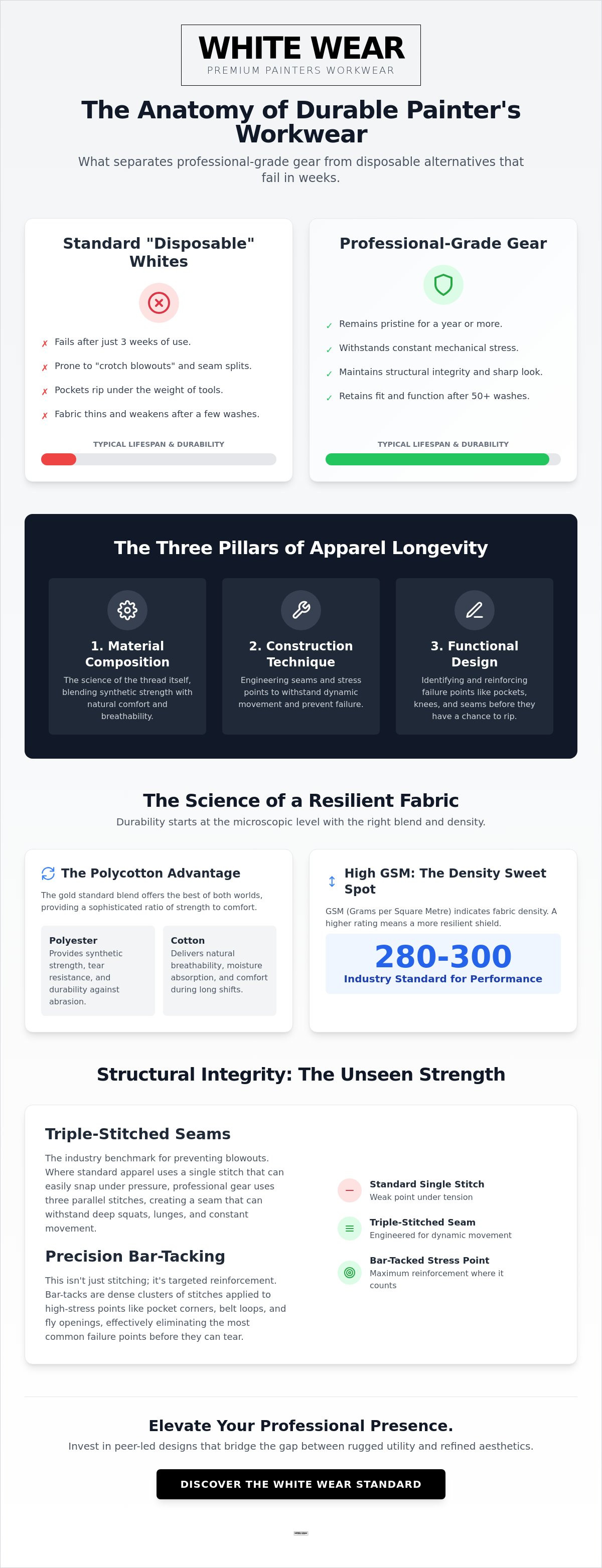
Understanding what makes painters clothing durable requires a look at three fundamental pillars. First is material composition. This is the science of the thread itself, where synthetic strength meets natural breathability. Second is construction technique. Even the strongest fabric will fail if the seams aren't engineered for dynamic movement. Finally, we look at functional design. This involves identifying potential failure points, such as pocket corners and fly openings, and reinforcing them before they have a chance to rip. This peer-led approach ensures that every stitch serves a purpose, providing a sense of dignity to those who perform the heavy lifting of the industry.
The Science of Fabric: Weaves and Blends That Endure
Durability starts at the microscopic level. It is not enough for a garment to feel heavy; it must be engineered to withstand the specific chemical and mechanical stressors of a job site. Analyzing what makes painters clothing durable involves a deep dive into the architecture of the fabric itself. We look at tensile strength, which is the textile's ability to resist snapping under the sudden pressure of deep squats or lunges. If the fibers lack this resilience, the garment will fail at the first sign of a demanding maneuver. A weight of 280-300 GSM represents the industry's technical sweet spot, providing a formidable barrier against abrasion while maintaining the lightweight agility required for constant movement.
High GSM (Grams per Square Metre) ratings serve as a reliable indicator of a fabric's density. A denser weave creates a more resilient shield, preventing paint from penetrating the surface and reaching your skin. This is particularly vital when working with volatile coatings where OSHA protective clothing requirements suggest specific material standards to ensure safety. For those who demand more from their gear, choosing high-performance painters clothing ensures that these technical specifications are met without compromising on style.
Why Polycotton Dominates the Painting Trade
Polycotton blends have become the gold standard because they offer a sophisticated ratio of natural breathability to synthetic strength. Polyester acts as the structural backbone. It prevents the garment from shrinking and helps it retain its polished silhouette through dozens of industrial wash cycles. Meanwhile, the cotton fibers work to absorb moisture, keeping you cool during the peak of an Australian summer. This synergy is essential for maintaining comfort during a twelve-hour shift. If you are curious about the specific technical details of these materials, you can explore our guide on What Fabric is Best for Painters Trousers? to see how these blends perform in the field.
Drill vs. Canvas Weaves
The method of weaving is just as important as the material itself. Traditional drill weaves are characterized by their diagonal parallel ridges. This structure provides a unique balance of toughness and flexibility, allowing the fabric to move with the body rather than against it. Canvas, on the other hand, offers a tighter, more uniform weave that provides superior puncture resistance. This is the preferred choice for painters working around sharp scaffolding or heavy equipment. Both options should feature a lint-free finish. This prevents loose fibers from shedding onto a fresh coat of paint, protecting the integrity of your final finish while you focus on the task at hand.
Structural Integrity: Why Stitching and Stress Points Matter
If the fabric is the soul of the garment, the stitching is its skeleton. Even the most advanced polycotton blend will fail if the architecture holding it together is subpar. When we analyze what makes painters clothing durable, we must look at the precision of the assembly. Standard apparel often relies on simple lockstitching that can unravel with a single snag. In contrast, professional-grade workwear utilizes a redundancy of strength. High-tensile threads are woven into the garment using specialized machinery to ensure that every seam acts as a structural bond rather than a potential point of failure. This focus on structural engineering ensures your gear remains intact through the most demanding physical maneuvers.
Hardware failure is another common frustration that professional gear eliminates. There is nothing more disruptive than a zipper that jams or a button that pops mid-shift. Premium painters clothing features heavy-duty YKK zippers and reinforced buttons designed to outlast the fabric itself. This commitment to tactile reliability means you aren't just buying a pair of trousers; you are investing in a tool that performs with the same consistency as your finest brushes. Every component, from the fly to the pocket closures, is selected to withstand the temporal reality of a grueling twelve-hour workday.
The Anatomy of a High-Stress Seam
Triple-needle stitching is the industry benchmark for preventing blowouts in high-stress areas. By running three parallel rows of high-strength thread along the main seams, the garment gains a level of resilience that double-stitching simply cannot match. This technique is particularly vital for the outseams and seat of the trousers, where the most tension occurs during movement. Beyond the seams, bar-tacking provides essential reinforcement at the corners of pockets and fly openings. These are small, dense zig-zag stitches that distribute weight and tension, preventing the fabric from tearing when you load up your pockets with heavy scrapers or tape. Wearing gear with this level of reinforcement provides a psychological benefit; you can focus entirely on the precision of your cut-in without worrying about a sudden seam failure.
Reinforcement Zones: Knees and Crotch
Painters spend a significant portion of their lives at skirting board level or perched on the rungs of a ladder. Reinforced knees are a non-negotiable feature for anyone serious about longevity. Many professional designs incorporate knee pad pockets, which protect both the fabric from abrasion and your joints from long-term damage. Furthermore, a diamond-gusset crotch is superior for those who are constantly climbing. This additional panel of fabric removes the four-way intersection of seams where most blowouts occur, providing a full range of motion. For a deeper look at how these features impact your daily performance, consult The Professional Guide to Choosing the Best Painters Pants in 2026 to ensure your next investment meets these rigorous standards.
Functional Longevity: Pockets, Zips, and Chemical Resistance
A garment's lifespan is often determined by its smallest components. While the fabric and seams provide the frame, the functional elements decide how the piece performs under the daily assault of a job site. When investigating what makes painters clothing durable, we must scrutinize the internal architecture of the storage systems. Generic workwear often utilizes the same thin fabric for pocket linings as the rest of the garment, leading to inevitable punctures from sharp scrapers or screwdrivers. Professional-grade apparel employs heavy-duty pocket linings specifically engineered to prevent tools from breaching the garment from the inside. This internal reinforcement ensures the trouser maintains its utility long after a standard pair would have surrendered to the scrap pile.
The aesthetic demands of the trade are equally rigorous. Professional painters are expected to maintain a pristine, white appearance to signal cleanliness and precision to their clients. This requires a fabric that can survive aggressive stain-removal processes and industrial wash cycles without thinning or losing its shape. According to the 2026 industry standards for apparel longevity, a garment must maintain its visual integrity through dozens of high-temperature washes. True durability means the fabric doesn't just hold together; it resists the degrading effects of chemical solvents and thinners, ensuring that accidental spills don't lead to immediate structural weakening. For those who refuse to compromise on these standards, investing in premium painters clothing is the only logical choice for long-term ROI.
Engineered Pocket Placement
Snagging is a constant risk when navigating scaffolding or tight interior spaces. Through peer-led development, we identify specific pocket placements that reduce snagging, positioning tool loops and cargo compartments where they are least likely to catch on external obstacles. This design philosophy also addresses weight distribution. By strategically placing heavier tool loads closer to the body's natural center of gravity, we prevent the fabric from sagging and tearing under mechanical stress. Whether you prefer internal or external holster pockets, the focus remains on ensuring that the weight of your kit doesn't compromise the longevity of the garment's seat or waistline. It's about moving with fluid confidence rather than fighting your own gear.
Hardware That Lasts
Functional longevity also depends on the survival of your hardware. YKK zippers remain the undisputed benchmark for professional painting apparel because of their ability to operate smoothly even in dusty environments. To complement this, shank buttons provide a secure, break-resistant closure that can withstand the constant tension of a physical workday. A critical aspect of maintaining these components is protecting them from paint buildup. High-performance designs often include fabric guards or recessed placements to keep zippers clear of overspray. This attention to detail ensures that your hardware continues to function with clinical precision, avoiding the frustration of a jammed fly or a snapped closure when you are miles from a replacement.
The White Wear Standard: Peer-Led Design for the Modern Painter
White Wear represents a fundamental departure from the status quo of the painting industry. We don't just manufacture utility items. We craft refined essentials that bridge the gap between rugged utility and modern lifestyle elegance. Our mission is rooted in a peer-led development process. This means our designs begin with the people who live the temporal reality of a 12-hour shift. We understand the physical toll of the trade. We also recognize the human desire to maintain a polished, authoritative appearance on-site. By focusing on what makes painters clothing durable from an insider's perspective, we ensure every structural reinforcement solves a specific professional challenge. It's about providing dignity through workwear that looks as good as it performs. This focus on worker dignity is a shared value across the Australian labor market, and you can learn more about Fair Farms to see how similar standards of respect and fairness are being championed in the horticulture sector.
For a comprehensive look at how we are redefining industry expectations, consult The Professional Painter’s Guide to Elevated Workwear in 2026. This guide explores the intersection of technical innovation and professional style.
Designed for the Australian Professional
The Australian climate presents a unique set of stressors that generic apparel often ignores. High humidity and intense UV exposure can degrade standard fibers faster than mechanical friction alone. Our design philosophy incorporates a constant feedback loop with Australian tradespeople. This direct line of communication ensures we account for national conditions while maintaining maximum durability. We select high-GSM polycotton blends that offer superior moisture-wicking properties without sacrificing the high-tensile strength required for heavy labor. Every stitch is influenced by the physical experience of painters navigating the heat of a summer job. This results in workwear that meets the highest standards of professional presentation while surviving the most grueling schedules.
Elevate Your Professional Image
Your workwear is your most effective business card. When you arrive on-site in gear that is clean, durable, and tailored for a professional silhouette, you signal a level of refinement and upward mobility. It tells your clients that you value precision in every facet of your craft. Understanding what makes painters clothing durable is the first step toward building a professional kit that lasts. Investing in premium gear offers a clear long-term ROI. Instead of cycling through "disposable" whites that fail after a few weeks, you choose gear that maintains its structural integrity for the entire season. This isn't just a financial decision; it's a commitment to your professional brand. Experience the difference of premium painters workwear and discover why quality is the ultimate foundation for success.
Mastering the Standard of Professional Excellence
True durability is never an accident. It is the result of a deliberate fusion between high-tensile polycotton blends and precision structural engineering. By moving beyond disposable alternatives, you embrace a kit designed with triple-stitched seams and reinforced stress points that respect the physical demands of your workday. Understanding what makes painters clothing durable allows you to invest in apparel that maintains its integrity through every deep squat and industrial wash cycle. It is a choice that prioritizes your comfort, your safety, and your professional reputation.
Our peer-led design process ensures that every tool loop and pocket placement is informed by real-world painting experience. We believe that every professional deserves gear that provides dignity while withstanding the temporal reality of a grueling shift. With nationwide shipping across Australia, high-performance essentials are more accessible than ever. It's time to stop fighting your gear and start wearing gear that works for you. Upgrade to professional-grade durability with White Wear and experience the difference of apparel designed for the modern master. Your craft deserves nothing less than the best.
Frequently Asked Questions
Does 100% cotton make for the most durable painters clothing?
While 100% cotton was once the industry standard, it is no longer the most durable choice for high-performance workwear. Modern polyester-cotton hybrids are superior because they combine natural breathability with synthetic resilience. The polyester fibers act as a structural skeleton, preventing the garment from sagging, shrinking, or losing its shape after dozens of industrial wash cycles. This blend creates a non-porous barrier that resists synthetic pigments better than pure cotton.
What is the best way to wash painters clothes to ensure they last?
Maintaining the visual integrity of your whites requires a rigorous cleaning routine that doesn't compromise the fabric's strength. Use a high-temperature industrial wash to lift stubborn paint stains, but avoid fabric softeners, which can coat the fibers and reduce moisture-wicking capabilities. For maximum longevity, turn the garments inside out to protect the hardware and air-dry them when possible. This prevents the high heat of a dryer from making the fibers brittle over time.
How often should a professional painter expect to replace their work trousers?
A professional painter should expect high-quality work trousers to last between 6 and 12 months, depending on the intensity of their schedule. While generic whites may fail in weeks, professional-grade apparel is engineered to survive the mechanical stress of daily ladder work. Regular inspection of the seams and hardware can help you identify early signs of fabric fatigue. Replacing your gear on this cycle ensures you always maintain a polished, authoritative image on-site.
What is bar-tacking and why is it important for workwear?
Bar-tacking is a series of tight, dense zig-zag stitches used to reinforce high-tension areas of a garment. You will find these reinforcements at the corners of pockets, the base of belt loops, and the fly opening. This technical detail is a primary factor in what makes painters clothing durable, as it prevents the fabric from tearing when subjected to the weight of heavy tools or the repetitive movement of a physical workday.
Are thicker fabrics always more durable for painting jobs?
Fabric thickness is often a misleading indicator of strength. While a heavy material might feel rugged, the actual durability is determined by the weave density and material blend. A 280-300 GSM fabric offers the ideal balance; it provides a formidable shield against abrasion without the restrictive weight of overly thick materials. Precision-engineered weaves, such as drill or canvas, offer superior puncture resistance and tensile strength compared to simply using a thicker, lower-quality thread.
Why do my painters pants always rip in the crotch area?
Crotch blowouts occur because standard trousers feature a four-way seam intersection that becomes a focal point for mechanical stress during ladder work. When you climb or lunge, the tension pulls directly on these stitches. Professional painters clothing solves this issue by incorporating a diamond-gusset crotch. This additional panel of fabric redistributes the tension and provides a full range of motion, ensuring the garment moves with your body rather than resisting it.
Can durable workwear also be breathable for summer painting?
It is a common misconception that durability requires a suffocating, heavy fabric. Technical polycotton blends are specifically designed to bridge the gap between rugged protection and thermal comfort. These materials allow for efficient airflow and moisture absorption, which are essential for surviving an Australian summer on-site. By selecting gear with a high-performance weave, you can maintain a cool internal temperature without sacrificing the structural integrity needed for demanding manual labor.


