


Price isn’t the only reason a business becomes a preferred choice. Using workwear to differentiate from low-cost competitors means making your value clear through specialisation, a defined audience and product features customers care about, rather than trying to win every sale on price alone.
It’s understandable to feel pressure when buyers can choose a cheaper option. But competing on price isn’t the only way to stand out: a focused offer can speak directly to the needs of a particular trade. This article explains how to position workwear for a defined audience, use practical product differences to strengthen your reputation, and build preference beyond a single purchase. It also shows how to distinguish product features from personal preferences, and why a clear point of difference can make your business easier to choose.
Key Takeaways
- Choose a clear position instead of trying to beat every low-cost competitor on price.
- Focus your workwear offer on the needs and preferences of a specific trade or customer group.
- Make practical attributes such as reliability and durability part of a distinct, credible value proposition.
- Explore how specialised painters workwear can help your business serve painting professionals with greater relevance.
Brand positioning and commodity brands
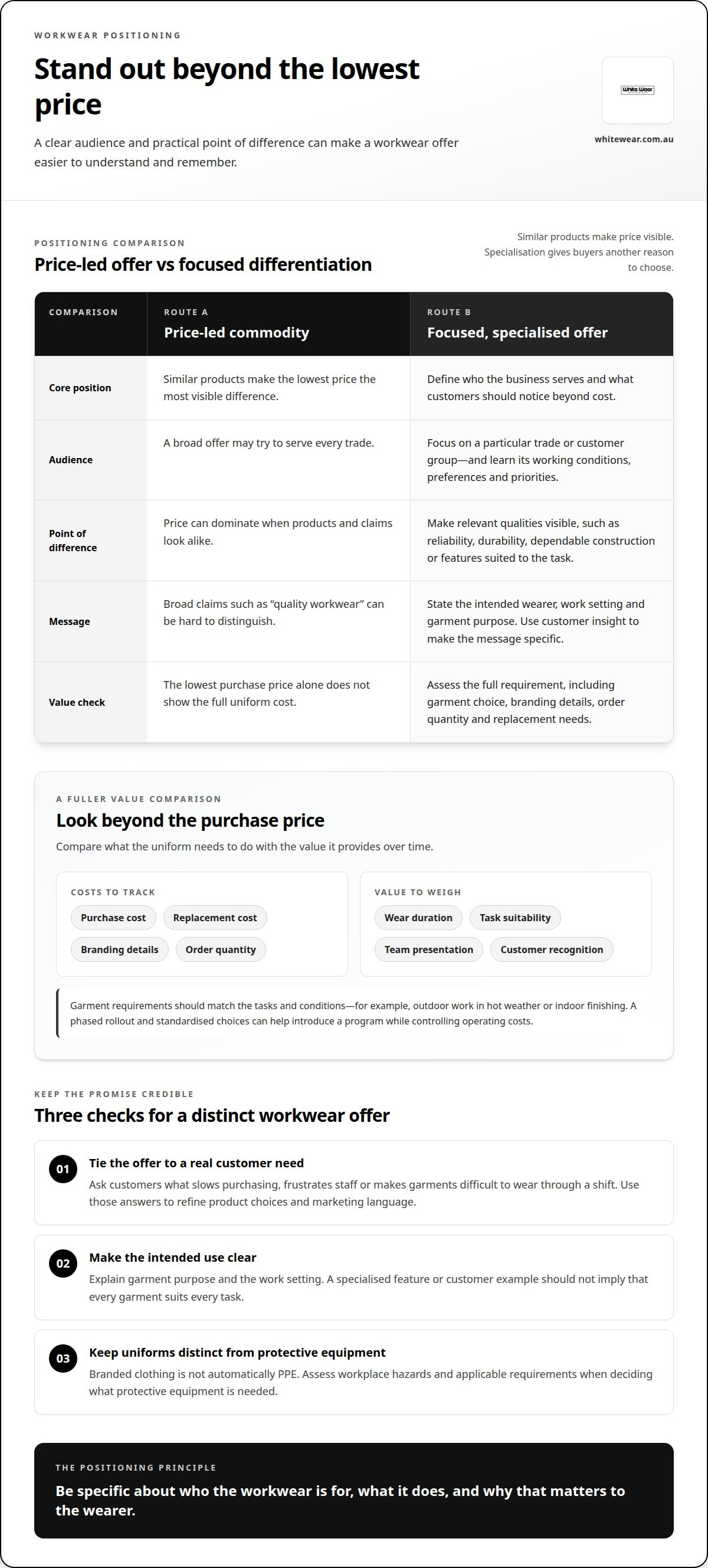
Commodity brands often offer similar products, making price the most visible difference. A stronger position defines who the business serves and what customers should notice beyond cost.
Branding as a Source of Differentiation
Branded workwear uses consistent clothing and visual identity to distinguish a business from low-cost competitors. The effect is practical as well as visual: a coordinated team is easier to recognise at customer meetings, on site and in project photos. Custom uniforms and embroidery can reinforce a business name and create a consistent image, while each garment still needs to suit the wearer’s work.
A fighter brand or private label offers another positioning option: a business can create a lower-priced line alongside its established brand. This separates value-focused buyers from customers seeking a more specialised offer, without asking one brand to carry both messages.
Budget and Premium Workwear Costs
Branded workwear costs per employee depend on garment choice, branding details, order quantity and replacement needs. The difference between budget and premium options also depends on expected durability and each item’s purpose. For a fair comparison, assess the full uniform requirement rather than treating the lowest purchase price as the whole cost.
To choose workwear for an Australian industry and climate, match garment requirements to the tasks and conditions, such as outdoor work in hot weather or indoor finishing. Track purchase and replacement costs, then compare them with wear duration, presentation and customer recognition to assess value. A phased rollout and standardised choices can help introduce a program while controlling operating costs.
Risks of Low-Cost Workwear
Low-cost workwear can create problems if its durability or suitability falls short of the job’s demands. More frequent replacement can erode the initial price advantage, while worn-looking garments may affect customers’ perception of a business. Price alone does not establish whether clothing is safe: assess it against the actual work and applicable requirements. A budget garment that suits the task may be a sound choice, while an unsuitable one can undermine workforce needs and brand presentation.
Differentiation through specialization and target markets
In saturated markets, similar products and broad claims make meaningful differences hard to see. Specialisation gives a business a sharper position: rather than serving every trade, it can focus on one audience and understand its working conditions, preferences and purchasing priorities.
Australian workplace safety and PPE needs depend on the hazards associated with each job. Branded clothing isn’t automatically protective equipment. Distinguish uniform choices from gear selected to address workplace risks.
A specialised offer is more relevant when it responds to a specific customer problem. For example, a business serving outdoor crews might emphasise clothing suited to frequent movement and changing weather, while a provider focused on food processing could address the demands of repeated cleaning. These examples show how customer needs shape an offer; they don’t mean every garment suits every task. Clear boundaries build credibility.
Distinctive marketing makes specialisation visible. Replace broad statements such as “quality workwear” with a concrete message about the intended wearer, work setting and garment purpose. A campaign aimed at landscaping teams, for instance, could show clothing in a recognisable work context and explain the problem it addresses. Useful detail gives buyers a reason to remember the business, rather than another generic product claim.
Customer insight can sharpen a business’s position. Ask key customers what slows purchasing, frustrates staff or makes garments difficult to wear through a shift. Use their answers to refine product choices and marketing language. Trade association members, business owners and workers can each reveal different priorities, helping distinguish real needs from assumptions.
Specialisation doesn’t require serving a large audience. A clearly defined group can be easier to understand and communicate with than a broad market. The key is alignment: the product, message and customer problem should point in the same direction. That gives buyers a specific reason to choose the business, even when competing offers look similar.
Differentiation can come from packaging, promotional marketing or a brand name, as well as functional features or advertising that sets an offer apart. Specialised features help smaller companies compete beyond price. When functional features are identical, marketing can instead emphasise price, local ownership, design or styling.
Identify the customers who are most profitable and easiest to work with, then recognise them with relevant incentives and opportunities.
Attribute leadership and preferred-provider positioning
Attribute leadership means becoming known for a specific quality customers value, such as reliable performance or lasting durability. For a workwear business, focusing on that quality can attract buyers who care about consistent standards, not just the lowest price.
Workwear can communicate quality through dependable construction, a professional appearance and features suited to the task. For example, coordinated, well-presented clothing can help a painting team maintain a consistent image at customer sites. Clear descriptions of intended use help buyers understand a garment’s value without implying that ordinary clothing provides protection.
Australian employers should distinguish uniforms from personal protective equipment (PPE). Consider the work’s hazards and applicable workplace requirements when deciding what protective equipment is needed. A uniform’s branding or appearance alone doesn’t establish that it provides protection.
Preferred-provider positioning develops when customers repeatedly associate a business with a useful attribute. A supplier that clearly explains garment purpose, durability and care gives buyers concrete reasons to remember its offer. The same focus should carry through product descriptions, staff guidance and customer communications. If a business presents durability as a strength, its claims should reflect the garments’ actual performance and intended use.
Choose an attribute customers can recognise and assess. Reliability, for instance, becomes more meaningful when supported by clear product information and consistent performance in the relevant work setting. A polished appearance may matter more to a customer-facing crew, while task suitability can take priority for workers focused on practical demands. These distinctions keep marketing grounded in real choices.
To assess whether the position resonates, track customer feedback, repeat purchases and the reasons buyers give for choosing the business. Ask key customers which workwear qualities matter most, then look for patterns. If comments repeatedly mention durability or presentation, refine product messaging around that attribute. Attention follows relevance: a precise, credible promise gives customers a stronger basis for choosing a preferred provider than a broad claim of quality.
How can distinctive workwear differentiate a business from low-cost competitors?
Distinctive workwear differentiates a business when it makes the value of its offer visible in everyday customer interactions. A recognisable, coordinated team can help customers identify who represents the business, while considered presentation can reinforce a professional impression. The advantage isn’t simply looking different: it’s connecting appearance and garment choice to what customers value.
Start with the customer encounter. A painting business meeting a homeowner can use a consistent team appearance to create a polished, recognisable presence. On a commercial site, the same visual consistency can help clients distinguish team members from other workers. These effects depend on a coherent look and work-appropriate clothing, not branding alone. A uniform should complement the work rather than distract from it.
Make the difference specific in your marketing. Instead of claiming clothing is “better”, explain how the offer serves a defined trade or work context. Use consistent colours and business identification across staff clothing, project photography and customer-facing material. That connection helps prospective customers recognise your business before comparing competing offers. Keep the message factual: don’t imply a garment provides protection unless it is designed and selected for that purpose.
- Define the audience: Identify the trade and customer setting the clothing represents.
- Choose a visual cue: Keep colours and business identification consistent across the team.
- Explain the relevance: Connect garment choices to the work and customer experience.
- Review the effect: Use customer feedback and repeat-purchase reasons to understand what resonates.
Workwear can also make an existing point of difference easier to remember. If customers value reliability, ensure every touchpoint supports that impression, from staff presentation to clear product information. If they value a refined appearance, keep the visual identity polished and consistent. This is a practical way of using workwear to differentiate from low-cost competitors without making price the entire conversation. Explore a more distinctive workwear approach for your business.
Low-cost competitors may use simple business models to operate efficiently. A business may offer the lowest price, the very best products and excellent service in two of those three areas, but not all three at once. When doubling down on differentiation, make a speed advantage 10 times greater. A local business can emphasise support for its local community and ask key customers how to improve service.
White Wear: Painters workwear
White Wear offers painters workwear and clothing for businesses seeking apparel tailored to the painting trade. If your point of difference depends on serving painters with relevant, functional clothing, this specialist focus can help align your workwear with your target market.
Workwear is part of the everyday experience on site. For painting businesses, clothing designed for the industry can support comfort and performance through demanding workdays, while a consistent team appearance helps present a considered image to customers. Choose clothing that reflects both the work being done and how you want your business to be recognised.
When you’re ready to make painters’ clothing part of a more focused offer, explore White Wear’s painters workwear and clothing. Choose apparel designed for the painting trade to align your team’s workwear with the customers you serve.
Make your next workwear choice count
Using workwear to differentiate from low-cost competitors works best when the clothing reflects the standard customers experience, from first contact to the finished job. Treat each uniform choice as a chance to reinforce that promise. The aim isn’t to look more expensive, but to make your business’s character and professionalism feel deliberate.
Before your next workwear decision, consider how the clothing fits the identity you want customers to remember. A clear, consistent choice can connect the people representing your business with the quality of work you stand behind. Keep that direction steady as your team and customer expectations evolve.
For a more focused workwear choice for painting professionals, contact White Wear. A considered decision can help your team feel aligned with the business you’re building.
Frequently Asked Questions
Why should someone buy from you?
Choose White Wear if you want clothing developed specifically for professional painters, rather than general trade apparel. Its painters workwear focuses on durability and function for the painting trade, with options designed to support movement and everyday tasks. For example, the signature Easy Move™ fabric with 3 % Lycra delivers stretch and flexibility in the brand’s pants and shorts, helping align clothing choice with the physical demands of painting.


