


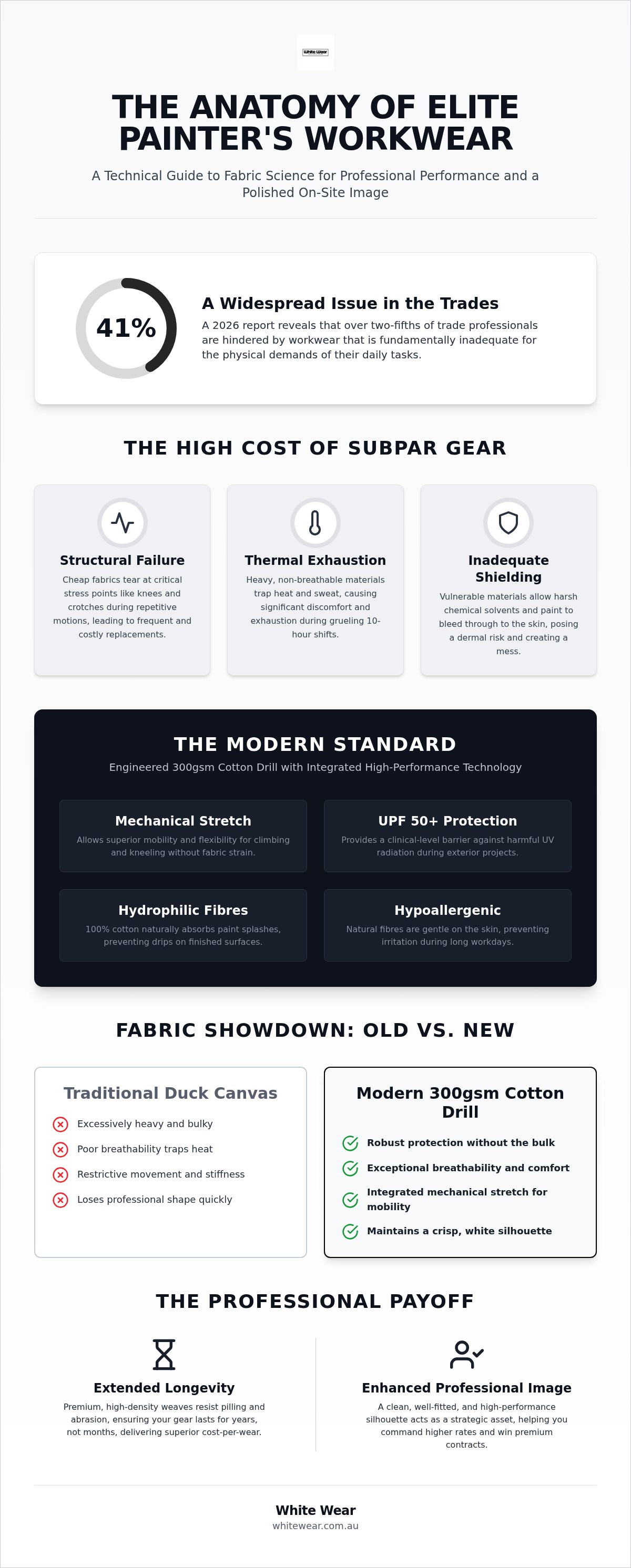
A recent 2026 report from Uniforms Australia revealed that 41% of trade professionals are currently wearing gear that is fundamentally inadequate for their daily tasks. You've likely felt the physical toll of these shortcomings during a grueling 10-hour shift. Whether it's the indignity of cheap fabrics tearing at the knees or the exhaustion of overheating in heavy, non-breathable materials, subpar clothing is a professional liability. Identifying the best material for painters clothes is the first step in reclaiming your comfort and professional image.
You deserve a wardrobe that mirrors the precision of your craft. We'll help you master the technical science of workwear fabrics to ensure your professional attire provides clinical protection and refined comfort. This guide examines the shift toward 300gsm drill cotton with integrated mechanical stretch and UPF 50+ protection. You'll learn how to select high-performance materials that offer a sophisticated silhouette and lasting durability, ensuring you maintain a polished appearance from the first coat to the final inspection.
Key Takeaways
- Understand why high-performance fabrics serve as a clinical barrier against chemical solvents while supporting your professional dignity on-site.
- Discover the mechanical science behind cotton drill's twill weave and why it remains the gold standard for breathability and tensile strength.
- Identify the best material for painters clothes by balancing the natural comfort of cotton with modern mechanical stretch innovations for superior mobility.
- Decode technical specifications like GSM to select a fabric weight that provides robust protection without compromising comfort during long shifts.
- Learn how peer-led design transforms utility workwear into refined essentials that are built to last for years rather than months.
Why Fabric Selection is the Clinical Foundation of Professional Painting
Professional painting is a discipline of precision, and your attire should reflect that standard. Far from being a mere utility, your workwear acts as a clinical barrier between your skin and the harsh chemical solvents inherent in modern coatings. When we analyze the architecture of a 10-hour workday, we see a series of grueling physical demands that require specific textile engineering. The best material for painters clothes isn't just about surface-level aesthetics; it's about thermal regulation and dermal protection during high-intensity interior and exterior shifts.
Choosing a fabric that breathes while blocking liquid penetration is a technical challenge. Traditional workwear often fails here, leaving tradespeople to choose between heavy, suffocating protection or light, vulnerable fabrics. A refined approach treats the garment as a piece of high-performance equipment. It supports the professional's dignity by ensuring they don't finish a shift soaked in sweat or covered in paint that has bled through to the skin.
The Environmental Demands of the Painting Trade
The physical strain of the trade is concentrated on specific stress points. Repetitive motions, such as climbing ladders or kneeling for skirting boards, demand a fabric with exceptional tensile strength and flexibility. Without integrated mechanical stretch, standard materials often tear at the crotch or knees, leading to frequent, costly replacements. In the harsh Australian climate, this protection must extend to the molecular level. Modern trade standards now prioritize UPF 50+ sun protection, ensuring that your clothing shields you from UV radiation during long exterior projects. High-quality textiles also resist pilling and abrasion, maintaining a smooth surface even after navigating tight crawl spaces or abrasive prep work.
Fabric Longevity and the Professional Image
Your appearance on-site is a direct reflection of your brand. While historical workwear relied on heavy cotton duck canvas for durability, modern professionals require materials that maintain a crisp, white silhouette without the excessive bulk. High-density weaves ensure that your painters clothing remains opaque and structured, even after dozens of industrial wash cycles. This longevity is where the true cost-per-wear analysis becomes clear. Investing in premium materials means your gear lasts for years, not months. A polished, professional image isn't just about vanity; it's a strategic asset that helps you command higher rates and win premium contracts. When a client sees a painter in clean, well-fitted, and high-performance attire, they see a master of their craft who respects the environment they're transforming.
The Science of Cotton Drill: Why Natural Fibres Lead the Industry
Natural fibres remain the pinnacle of trade apparel for a reason. The diagonal twill weave of cotton drill provides a level of durability that plain weaves simply can't match. This specific construction makes it the best material for painters clothes, offering a dense shield against the abrasive nature of site work. By staggering the warp and weft threads, the drill weave creates a heavy, diagonal ribbing. This architecture significantly increases the fabric's tensile strength, ensuring it can withstand the constant friction of brushes, tools, and ladders without shredding.
Beyond its physical strength, 100% cotton is a hydrophilic powerhouse. It possesses a natural ability to absorb paint splashes, trapping droplets within the fibre rather than allowing them to run off onto a client's finished floor or expensive joinery. For professionals with sensitive skin, the hypoallergenic properties of cotton are a necessity. While synthetic alternatives can trap bacteria and cause irritation during long shifts, natural fibres remain gentle and non-reactive. In specific high-risk environments, even federal safety standards acknowledge the importance of cotton for its inherent protective qualities and reliability.
Tensile Strength and Tear Resistance
The physics of the drill weave act as a built-in reinforcement system. It resists punctures from sharp edges and minimizes the risk of small snags turning into catastrophic tears. This structural integrity is why heavy-duty painters trousers are almost exclusively crafted from high-gsm drill. High-quality cotton workwear often requires a brief break-in period. This isn't a flaw; it's a hallmark of density. Over the first few washes, the fibres soften and settle, resulting in a garment that feels like a second skin while retaining its original protective shape.
Breathability in High-Heat Environments
Working in the Australian heat demands superior moisture management. Cotton fibres utilize natural capillary action to wick sweat away from the body, allowing it to evaporate quickly. This is a stark contrast to generic canvas, which is often too stiff and tightly closed to allow for adequate airflow. By choosing natural fibres, you avoid the "sauna effect" caused by cheap synthetic blends that trap heat and moisture against the skin. This regulation of your micro-climate is essential for maintaining focus during a 10-hour shift. To experience this balance of protection and airflow, consider upgrading to our professionally curated painters clothing designed for the modern trade.
Modern Innovations: Synthetic Blends and Mechanical Stretch
While 100% cotton remains a staple, the integration of high-performance synthetics has redefined what constitutes the best material for painters clothes. Modern polycotton blends aren't the stiff, scratchy fabrics of the past. Instead, they represent a calculated evolution. By weaving polyester into the cotton matrix, manufacturers create a textile that retains the soft hand-feel of natural fibres while gaining the structural resilience of synthetic engineering. This combination ensures garments dry faster and resist the deep-seated wrinkling that often plagues pure cotton after a long shift.
One of the most significant breakthroughs is mechanical stretch technology. Unlike traditional elasticated fabrics that rely on elastane or spandex, mechanical stretch is achieved through the physical geometry of the yarn and the weave itself. This is a critical distinction. Elastic fibres eventually degrade under the heat of industrial dryers and exposure to paint chemicals, leading to sagging and loss of shape. Mechanical stretch provides permanent flexibility that won't snap or wear out. It creates a "shape memory" effect, ensuring your workwear maintains its tailored silhouette rather than developing the unprofessional, baggy knees common in lower-grade whites.
The Ergonomics of Flexible Workwear
Precision in painting requires a full range of motion. Whether you're cutting in at ceiling height or reaching for a low skirting board, fabric resistance creates unnecessary physical fatigue over a 10-hour day. Flexible materials support the clinical precision required for high-end detail work by moving with the body rather than against it. This ergonomic freedom is particularly vital in painters overalls, where the garment must accommodate full-body movement without binding at the shoulders or hips. By eliminating the constant pull of the fabric, you preserve your energy for the craft itself.
Pilling Resistance and Surface Integrity
A professional image is easily compromised by pilling, those small bundles of fibre that form on the surface of cheap fabrics. Beyond looking unprofessional, these "pills" act as microscopic traps for dust, sanding debris, and airborne contaminants. High-performance synthetic blends are engineered for superior surface integrity. They remain smooth and crisp through hundreds of industrial wash cycles, upholding the refined essential aesthetic your business demands. This smooth surface also plays a functional role in stain resistance. It prevents wet paint from finding a foothold in the fabric's texture, making it easier to maintain that pristine white finish that clients associate with top-tier workmanship.
Technical Specifications: GSM, Weave Density, and Weight
GSM, or Grams per Square Metre, is the definitive metric of a fabric's substance. It's the most critical number on your clothing tag because it governs the balance between physical protection and thermal fatigue. Selecting the best material for painters clothes requires a clinical understanding of how this weight translates to on-site performance. A higher GSM indicates a denser, more robust textile capable of withstanding the rigours of commercial sites. Conversely, a lower GSM prioritises the breathability needed for high-output tasks in confined spaces.
Beyond durability, weave density determines the opacity of your attire. White workwear is a symbol of trade precision, yet it risks looking unprofessional if the fabric is too thin. A high-density weave ensures your trousers remain opaque and structured, maintaining your professional dignity even when the garment is under tension. For 2026, Australian trade standards have converged on a specific high-performance threshold. High-tier apparel now typically utilises a 280-300gsm drill cotton. This weight provides a sophisticated shield that meets modern UPF 50+ sun protection requirements while resisting the abrasive prep work common in the painting industry.
Lightweight vs. Heavyweight: A Seasonal Framework
Different environments demand different technical weights. Summer performance (150-200 GSM) is engineered for the extremes of Australian humidity, optimising airflow when temperatures exceed 35 degrees. For interior specialists, all-season durability (240-280 GSM) offers a versatile mid-weight that balances protection with a lighter feel. However, for exterior and commercial projects, heavy-duty protection (300+ GSM) remains the gold standard. This weight provides maximum abrasion resistance against render, brickwork, and scaffolding, ensuring your gear lasts for years rather than months.
The Impact of Thread Count on Paint Penetration
A tighter weave acts as a mechanical filter. It blocks fine paint mist and overspray from reaching the skin, a feature that looser, cheaper fabrics cannot replicate. This density also contributes to the "clinical authority" of your appearance. A high-thread-count finish ensures a smooth, refined surface that drapes naturally over the body, rather than sagging or bunching. This superior drape improves your professional silhouette, signalling to clients that you value precision in every detail of your business. To find the perfect balance of weight and performance for your next project, explore our range of painters workwear designed specifically for the Australian trade.
The White Wear Approach: Peer-Led Material Selection
At White Wear, we believe that the best material for painters clothes is one validated by those who actually wear it. Our development process isn't confined to a sterile laboratory; it begins and ends on-site. We treat our workwear as a refined essential, a philosophy that rejects the disposable mindset prevalent in the industry. By testing our textiles against real-world Australian solvents, high-build acrylics, and the unrelenting intensity of the sun, we ensure every garment provides the dignity and comfort you deserve during a 60-hour work week.
This peer-led approach allows us to refine material specifications with surgical precision. We understand that a fabric might look good in a catalogue but fail when subjected to the repetitive friction of a sanding block or the chemical splash of a stripping agent. Our mission is to provide apparel that respects the physical reality of your workday, treating textile engineering as a tool to reduce fatigue and enhance professional performance.
Designed by the Trade, for the Trade
Our feedback loop is continuous. We listen to the professional painters who push our gear to its limits, using their insights to adjust weave density and stretch ratios. This commitment to performance is universal across our entire range. For instance, our womens work wear utilises the exact same high-performance materials and 300gsm drill as our men's collection. We don't compromise on protection based on gender; we provide clinical-grade gear for every professional. The White Wear promise is simple: workwear that moves with you, protects you, and upholds your status as a master of your trade.
Your Professional Legacy Starts with the Right Gear
Investing in a high-performance uniform is a declaration of your commitment to craftsmanship. When you select the best material for painters clothes, you're building a professional legacy that prioritises quality over convenience. A well-constructed wardrobe shouldn't be replaced every few months. Instead, it should serve as a reliable partner that lasts for years, maintaining its crisp silhouette and protective properties through countless wash cycles. Your gear is the first thing a client sees, and it should signal the same level of precision you bring to their walls. Explore our collection of high-performance painters workwear to experience the intersection of trade authority and modern elegance.
Elevate Your Professional Standard with High-Performance Textiles
Mastering the technical specifications of your gear is a strategic investment in your longevity and dignity. You now understand how high-density drill cotton and mechanical stretch innovations provide a clinical barrier against solvents while maintaining a refined silhouette. Identifying the best material for painters clothes ensures you aren't just protected from the elements; you're empowered to perform with precision throughout the most demanding 10-hour shifts.
Our peer-led design process ensures every garment respects the physical reality of the Australian trade. We utilise premium materials specifically engineered for our unique climate, ensuring clinical precision in every stitch and seam. Your craft deserves attire that mirrors your mastery and supports your professional image. Upgrade your wardrobe with professional-grade painters workwear and experience the difference that refined essentials make on-site. It's time to move beyond disposable gear and embrace workwear that works as hard as you do.
Frequently Asked Questions
What is the best fabric for painters trousers in Australia?
A 300gsm drill cotton with integrated mechanical stretch is the best material for painters clothes in the Australian climate. This weight provides the necessary tensile strength for abrasive prep work while meeting 2026 trade standards for UPF 50+ sun protection. It offers a clinical level of protection against the elements without the bulk of traditional canvas. This specific construction ensures your trousers remain structured and professional through the most grueling 10-hour shifts.
Is 100% cotton better than polycotton for painting?
100% cotton is the gold standard for breathability and moisture management, making it ideal for high-heat environments. However, modern polycotton blends offer superior durability and quicker drying times for wash-and-wear efficiency. The choice depends on your specific workday. If you have sensitive skin or work in extreme humidity, pure cotton provides unmatched comfort. If you require a garment that maintains its crisp silhouette through industrial wash cycles, a refined polycotton blend is often the superior choice.
What does GSM mean in painters clothes and why does it matter?
GSM stands for Grams per Square Metre, a technical metric that defines the weight and density of the fabric. In the painting trade, GSM is a primary indicator of durability and protection. A higher GSM, typically around 300, suggests a heavier, more robust material capable of resisting punctures and abrasions. Understanding this number helps you select gear that balances physical protection with thermal comfort, ensuring your attire acts as a reliable barrier against on-site hazards.
How do I stop my white workwear from pilling?
To prevent pilling, you must invest in fabrics with high surface integrity and dense weaves. Cheap, loose-knit materials are prone to surface fuzzing that traps dust and contaminants. High-performance synthetic blends are engineered to resist this degradation, maintaining a smooth, polished appearance. Always follow care instructions and avoid abrasive contact with rough surfaces where possible. Selecting gear designed with clinical precision ensures your professional image remains untarnished by the unsightly bundles of fiber common in budget workwear.
Do I need different materials for interior vs exterior painting?
Interior projects often benefit from mid-weight fabrics (240-280 GSM) that prioritize airflow in confined spaces. Exterior shifts, however, demand materials with maximum UV resistance and higher density to withstand abrasive surfaces like brick or render. For the Australian sun, UPF 50+ rated clothing is non-negotiable for outdoor work. While the best material for painters clothes often serves both environments, tailoring your fabric weight to the specific architecture of your workday significantly improves long-term physical comfort.
Can modern painters clothes really resist paint soaking through?
High-density weaves act as a mechanical filter against fine spray and mist. While no standard fabric is entirely waterproof, premium cotton drill utilizes natural capillary action to absorb splashes before they reach the skin. This prevents paint from soaking through and protects your dermal health from chemical solvents. Modern textile engineering ensures that your workwear provides a clinical level of defense, allowing you to maintain a clean, professional silhouette even during heavy application or spray projects.
How should I care for high-performance painters fabrics to make them last?
Maintaining the longevity of high-performance workwear requires a disciplined care routine. Wash your garments in cold or warm water using mild detergents, and avoid harsh bleaching agents that can degrade the fibers' tensile strength. While many modern fabrics are engineered for industrial dryers, air drying preserves the integrity of mechanical stretch features. Proper care ensures your refined essentials last for years rather than months, protecting both your professional image and your long-term investment in quality gear.
What is mechanical stretch and why is it better for tradies?
Mechanical stretch is a technical innovation where flexibility is achieved through the physical geometry of the weave rather than the addition of elastic fibers like spandex. This is superior for tradies because it doesn't degrade under high heat or chemical exposure. It provides a permanent range of motion that supports the clinical precision required for cutting in or detail work. You get the comfort of a flexible garment without the sagging knees and lost shape that plague traditional stretch fabrics.


